
Our son began severely yawning very early in his ALS suffering. I called the yawning “severe” because each yawn forced his mouth open as far as possible. He sometimes had as many as 10 severe yawns in one yawning episode. There was always the chance he could have dislocated his jaw, but he was lucky that never happened. After each yawn, his jaws always clamped down extremely hard and rapidly, but he was also lucky that he never chipped or broke a tooth. No one knew what triggered these episodes. Some said it was the body’s way of bringing in a large quantity of oxygen to help with breathing difficulties. There were quite a number of other things that occurred whenever our son suffered a yawning episode.
Burning, corrosive, watery tears
Each yawn made him squeeze his eyes shut so tightly that tears poured out, and they burned, so we had to wipe his eyes after each yawn. He was very particular as to how he wanted us to wipe his eyes. (See diagram below). He described this in his book “Never Say Invisible” (https://www.neversayinvisible.com/book/).

His instructions: Wipe from the inside corner of each eye straight across the closed eyelid to the outside corner (the green arrows above). He explicitly told us NOT to follow the curvature of the eye lids (red arrows above). We had to apply a little pressure while wiping to absorb the tears. We used OTC (over the counter) eye drops to moisten his eyes whenever necessary. Also ,at night, we put Systane in his eyes (Systane is just an overpriced mixture of Vaseline and mineral oil) because his eyes became super dry at night. Unfortunately, the Systane left a greasy coating on his eyes, so it was difficult for him to watch TV after we put him to bed.
Clenching hands
Even when he was not yawning, our son’s hands were always curled and closed, so his hands were clammy. Involuntary, severe hand clenching also occurred during every yawning episode. Each yawn made his hands clench so tightly that his fingernails sometimes dug into his palms. I designed and made hand grips that prevented the clenching and kept his hands open and dry. I described these in my article on this website: https://www.guidetoals.com/devices-for-the-hands-wrists-and-arms/.
Arm crossing
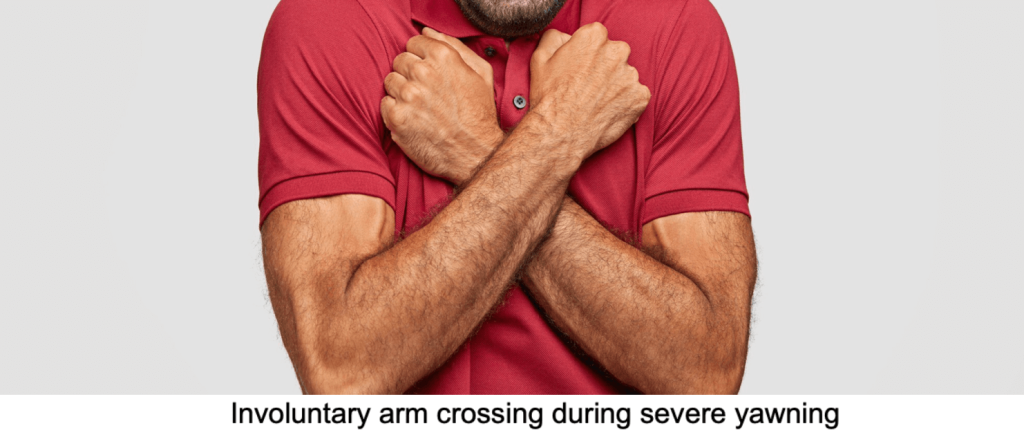
Besides clenching his hands, each yawn caused his arms to lift off of his powerchair’s arm rests involuntarily and end up crossed tightly across his chest as in the photo below. After each yawning episode, we had to place his hands and arms back in comfortable positions on the armrests of his wheelchair, or at his sides if he was in bed.
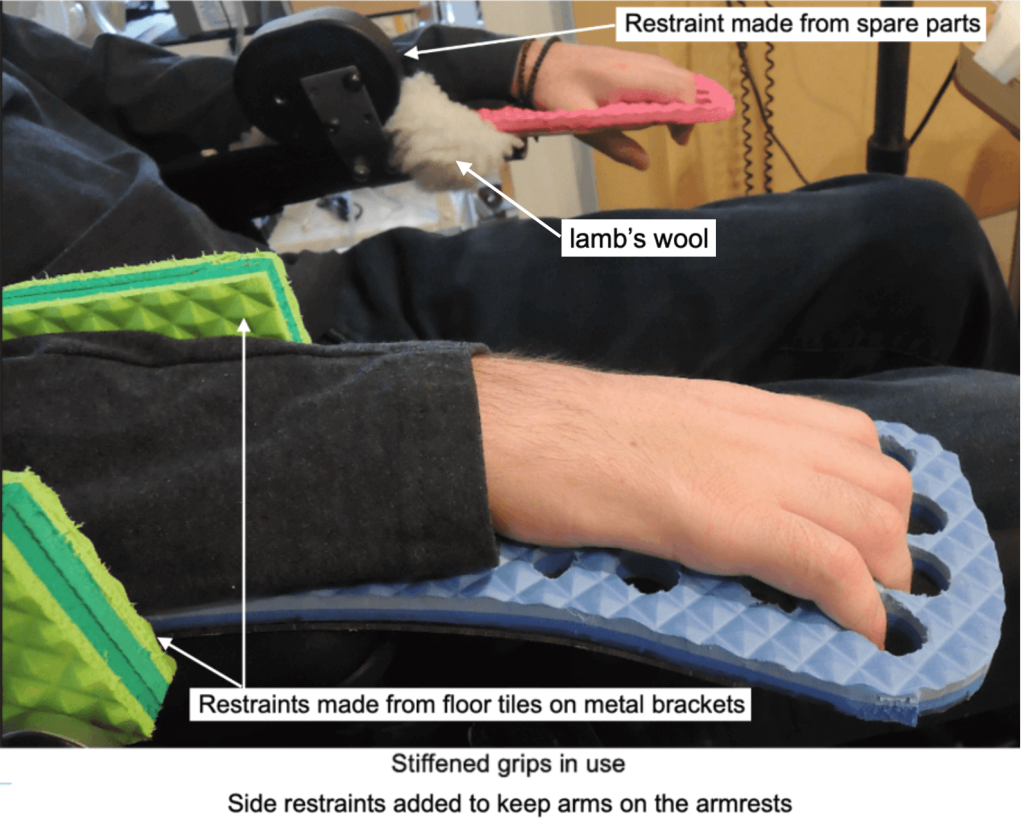
I eventually added some restraints to his armrests to keep his arms in place (see photo below: the two green restraints were for his right forearm, and the black restraint was for his left forearm). These felt restrictive to him but we didn’t want to strap his forearms to the armrests. We eventually put lamb’s wool padding along the armrests because he couldn’t tolerate his skin against the restraints.
Tongue and cheek biting
After each yawn, our son usually bit down quite hard on his tongue and/or the inside of his cheek. These bites were very painful. I came up with a solution to this involuntary, painful biting, but we had to be very close to him and be ready to make this work. This solution is detailed in my article about bite prevention on this website at: https://www.guidetoals.com/bite-prevention/. I’ve repeated the information below:
We bought a large bag of the silicone spatulas (I called them “butterknives) shown in the photo below.
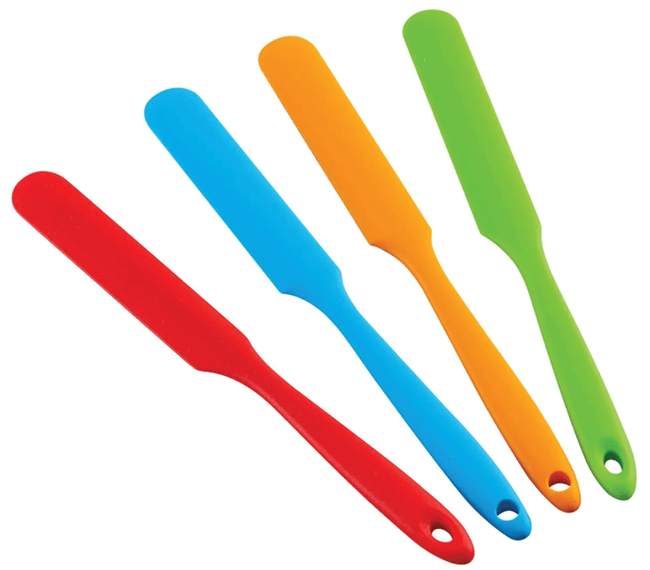
Silicone spatulas. Available at Walmart.
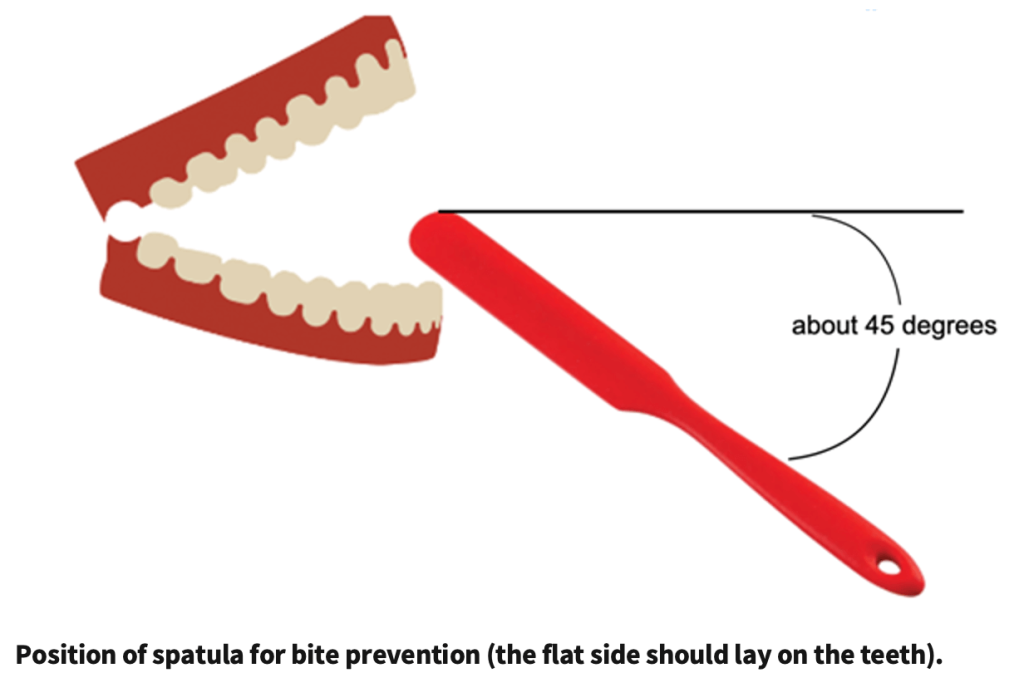
Whenever we saw our son beginning to yawn, we would hover very close and insert the first half inch of the tip of the spatula into his mouth just past his lower teeth, but without touching anything in his mouth (see image below), and then, very importantly, tilt the handle downward about 45 degrees. (Note: the rubber blade of the spatula had to lay flat on his bottom teeth.) It was very important NOT to touch anything in his mouth prior to the end of the yawn because he told us the touching would interfere with the yawn.
At the end of his yawn, he would bite down harmlessly on the spatula tip. (I couldn’t draw the spatula flat, but if you try this, make sure it is flat side up.) The reason we tilted the spatula down was that if the spatula was completely horizontal before the yawn ended, the bite would flip the handle downward anyway.
Please note: The silicone is soft rubber and tends to split very easily from all the biting. A metal rod inside the silicone gives it stiffness. Once it’s split, throw it away because you don’t want bacteria building up in the split.
Yawning completely stopped
As our son’s ALS worsened, his yawning completely stopped.
