
WHEN OUR SON moved into our house after his ALS diagnosis, he used his old bedroom, which had an attached full, but small, bathroom with a brand-new tub and glass enclosure (see photo below). It was very difficult to get him inside the enclosure because of all the steps and safety precautions we had to follow to make sure he didn’t fall or slip.
The sliding glass door was in the way, but I couldn’t get it off the rails. A grab bar was already inside the enclosure (on the left wall), but it was for helping someone sit in the tub. I installed a vertical grab bar outside the enclosure.

Our son’s first bathroom
Since the door to the bathroom was next to the tub, our son used the doorknob as a grabbing tool. When he was still able to walk with forearm braces or a little later when he was in a push wheelchair, we could guide him up to the bathtub/shower enclosure.
I had to stand him up facing the door and place his left hand on the grab bar and his right hand on the doorknob to start. Then I began lifting one leg at a time over the bathtub edge to move him inside. He also tried holding on to the hand-held showerhead mount, but that wasn’t designed to support anyone. Because he was extremely stiff, this was very difficult.
The sliding glass door was always in the way too.
Shower chair with no back
We started with a simple plastic shower bench like the one shown below sitting in the tub. It had no back. It was very difficult to sit him down because of his stiffness and clumsiness. At least he could sit up by himself.
I had to stand behind him in the tub and wash and rinse him with the handheld showerhead. It was also very difficult standing him up, getting him out of the tub onto the floor, and drying him while he was holding onto the grab bar and doorknob. Then I had to sit him back down in his wheelchair.
Shower chair with back
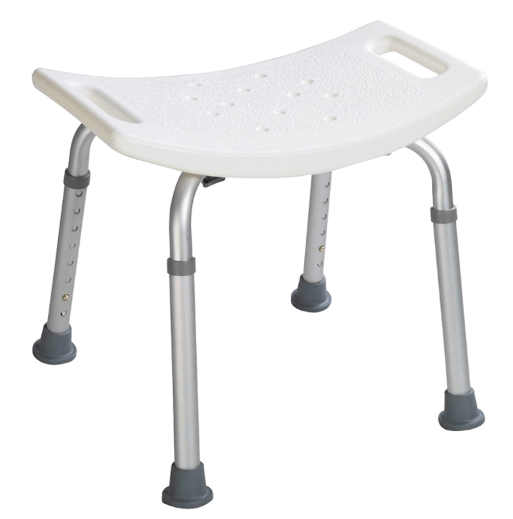
Shower chair with no back
Shower chair with back and slide
The ALS Loan Closet had also loaned us a sliding shower bench (shown below). But we could not use it because after we had positioned our son in the seat outside the shower enclosure, we couldn’t lift his legs due to his stiffness or slide him in because the shower door interfered. We never used it and returned it.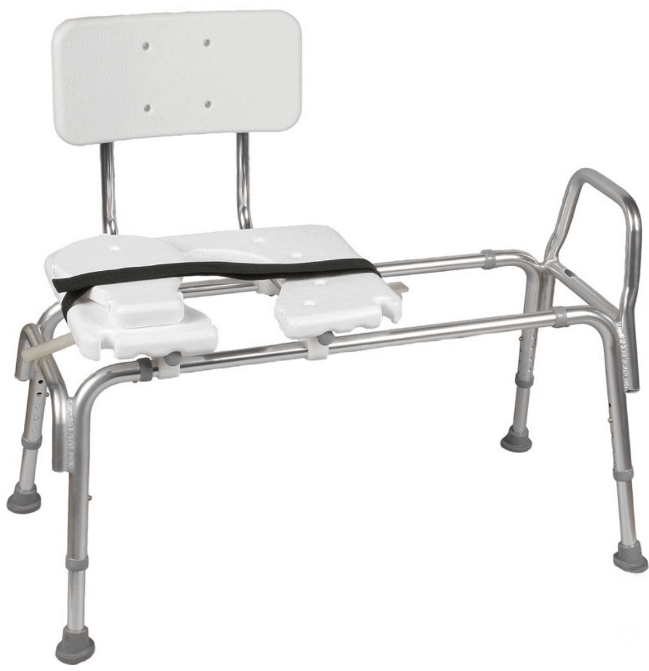
Shower chair with back and slide
Shower chair with back
I bought the shower chair in the photo below, but it was unstable. Our son could not lean back because the chair itself tipped backward. We dumped it.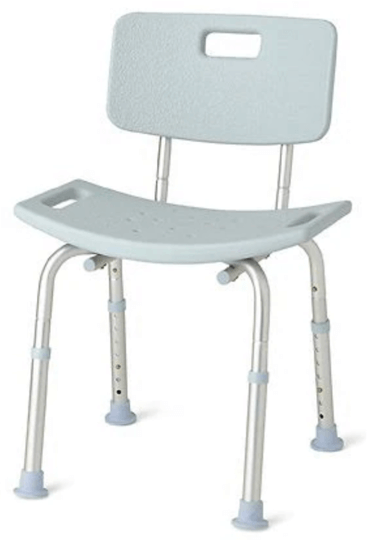
Shower chair with back
Wall-mounted fold-down shower bench
With GoFundMe donations, we added a new wing to the house. The new bathroom was completely accessible with a roll-in shower and a drop-down, wall-mounted bench. See photo below. The curtain rod swung out of the way, so we could bring our son to the bench using the ceiling lift.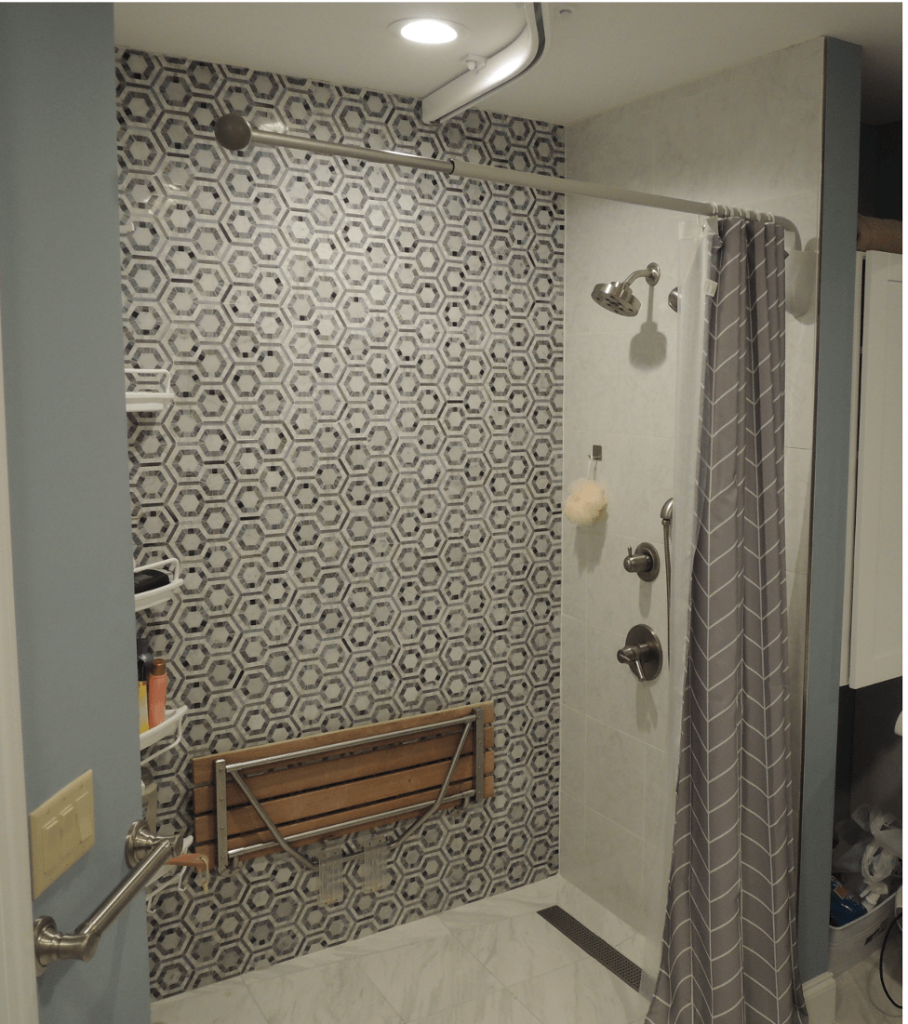
Roll-in shower with fold-down bench
The shower had a standard showerhead plus a hand-held head (it’s just behind the curtain on the right) on a height-adjustable mount. I made sure the plumber mounted the hand-held shower head to the right of the faucets so I didn’t have to reach under the running water coming from the upper showerhead to grab it.
Also, the hose to the hand-held piece was a flexible metal, not crappy plastic. Using the ceiling lift (explained in “Patient lifts” in this Guide), we placed him on the bench. The bench was narrow, but as long as he could sit up, it worked well.
All of us (the architect who specialized in ADA compliancy, the builder, my son, and I) forgot to have grab bars installed in the shower stall.
About a year later, Jeremy ’s spasticity got much worse. He stiffened up every time he sat on the bench and began to slide off. A couple of times, I had to plant my leg between his legs to prevent him from falling off the bench. He had numerous panic attacks.
As his disease got even worse, he could not sit up on the bench at all. His feet were turned inward, so he couldn’t support himself on the bench by placing his feet flat on the floor. We began strapping him to the bench, but that wasn’t safe. Our son began shopping for a shower chair, but they were obscenely expensive.
Showerbuddy
We finally obtained a Showerbuddy shower chair from the local ALS Loan Closet. Note: The website is shower-buddy.com, not showerbuddy.com. (See the two photos below).
While the chair was in the middle of the bathroom, we used a SureHands ceiling lift to place our son in the chair, get the straps in place, and wheel it into the shower stall.
This chair could tilt back and it had a headrest, which we eventually needed when our son developed head drop, but some models don’t tilt or have headrests. You have to think about future needs before you buy or get a shower chair. Otherwise, you won’t have anything to support the patient’s head.
I also wrote about a homemade shower head support in “Head and Neck.”
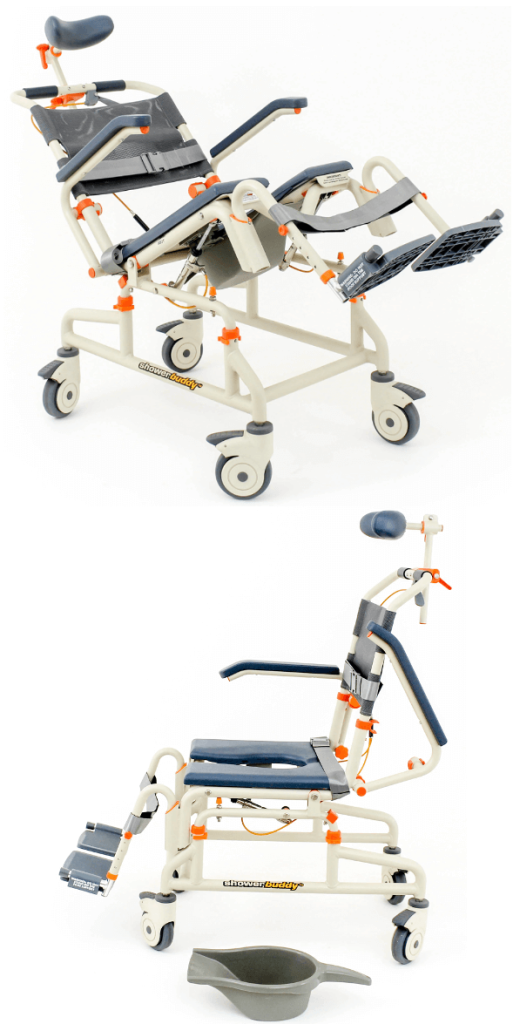
Showerbuddy pros and cons
For this discussion, please keep in mind that our son was completely limp and paralyzed until spasticity caused him to stiffen like a statue.
Headrest
The headrest (shown below) was very easy to adjust (forward and backward, up and down) with the simple orange handles. (I wish our power chair headrest was that easy to adjust). However, the Showerbuddy headrest always flopped clockwise to counterclockwise and back again (looking at it from the front) no matter how much I tightened the orange handle behind the headrest because of a design fault. Showerbuddy even sent me new parts, but they performed the same.
The orange sleeve inside the white cylinder (see photo below) for the headrest post did not stay put.
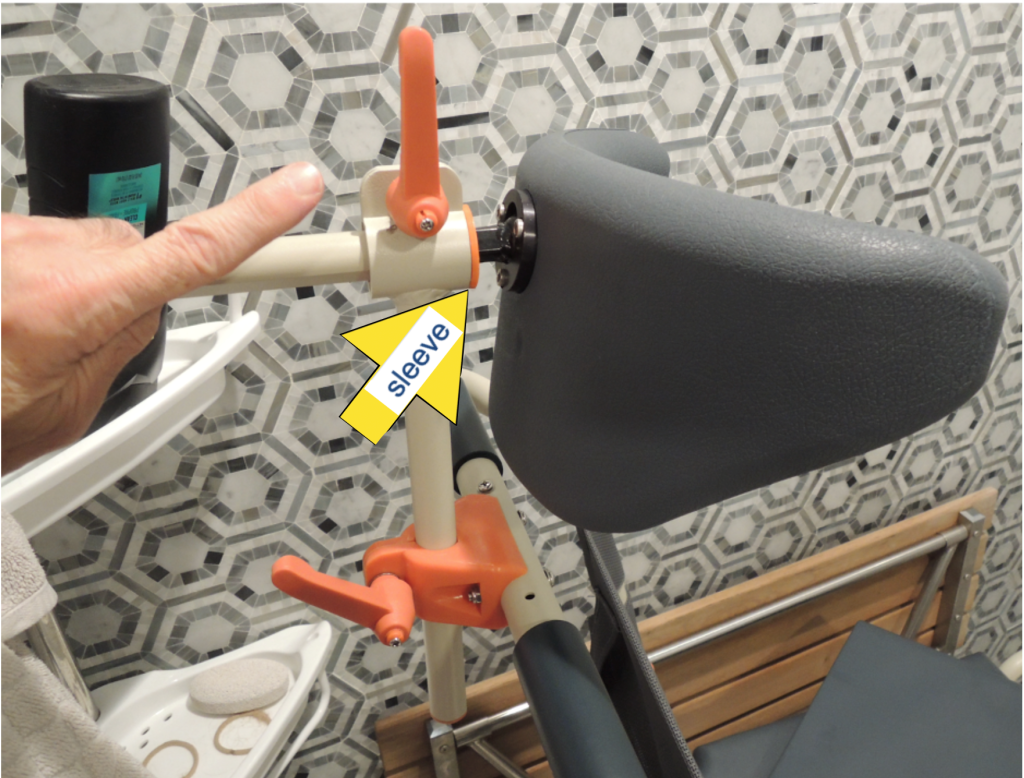
Showerbuddy head support and mount
Armrests
Our son couldn’t use the armrests because they were too skinny. Because he had no strength, he couldn’t keep his arms on them. I took the armrests off.
Tilting feature
Also, because our son had no muscle strength, he slouched terribly and leaned forward. His back almost formed a semicircle from the slouching. The slouching made the upper part of his body curve forward so we had to tilt the chair back to prevent his butt from sliding forward into the potty opening. But due to head drop, we had to adjust the headrest quite far forward so his head tilted forward while he was tilted back.
When we had to tilt him back, we had to apply a lot of force because we were essentially on the low end of a seesaw trying to lift his whole body weight on the high end. All this while holding his head to prevent choking. When we had to tilt the chair upright again, we had to hold on tightly when we released the locks—otherwise, the chair would slam down hard into the upright position.
Straps
The chair has many Velcro-backed retaining straps. We used the upper torso strap to prevent our son from tilting to either side, and we used a lower body strap to try to keep his butt from sliding forward, but this didn’t work well. It didn’t prevent his butt from sliding forward into the potty opening either.
A very long shin strap went across both legs, but our son hated it because it was so confining, though it helped deal with leg spasticity. Usually one leg would stiffen and stick straight out from the chair. The dangerous thing that happened to him a couple of times was at the end of the shower when we tried to lift him out of the shower chair with the ceiling lift. We had forgotten to remove the straps, so the whole chair was lifted off the floor.
Backrest
The backrest was just a woven plastic cloth. It was rough on our son’s back after he got pressure sores, so I always draped a small towel on it before we placed him on the chair. I had to hold the towel in place while we lowered our son into the chair so the towel would not “ride up” as he rubbed against it.
The other problem with the backrest was that nothing held it in place. It kept sliding downward and crumpling up, so I always had to hold the backrest up as we placed our son in the chair. The backrest needed suspenders for the same reason a guy wears them.
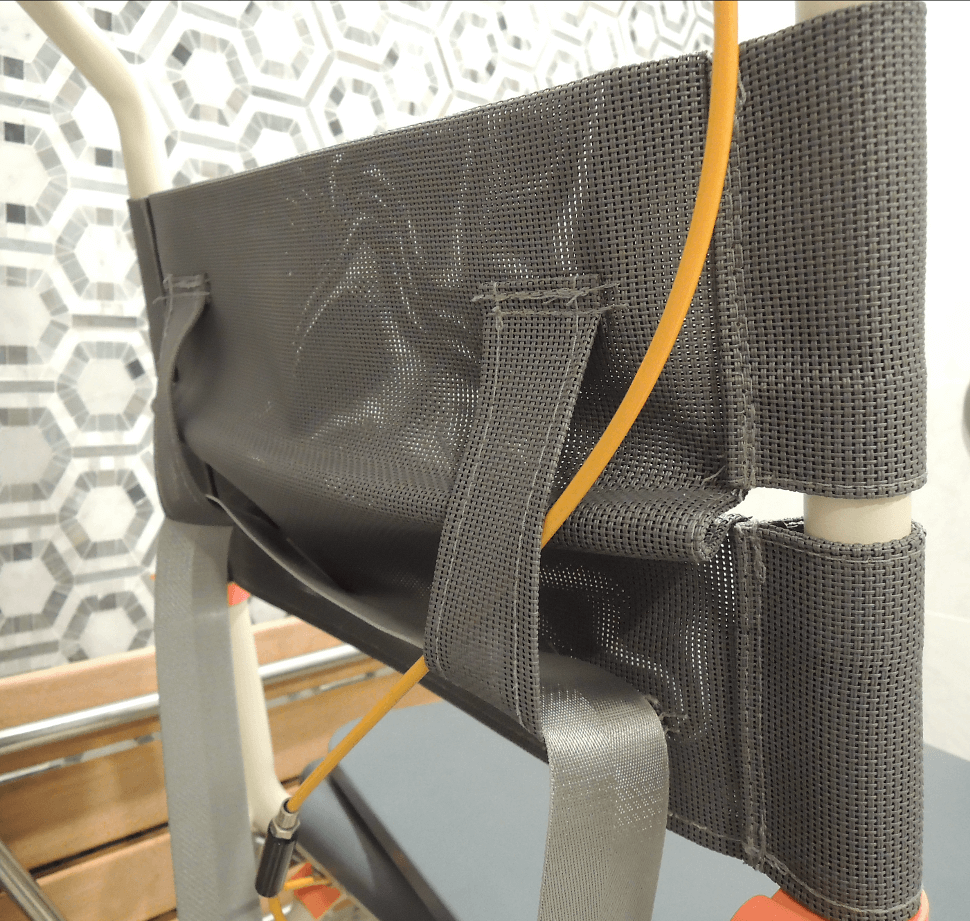
Showerbuddy backrest (notice that it’s crumpled along the middle because it doesn’t stay up)
Footrests
The footrests had two issues. They were attached to calf-length mounts, which couldn’t be lengthened enough to accommodate our son’s calf length. He wasn’t even tall. It was the same thing that happens if you sit on a chair that is too low to the floor: you slouch, and your knees are up in the air, tilting to one side or separating (manspreading). Our son’s knees were always slightly lifted above the seat and twisted to one side while his torso shifted to the opposite side. This made him sit crooked and tilt. Strapping him in didn’t help, either. If the footrests could have been lowered more, all this could have been avoided. A more painful problem: One or both of his feet tended to fall through the gap between the two footrests so the sharp edges pressed against his feet. The shin strap didn’t prevent this. There should have been an option for a foot pedestal with no gap or with two separate shin straps.Potty seat and seat filler
The chair was designed to be rolled over a toilet so it could be used without the pot mounted under the seat. See photo below. Our son never used this feature. When we first got the chair, Jeremy kept sliding into the opening when he was in the shower. To deal with this problem, I bought some lawn chair webbing, wrapped it around the seat, the frame, and the potty opening and secured it. This worked fairly well. Our son eventually bought a Showerbuddy padded potty cover seat that sat on the potty hole and perfectly fit over the hole. It was expensive. The problem with the potty hole cover was that Jeremy’s own weight made a depression in the cover and it always filled with water, so he always ended up sitting in a puddle. When we finished his shower, we had to tilt him upright, then lift one leg at a time to allow the water to drain from the seat. It was also important to lift the potty hole cover (as in the picture below) after the shower to allow it to dry to prevent mold growth. I spoke with someone at Showerbuddy about possibly drilling holes in the potty cover to allow drainage, but I was told the potty cover was not a uniform material through and through. It was foam with a plastic coating. If I had drilled a hole, the foam inside would have come out.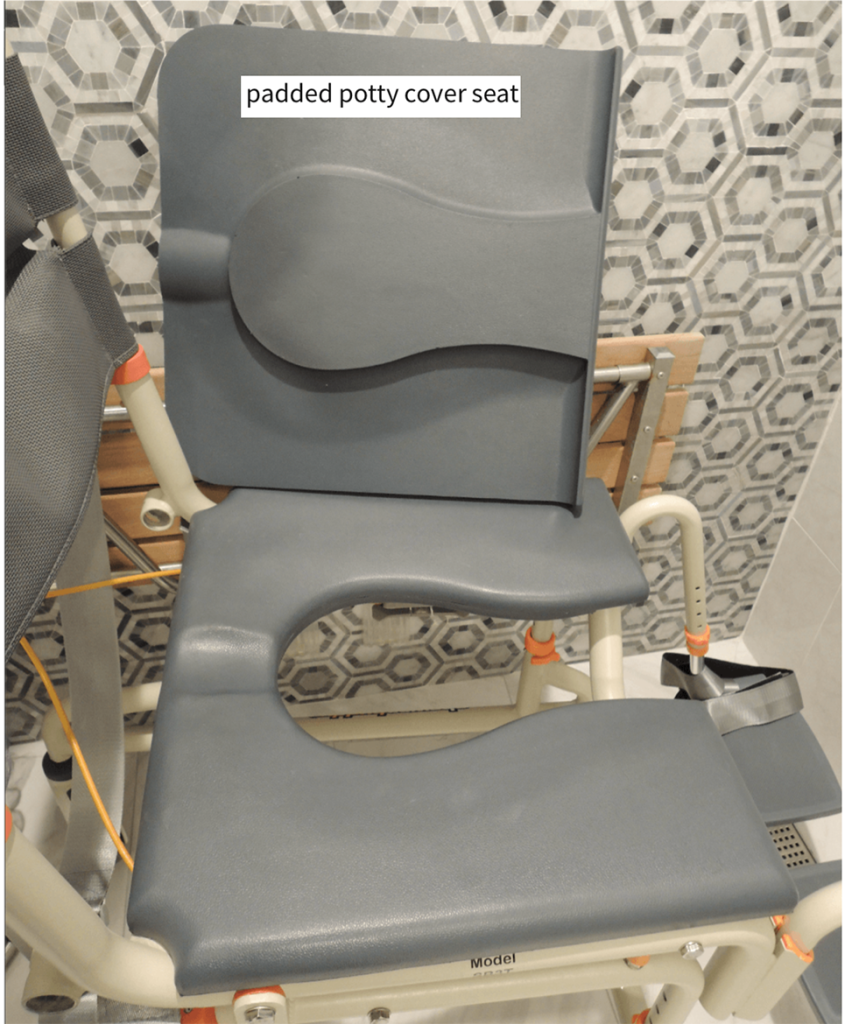
Showerbuddy potty seat and cover
Wheels
The wheels worked very well, rolled quietly, and locked well to hold the chair steady. I haven’t painted a very good picture of the Showerbuddy, but we got it free from the ALS Loan Closet, so we got used to it. I returned it to the ALS Loan Closet after our son passed away.The RAZ shower chair
A friend of ours whose husband died from ALS gave us his stainless steel RAZ shower chair (see photo below), and made our Showerbuddy look like a toy. We never got a chance to use this one and gave it to an acquaintance who had multiple sclerosis.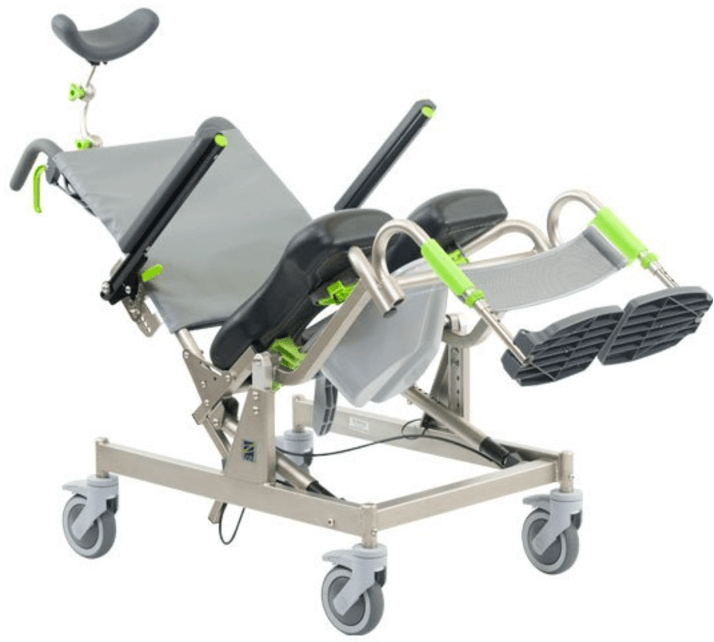
RAZ shower chair
