
Some of the information in this document applies to just the ALS patient, some to family members, some to next-of-kin, some to designated executor(s), and some to everyone. I know this is an unpleasant topic but it is a very necessary one. If these action items are not dealt with in a timely manner, the people I just mentioned will have a very difficult time with the deceased’s bank accounts, loans, credit cards, logins, passwords, investments, personal property, will, beneficiaries, computer access, insurance policies, businesses, business partners, etc.
Note: In this document, I may be using “you” (the reader) to mean the ALS patient, the spouse, any children, other family members or next-of-kin, relatives, one or more beneficiaries, the caregiver(s), one or more designated executor(s), friends, etc. In some cases, like ours, I was the executor AND the next-of-kin, AND a beneficiary AND a caregiver.
“Get your affairs in order” is an unsettling and unpleasant thought because the ALS patient has to face up to his or her own mortality (and the loved ones’, too), but if you, the ALS patient, really wants to help your loved ones and all of those involved, please, get over your stubbornness, uneasiness, or distaste for the subject, swallow your pride, grit your teeth, and get your affairs in order! Once you begin this project, you might even get involved in it as an interesting project because you probably would not have realized how much info you have in your head, or stored in a drawer, or on a computer, that others will need. Once you’ve finished, you can put the paperwork in a known place and live the best that you can. Everyone will be glad you got your affairs in order. And please keep in mind that many of the things you do get in order (lists of passwords, legal docs, etc.) will change over the ensuing months or years and may have to be updated. Review what you’ve listed frequently. And have a will drawn up if you haven’t already done so!!!!
Some of the information I give here applied nationwide, but some only applied to my wife and son and me as New Jersey residents, and some information applied only to us as residents of Essex County in New Jersey where our son lived until he passed away.
I’m sure there is plenty of information and issues I haven’t covered. Our son passed away in October 2021, so some of this information was current for about 1 – 2 years after that, because things change.
The very first week in 2018 when our son Jeremy received his ALS diagnosis, the doctor told him (and I’m not mincing any words), “You have ALS. Get your affairs in order.” No beating around the bush there. Our son was very upset about that because it was a death sentence. He heard that same sentence a second time from another doctor about 2 – 3 years later and became upset again. Our son passed away on 10/29/21 a day before his 42nd birthday.
Probating the Will
Our son had named me, his father, executor in his will. The will was probated in the Essex County (NJ) Surrogate Court (aka “Probate Court”). I received legal status to execute his last will and testament. That was just the beginning of lawyer fees.
There are ways to avoid probate. Here’s a link to a New Jersey law firm’s website that may help you. https://www.brattonlawgroup.com/faqs/how-do-i-avoid-probate-court-in-new-jersey. There are many other sites.
The Surrogate Court will send you (or probably through your lawyer first) notarized and dated Letters Testamentary proving that you have been appointed executor with court approval. As the executor you have to send certified letters to all beneficiaries about dividing up the estate, etc. Of course, the Court wants a fee for each letter you are required to mail out (and of course the lawyer charges to write these). Note: Some places I dealt with required recent Testamentary Letters, so I had to ask my lawyer for re-issued copies with current dates as time passed.
All those who incurred expenses while dealing with the estate must notify the executor(s) and provide receipts (funeral costs, medical expenses, accounting expenses, etc.). Our lawyer told me that the executor (at least in NJ) can take a 5% commission from the estate for the work involved. I declined that for both my mother and my son because I was a beneficiary anyway.
Master Document of Everything
You should create a “Master Document of Everything” as you get your affairs in order. You, the ALS victim, your caregivers, next-of-kin, and your family, must think of each other to make the overwhelming paperwork that will ensue as easy as possible. The more things you get in place now, the less difficulty you, the executor and your loved ones will have later. Keep updating the Master Document of Everything.
I already had some experience as an executor for my mother so I knew some of what I was going to encounter, but her life was much simpler, and so was the work for me as executor. But as executor of my son’s will, I went through a huge amount of paperwork, phone calls, emails, and computer files untangling our son’s social connections, financials, and business affairs, besides grieving.
Our son had prepared a one-page document well in advance of his passing entitled “Read Me First”. It was a very brief “Master Document of Everything”. It contained various passwords and some account information for us to read after he passed away. It was a start, but it omitted a tremendous amount of information. I had a lot of work cut out for me.
Our son had written in his “Read Me First” document that we should send a “blast email” to all his contacts after his passing, but there was no list of contacts. Fortunately for me, I had password access to his computer, to his Facebook account, to his Messenger account, to his email account, and to his cellphone, including text-message contacts. After he passed away, I was able to contact a huge number of his friends to tell them of his passing, and they told others. His cellphone was useful for connecting to all his friends, many of whom I had no email addresses or phone numbers for because their names only existed in Messenger, in text messages, or Snapchat. Almost everyone I contacted wrote back to offer condolences.
In his “Read Me First” document, our son told us about a website called LastPass.com which contained all his user names and auto-generated passwords. The “Read Me First” document provided me with his Master Password to LastPass.com itself. Once I was in LastPass, I saw all the businesses and websites he had dealt with. All the associated user names were there, but I could not enter any of the websites listed because the auto-logon feature never worked for any of the links. I had to go to each actual website one at a time, enter the given username, then click on “Forgot password” and change it so I could return to it. In many cases, I discovered, after struggling to enter some of his LastPass websites, that he hadn’t used them in many years, so some accounts were empty or useless.
Are there websites that you absolutely cannot get into at all? You’ve got to get someone in the know to hack into the site.
One of my son’s banking websites that I was able to enter after seeing it on LastPass hadn’t been used in many years. I actually saw that there was a zero balance. I informed that bank about my son and that I wanted to close the account. They wanted a Death Certificate and other paperwork first. I told them the account was empty and I wasn’t sending them anything. They closed it.
Desktops, cellphones, laptops, tablets of the ALS patient or deceased
I found out quickly that many of the websites that our son had accounts on would not recognize my own computer, cellphone, laptop, or tablet, so I had to use his equipment just to log in to his accounts. Forget “Trust this device” (that never worked well.) Once I got into his accounts on his equipment, I had to add my own cellphone number, email address, change the passwords, etc., so I could use my own equipment. Accessing one of his online accounts that required “2FA” (two factor authentication) after already entering a user name and password raised the difficulty manifold. Lesson: Try to get your own contact info included in the ALS patient’s devices for two factor authentication and alternate contacts ahead of time to avoid these problems.
I kept checking our son’s laptop frequently after he had passed because there were always important things coming into his email account. However, about a year and a half after our son’s passing, I began getting notifications from Google that his cloud storage was almost full and I would have to buy more storage or else his laptop would no longer send or receive any emails. By that time, I had added my email address to almost everything important that was coming into his email account, so I decided not to buy additional storage. But now we have no access to his cloud photos and files. Interestingly, the mechanism still seemed to allow forwarding of some of the emails to my email address, even though his is blocked. But a word to the wise: deal with this issue while there’s time. After about 2 years, I let the batteries on his laptop and cellphone run down because I was tired of finding and deleting spam on his devices.
Who owns the deceased’s cellphone, laptop, and computer?
The battery in my son’s iPhone had died shortly after his passing, and I desperately needed it functioning so I could contact all his friends. I took the cellphone to an Apple store, but they wouldn’t touch it because when they looked up its owner history, they told me it actually belonged to his employer, which I didn’t know. To make matters more complicated, the company that gave him the phone, PerfectoMobile, had been sold to a second company named Perforce. Perforce was the one that he left to go on ALS-caused disability. I couldn’t get help from Perforce. I ended up going to a cellphone store in a mall and they replaced the battery, no questions asked. Lesson to be learned: keep the electronic devices operating!!!
“Owner” or “Co-Owner” Status
If you can get “owner” or “co-owner” status, or share bank accounts with the ALS patient, logging on and dealing with paperwork will be much easier. Being listed as a beneficiary or contact isn’t good enough to gain access after passing. For instance, our son had purchased his accessible van, and it was only titled in his name. When he died, it became an asset of the estate, so I had to sell it through his estate.
Co-owners have unrestricted access. Some places of business wanted a copy of our son’s will or a Power of Attorney (POA), even though these were irrelevant for the deceased. I told them those weren’t necessary and they backed off. They had no business seeing his will, and the POA became null and void at death. It showed they didn’t know what they were talking about.
Does the ALS patient have any important documents (birth certificates, Social Security card, marriage license(s), power-of-attorney document, insurance cards, driver’s license, membership cards, ATM cards, credit cards, bank cards, etc.)? Do you know where all of these are? Add them or locations to them to your Master Document. Do you have color copies of them? Are they official documents (usually notarized), or photocopies, or actual photographs, or are they only on a computer somewhere? Example: Our son’s Death Certificate was 8½” x 14” and wouldn’t fit in our home copier, so I took an actual high-resolution color photograph of it. Many times, I was able to email a copy of that photo to whatever institution required one. When you have to submit a death certificate, some places will accept faxed copies, photocopies, cellphone photos, some want actual ones. The same issue applies to the Testamentary Letter: some will accept photocopies and others want the real thing with the raised seal.
ALS patient’s signature
Do you have a legible copy of the ALS patient’s signature before he or she can or could no longer hold a pen? That image can be applied to a computer document or legal document that required his signature.
Do you have the following information on the ALS patient?
Insurance Plans
Do you have the names of his or her insurance institutions, their phone numbers and policy numbers
Employer contacts
If the person with ALS was still working, or on disability, find out if there are any employer plans, life insurance plans, stock options, coworker contacts
COBRA
https://www.dol.gov/general/topic/health-plans/cobra
COBRA gives workers and their families who lose their health benefits the right to choose to continue group health benefits provided by their group health plan for limited periods of time under certain circumstances such as voluntary or involuntary job loss, reduction in the hours worked, transition between jobs, death, divorce, and other life events. Qualified individuals may be required to pay the entire premium for coverage up to 102% of the cost to the plan.
Health insurance
Is the patient covered? What is the policy number? Who are the beneficiaries? Side note: if the ALS patient does NOT have health insurance in place BEFORE diagnosis of ALS, there is probably NO chance of purchasing coverage AFTER diagnosis.
Health savings plans
Was/is there a health savings plan? What is the policy number? Who are the beneficiaries?
Long term disability
Was/is there a plan? What is the policy number and contact phone numbers?
Medicare
Was/is there coverage? What is the policy number?
Medicaid
Was/is there coverage? What is the policy number?
Life insurance
Any policies outside of any employer coverage? What is the policy number? Who are the beneficiaries? Whom do you contact?
Financial Planner
Is there a financial planner? Name, company, contact info?
Tax-Preparers, Accountants, or CPAs
Do you know if the ALS patient has a tax-preparer, accountant or CPA? My name was fortunately in my son’s file at his accountant, so I was able to deal with that mess without needing any legal paperwork.
Cryptocurrency
Does the ALS patient own any cryptocurrency? Do you know what website it was purchased on? Be forewarned that, unless you are named as a co-owner (not simply a contact), gaining access to these accounts was, at least for me, a nightmare and extremely difficult. One of the websites made it very difficult to contact a human being. It was also difficult to sell the cryptocurrency and also very difficult to transfer the money to my son’s estate bank account.
One woman I met through an acquaintance has lost her son suddenly. He owned cryptocurrency, but there was no indication from which seller he had bought it. Crypto is not like savings bonds: at least in my experience, I had to sell it through the actual website it was purchased on. Her son also had NO will. The poor lady couldn’t figure out how to sell the crypto, and didn’t even have any legally designated ability to do so.
Financial institutions
The Master Document of Everything should have account numbers for banks, savings accounts, checking accounts, safe deposit boxes, money markets, savings bonds, investments, 401Ks, IRAs, investment institutions (like Fidelity, Wells Fargo), etc. Print copies of as many statements from these institutions as possible (or at least take screen shots or photos) so you have account information. Our lawyer needed these as part of the estate work for tax purposes, etc.
Banks
Banks will freeze the accounts of a deceased customer as soon as they find out about a death. That means that no one can pay any bills or stop automatic withdrawals or automatic payments from the deceased’s accounts. Our son’s bank still allowed deposits from me or outside sources into those accounts. I paid our son’s daytime home health aide’s last paycheck out of our own checking account because his checking account was frozen and she needed the money. The automatic withdrawals and payments from his account meant his checking account balance got lower and lower until Probate Court officially named me the executor. Our son’s checking account continued receiving deposits from his former employer’s disability insurance plan for him, until I notified them that he had passed. Those deposits had kept the checking account in the black and were covering automatic payments and withdrawals. After the disability deposits ended, his checking account balance dropped very low. That triggered emails from numerous places stating that they hadn’t received payment and were going to stop whatever our son was paying for. Even though I was frozen out of access to his checking account, there were still funds going in and automatic payments going out via online activities.
Here’s an interesting tidbit: Even though my son’s bank had frozen his account, I had found out that his estate was entitled to 50% of all the assets. The bank never told me this, of course.
See the section entitled “NJ Forms: L-8 (sort-of easy); L-4 (unpleasant); 0-1 (nightmare)” below.
Business accounts
Did/does the ALS victim own a business, or was/is he or she a partner? Are any next-of-kin legally connected to the business?
Websites taking automatic withdrawals or payments
These are websites that take payments automatically, like gyms, subscriptions, cellphone plans, car loans, mortgage payments, etc. How do you stop them? These businesses will just keep taking money from the deceased’s checking account, or savings account, or credit cards until you stop them. Some don’t take money unless autopay is set up.
Our son’s disability checks were going into his bank account, and then some of the money was automatically transferred to a second account in that bank to allow automatic withdrawals to things he had signed up for. Stopping that mechanism was not easy. I had full access to my son’s bank account with a power of attorney document in place before he died. That was fine UNTIL I notified the bank that he died. (I tried to delay notifying the bank, but the unstoppable bills forced me to notify the bank, plus I had to notify the government to stop disability payments.) The POA then became null and void and the bank locked me out of his account. It took me a very long time and a lot of lawyer fees to get the remainder of my son’s money out of the bank. The last disability deposit was taken back by the government, and then some of his bills became overdue. Supposedly his estate is protected from any legal action by creditors until the will is probated.
Credit and Debit Cards
What credit and debit cards are there? Are there unpaid balances? Cancel the cards! That will stop a lot of automatic transfers, regardless of who initiated them. I learned something interesting about my own credit card: Our own account was hacked in 2023, so the credit card company closed the account. When I got the new credit card number issued from that same company, some vendors that had stored the hacked number in their system automatically got my new credit card number.
Recurring Bills Due
Are any bills due or coming due? Are there recurring bills, like utility bills, mortgage payments, property taxes, etc.? After I got access to my son’s accounts, I viewed his monthly statements and saw many vendors that were getting paid automatically. I was able to stop them.
Do you know the ALS patient’s Social Security Number? Do you have access to his accounts so you can pay his bills? Does the ALS patient’s spouse (if married) know how to log onto the patient’s banking website and pay a bill? I had to write out directions for my wife because she’s only paid the bills online a few times. Our lawyer told us to stop paying any bills until our son’s will was probated.
“Date of Death Valuation”
The value of a financial instrument (a stock, bond, mutual fund, etc.) on the date of purchase is called the “cost basis”. You need this for your own tax reporting to calculate capital gains or losses. For the executor to deal with a deceased’s tax reporting, the cost basis is no longer used; the important thing is the Date of Death Valuation. The executor will need the values of each and every item on the day of death (not day of purchase). Here’s an interesting fact: If the Date of Death Valuation of a particular item is lower than the original market value, then the capital gains the estate has to pay will be lower. Conversely, if the Date of Death Valuation of a particular item is higher than the original market value when purchased, then the capital gains the estate has to pay will be higher.
How to deal with billing questions
Billing offices (especially medical ones) always insist on HIPAA privacy and won’t talk to anyone except the patient or someone the patient had previously designated to act on his or her behalf. I quickly learned something very helpful: Since my son was a male, I impersonated him on the phone, and because he couldn’t speak, I even impersonated him in some cases before he passed away. The billing people never met or knew him: he was just a name and a voice. So, when I had to call a billing office regarding some issue with my son’s account, I always had the bill in front of me. I already knew his Social Security number by heart (even though that was none of anyone’s business), his date of birth, and all the other relevant information. Whenever I called one of these places, I just pretended to be my son. I answered all their questions, and got all my answers. It was very expedient. Was it illegal? Probably. It was expedient? Yes. I’ll leave it at that.
Lawyer(s)
Do you and the ALS victim have lawyer(s) working for you to deal with the estate? Our son got his will finished, signed and witnessed only about 3-4 weeks before he passed away. He could not hold a pen, so the lawyer filmed him answering yes to her questions by blinking his eyes to affirm the answers.
Social Contacts, Friends, Former Coworkers, etc.
The Master Document of Everything should have all these contacts.
Usernames and Passwords
Does your Master Document of Everything have usernames and passwords for all accounts?
Two-Factor Authentication (2FA)
Is 2FA required when you are logging in to a website? Where does the verification code go? To a cell phone, or a computer, or a tablet, or a laptop, or email, or text, or outer space? Before I organized my son’s things, I had to have on hand our son’s cellphone, his laptop, my cellphone, and my iPad for an incoming 2-factor code because I never knew which device would receive the 2FA. I slowly migrated everything to my own devices.
Authenticator App(s)
If logging in to a website or online account requires an authenticator app, do you have access to the app? My son’s accountant insisted on an authenticator app so he could send me tax documents, but it would not work on my mobile devices. He had to send me lengthy documents by email.
Transfer on Death aka Paid on Death
We learned about a Transfer on Death (“TOD”) or Paid on Death (“POD”) for our own use unrelated to our son’s passing. Here’s what our lawyer told us: “TOD” and “POD” are equivalent designations. Since my wife and I own most of our assets jointly, the assets will pass to the other surviving spouse automatically at death and outside of the Estate (i.e., not subject to the Will). For assets that are owned individually such as retirement plans (IRA, 401k, etc.) those will pass directly to the named beneficiary which in this case is the surviving spouse. These assets will pass outside the Estate (i.e. not subject to the Will). As for any assets which are owned individually which are NON-retirement (i.e. patent, book, house, etc.) those will go through probate. Our house is owned jointly, so ownership and future sale will be outside of the will and the state can’t touch it.
Last Will and Testament
Does the ALS victim have a will? How many executors are there? Even though the will might name one or more executors, nothing will move forward until the Probate (Surrogate) Court officially designates the executor(s) and sends a Testamentary Letter (the name used in New Jersey) to the executor(s). The executor(s) cannot do anything legally until the will is probated. And many businesses won’t deal with you until they have a copy of a recent Testamentary Letter AND a copy of the death certificate.
Testamentary Letter
The Testamentary Letter I originally got from the court had the date it was notarized. I didn’t know that Testamentary Letters weren’t written in stone: One of my son’s financial institutions I had to deal with about a year after his passing insisted that I get an updated Testamentary Letter, so I had to pay more lawyer fees for her to go to court and request a new one. I guess this was to make sure that my legal status was still valid.
Co-Executors
My mother’s will named both my brother and me as co-executors. Since at the time of my mother’s passing, I was retired and my brother was still working AND he was living out-of-state, he didn’t want to be an executor. He had to renounce his executor role on yet another Surrogate Court form so I alone could deal with my mother’s estate. For my mother’s will, I dealt with the Morris County, New Jersey Surrogate Court myself (with no lawyer) and it was a nightmare of non-working online forms and websites, extreme clerk incompetence, conflicting information, and frustration. The COVID nightmare made it even more difficult. For our son’s will, I used a lawyer to help me get it probated at the Essex County, NJ Surrogate Court and it was so much easier and worth the lawyer’s fees. Our lawyer told me not to pay any bills until I was appointed executor by the county. The Probate court appoints the one(s) designated in the will as the executor(s).
Executor’s or Executors’ Commission(s)
If there is/are no designated co-owner(s) on any of the deceased’s accounts, the business (bank, investment firm, etc.) will insist on the Probate process first. The executor(s) is(are) entitled to a commission(s) for dealing with this. The commission is paid out of the estate, besides paying all costs incurred from the burial or cremation or funeral, satisfying any creditors, etc., before the rest is divided among the beneficiaries, if there’s anything left.
Property owned by ALS patient
Does the ALS patient own any real estate, or a car, a truck, a motorcycle, a boat, a handicap van in his or her name, and any other worldly possessions? Are there any loans or liens on them? If yes, the executor cannot sell any of them because any and all of them become part of the estate which has to be probated. But make sure you have the titles and mileages of vehicles for the probation work. Once the Probate Court is finished, donating any or all of the vehicles and property you don’t want might offset the taxes you will have to pay if you sell any of them and might be a better financial move.
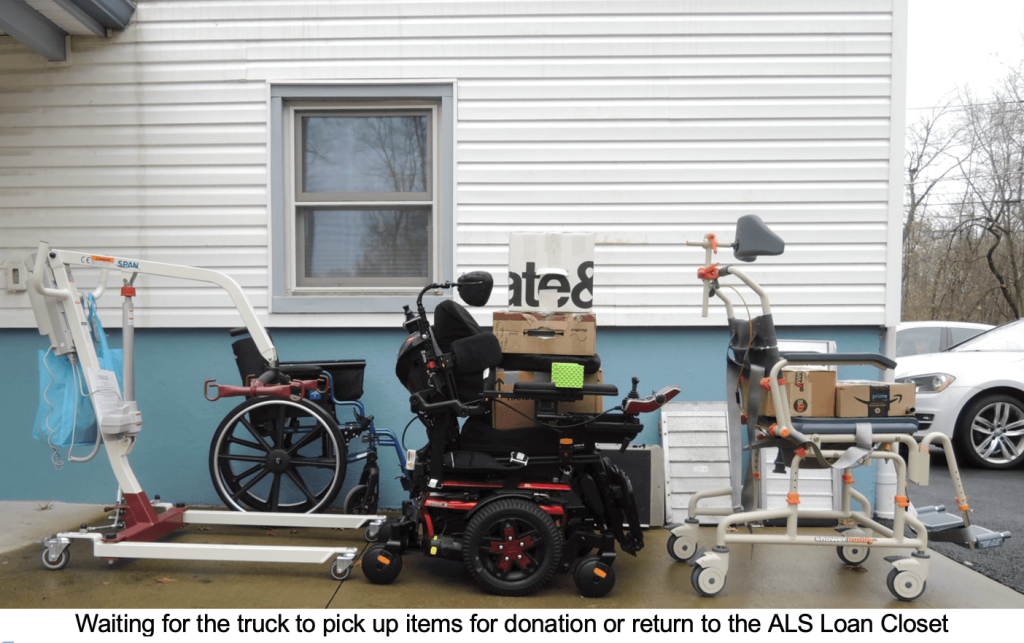
Medical equipment, shower chairs, wheelchairs, communication equipment, computers, cell phones, medicines (it’s illegal to give prescription medicines to others), clothing, mementos, jewelry, musical instruments, record collections, etc: you can donate to charities, sell, throw away, keep. We discovered that it wasn’t easy trying to sell many of our son’s personal property like clothing. All kinds of weirdos reply and try to get things for nothing. There are no-shows. Someone told us to do the transactions away from our own residence, so I sold some items in a school parking lot. I returned to the ALS Loan Closet numerous items they had loaned us (a shower chair, patient lift, portable ramps, call buttons);. I also gave them other large items that we got through insurance and friends (power chair and push wheelchair) (see photo below).
“Closing the estate”
Here is some interesting information regarding “closing the estate” from
https://www.klenklaw.com/practices/probate-and-estate-administration/closing-an-estate/
“Closing an Estate”
Though you hear the term consistently, there is no such thing as Closing an Estate. Probate instructions never tell you how to “Close the Estate,” because it never actually happens. The term refers to the distribution of the estate’s final assets, which typically means that the Executor has run out of things to do.
“Why Do Estates Never Close?
The executor is always the executor. For example, let’s say 20 years after the deceased’s death, the personal representative discovers a previously unknown bank account. The executor may have distributed all other assets 19 years before, but the executor still has the right to gather this new bank account. The executor still has this power because the estate never closed; it just ran out of things to do. The administrator’s power remains. But, the executor’s liability also remains.
“The Executor’s Final Act, “Closing an Estate”
Because the executor is responsible forever, the administrator should receive a release of liability before distributing any funds. Without a release, a beneficiary could years later bring a Surcharge Action. The personal representative, now without any estate funds to pay his lawyer, must respond. Even if the charges are baseless, the executor is stuck paying the legal bill. Instead, before making any distribution, the administrator should insist on receiving a release. If beneficiaries refuse, the executor is free to file a Formal Accounting. If the judge approves the accounting, the executor is discharged.
“With a release, the administrator can distribute the assets with confidence. With the distribution of all assets, the executor is said to have “closed the estate.” But, the executor still retains the power to gather newly discovered assets and address future complaints. The executor should not take the job lightly.” Scary, huh?
After all my son’s obligations in his will were satisfied (in August 2023), my lawyer handling the estate said that the Surrogate (Probate) Court had to be notified and it also wanted a full accounting of everything that was associated with the estate account (deposits and withdrawals). I was keeping accurate records for quite a while in the beginning, and then I wasn’t anymore, because I usually forgot. The lawyer also told me that from her experience, the court usually didn’t follow up with any accounting review, so she asked my wife and I if we wanted to let things just idle. We agreed.
Do you and the ALS victim have an Advanced Health Care Directive? See: https://www.nia.nih.gov/health/advance-care-planning-health-care-directives
POLST
Do you and the ALS victim have a POLST (Physician Orders for Life-Sustaining Treatment, https://polst.org ) signed by a doctor? This is important if you have to take the ALS victim to the hospital. POLST documents are not for the healthy; this is discussed in the cited website.
Do NOT Resuscitate/Do NOT Intubate (DNR/DNI)
Do you and the ALS victim have DNR/DNI (Do Not Resuscitate/Do Not Intubate) on the POLST? Some places won’t honor the DNR/DNI and try to rescue a patient. If you don’t have the POLST with you during a medical emergency, the EMS will try to rescue a patient.
Contingency plan for caregivers
Who will care for your ALS patient if you, a caregiver, suddenly died? What if all the caregivers died? Who cares for the ALS patient? Have you designated someone else to take over? Do you and your spouse have wills, powers of attorney, irrevocable trusts set up to care for the ALS victim if the ALS victim outlives you both? In other words, who or what institution will care for your ALS victim? Our son always had one caregiver, then eventually two caregivers present at all times. I dreaded the thought of our son left lying helplessly in bed or sitting helplessly in his wheelchair alone because all the caregivers died in the next room. He would just die in place. Think about that.
Organ donation
Does the ALS victim wish to donate organs? Our son did. But the ALS victim can’t just check off a box that says he or she wants to donate organs or tissue. There’s paperwork requiring tissue typing, bloodwork, xrays, medical history, illnesses precluding donation, and probably more. We didn’t know if ALS precluded donation. In our son’s sad case, two staff members from the NJ Sharing Network (an organ donor institution; https://www.njsharingnetwork.org ) came to our son’s bedside on his last day alive and wanted to delay the beginning of hospice until all the background work was done. Our son was of clear enough mind to throw them out because he was tired of suffering and wanted to die.
Brain tissue donation
Our son wished to donate his brain tissue to ALS research. Columbia University ALS Research group (https://www.alscenter.cuimc.columbia.edu/research ) was notified towards the end about a donor. As soon as he passed away, he was taken to a funeral home. The Columbia University ALS Research group was initially not very cooperative or responsive to our son’s bequest until his own ALS Neurologist found out he had passed away. She was in this very research group and she made sure the process proceeded efficiently. They sent a team to the funeral home quickly to harvest brain tissue.
Palliative Care and Hospice Care
Do you know what palliative care is and isn’t? Do you know what hospice care is and isn’t? Apparently, there doesn’t seem to be any consistency from one hospice organization to the next about what they will and will not do. They all seem to be willing to provide comfort and alleviate pain, but some will allow only their own doctors to treat the ALS victim, some will eliminate many medicines, some will prevent many treatments, equipment, and tests. If the ALS victim were taken to the ER, it would automatically void the hospice plan. You would have to restart the plan if and when the ALS victim came back home.
Arrangements after Passing
What does the ALS victim want right after passing: Funeral? Burial? A service? Hearse? Cremation? Cemetery? Casket? Scattering of ashes? Urn? How fancy? Notify the papers? Be wary of criminals reading the obituaries to take advantage of you. The costs can easily skyrocket way, way above $10,000. Right after our son’s passing, the hospice staff helped me get my thoughts in order. He passed away on a Friday at 6:15 PM October 29, 2021. Because of the nature of the funeral industry, they are available 24/7. I didn’t know what to do, but the hospital staff was used to this trauma. They told me to go on the web as soon as I got home, find a funeral home and make arrangements. I found a local funeral home with a complete and easy online form to fill out, along with a very clear list of itemized prices. The funeral home we used notified the Social Security Administration which in turn stopped disability payments to our son’s bank account. The last payment was considered an overpayment and they took it back. The funeral home also issued the death certificates. Order at least 15 of them for yourself. Our son was cremated according to his wishes and his ashes scattered, so we only paid about $2000. Every extra step we would have wanted would have cost more. Even viewing the cremation or accompanying the ashes would have cost extra.
Veterans
Regardless of whether the deceased was an ALS victim or not, was he or she a veteran? If yes, have you notified the VA? There are some death benefits available including a burial allowance and flag, but the deceased’s Form DD214 is required. The deceased is entitled to a U.S. flag. See: https://www.benefits.va.gov/compensation/claims-special-burial.asp.
Fundraising sites
Does the ALS victim have a GoFundMe site? Or a blog or any other websites? Who’s the administrator(s)? Who’s maintaining the site and advertising it? Where are the funds coming from to pay for these sites? The online services maintaining the site (developers, artists, advertising, marketing, blast emails, etc.) have to be paid if you want the site to continue or be notified if you want the site to be shut down. Do you know how to contact them?
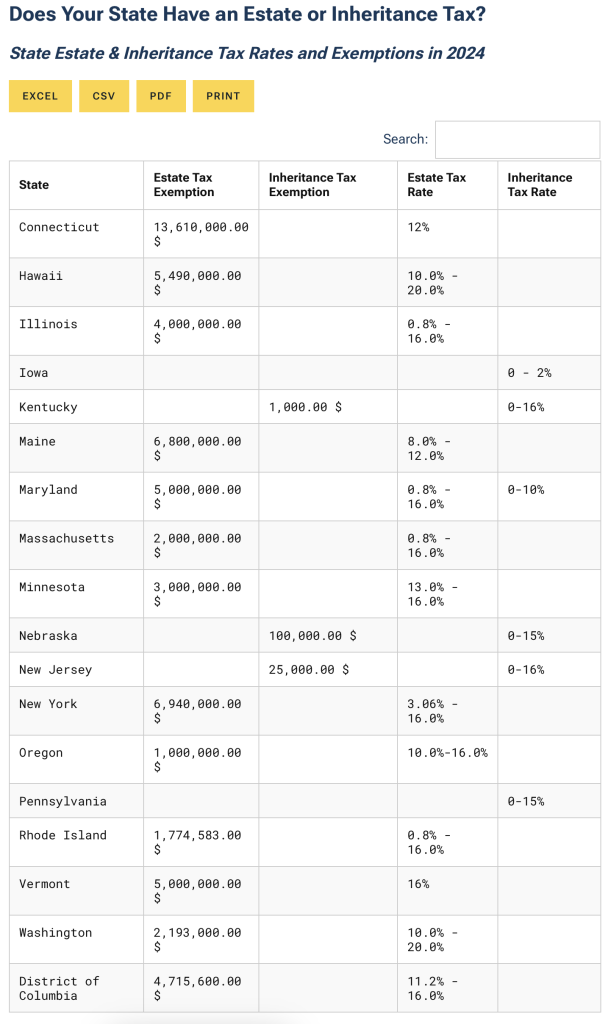
What states require an inheritance tax waiver?
Each state sets its own inheritance tax rules, exemption amount, and rates. Here’s some information from http://taxfoundation.org:
NJ Forms: L-8; L-4; 0-1
NJ is one of about 15 states that requires a NJ Form L-8 (sort-of easy to deal with if you’re lucky), or Form 0-1 (a nightmare to deal with, if you’re unlucky like I was) before they will send you the full amount in the account and close it. A friend of mine was in a similar situation after he lost his wife. He discovered a NJ Form L-4 (unpleasant, but not as bad as the dreaded 0-1); which even my hot-shot lawyer didn’t know about. She filled this out, submitted it and things moved quickly after that. Even though our son’s bank was based in California, they held onto his funds because he had dealt with a NJ branch, so they required an L-8, (I don’t think they were aware of the L-4 or 0-1 Forms). They held onto it for a very long time until they got the correct form. Interestingly, I had found out that NJ requires any financial institution insisting an L-8 to relinquish 50% of the funds, so I demanded my 50% and got it. By the way, 0-1 is “zero-one”, not “capital O-1”. I’ve seen both on the web, but in NJ, it’s “zero-one”.
Another one of our son’s bank accounts had about $8 – $10 in it at his passing. I told the bank I wanted to close the account and send the balance to his estate. They told me they had “written off” the balance and there was nothing left. I told them bullshit and that I wanted the money. I eventually got the check.
In New Jersey, the executor of a will needs certain forms in place before the following can be released from the deceased’s estate:
- New Jersey bank accounts;
- Stock in New Jersey corporations;
- Brokerage accounts; and
- New Jersey investment bonds.
The correct form to use will be dictated by who the beneficiaries are. They fall into certain Classes.
Form L-8 is required if there are only Class A beneficiaries, such as:
- Surviving spouse;
- Surviving civil union partner when a decedent’s death is on or after February 19, 2007;
- Surviving domestic partner when a decedent’s death is on or after July 10, 2004;
- Child, stepchild, legally adopted child, or issue of any child or legally adopted child (includes a grandchild and a great grandchild but not a step-grandchild or a step great-grandchild);
- Parent and /or grandparent.
Form L-8 cannot be used for release of real estate.
The following are NOT Class A beneficiaries:
- Sisters and brothers of the decedent;
- Sons-in-law or daughters-in-law of the decedent;
- Nieces and nephews, aunts and uncles;
- Ex-spouses;
- Mutually acknowledged children;
- Step-grandchildren and charities
The paperwork becomes more complicated if any of the beneficiaries aren’t Class A. Our son had designated two dot-org institutions in his will. Those automatically prevented me from using Form L-8.
Here are links to NJ forms.
NJ Form L-8 Affidavit for Non-Real Estate Investments: Resident Decedents: https://www.state.nj.us/treasury/taxation/pdf/other_forms/inheritance/itl8.pdf
NJ Form L-4 Preliminary Return to request specific waivers
https://www.state.nj.us/treasury/taxation/pdf/other_forms/inheritance/itl4.pdf This form seems to be some kind of shortcut to getting the more complicated 0-1.
NJ Form 0-1 Inheritance or Estate Tax Waiver (Form 0-1) (https://www.state.nj.us/treasury/taxation/inheritance-estate/inheritance-waivers.shtml) can only be issued by the Division. You do not fill out the waiver. This is a nightmare with what could be a half-year or longer wait just to get the form. After Form L-4 was submitted, Form 0-1 came rapidly. Form 0-1 had to accompany a half-inch thick pile of forms and be sent back to the NJ Treasury department. We finally got a tax waiver on our son’s estate.
States with inheritance taxes
From AARP:
https://www.aarp.org/money/taxes/info-2020/states-with-estate-inheritance-taxes.html
Disability
Our son was such a good employee at the company from which he had to leave due to ALS that they said they would cover him for disability until he was 65, but he passed away at 42.
Someone stated on the Facebook caregiver’s group that I’ve posted to that there is a big payout difference between SSI and SSD. SSD is your money that was taken from your check weekly when you were working and you get much more than SSI.
Summary
1) Everyone should have a Will (Last Will and Testament)
2) ALL financial accounts must have POD/TOD/Beneficiary information. These accounts do not go through public probate which can be time-consuming and have “expensive” probate fees (3-7% of the asset). The probate process and costs vary by state.
3) Joint accounts do not go through the probate process (Joint Tenancy is another issue)
4) Your house does go through probate. To avoid that, one may create a Living Trust (it is revocable) that keeps the assets private, no creditor can claim, and it does not go through probate.
5) Retirement communities:
Continuing Care Retirement Community (CCRC)
https://www.aarp.org/caregiving/basics/info-2017/continuing-care-retirement-communities.html
Active Adult Retirement Community (https://www.actsretirement.org/communities/new-jersey/).
6) Health proxy (https://www.health.ny.gov/publications/1430.pdf ) if you are seriously ill/incapacitated, the health proxy authorizes named individuals to make medical treatment decisions on your behalf.
7) Advanced Health Proxy (https://www.nia.nih.gov/health/advance-care-planning-health-care-directives, a Living Will) document . This tells the doctors not to Resuscitate, no ventilator, no feeding tube, or any other treatment that you do not want. Without that the doctors are obliged by law to keep you alive by any and all means, see Terry Schiavo case: https://www.youtube.com/watch?v=O-rQ3tIabvM.
8) Durable Financial Power of Attorney: this document authorizes someone to make financial decisions on your behalf when you are not able to do that (bills/taxes have to be paid!) – but ONLY while you are alive.
9) Your Last Wishes. This does not deal with assets but your wishes – like burial/cremation, Funeral arrangement, Celebration of Life ceremonies, instruction of whom to notify with what message, obituary, etc.
10) Have a Master Document of Everything. This is a spreadsheet or some other document format of your important contacts info – like your attorney, CPA, Funeral Director, Doctors, plumber, real estate agent, handyman, banks, etc. Make it easy on your heirs!
11) Simplify your life. Consolidate your financial accounts in one place. Declutter your life. Very likely that your heirs do not care about your beautiful china, or super 8 movies, etc!
12) Estate Tax and inheritance tax after one’s death. Some give away money to heirs and charity to reduce assets. It helps reduce the tax. There are other ways to reduce the impact through a variety of trusts. A lawyer, financial advisor or accountant can advise you.
13) Convert extra IRA funds into Roth IRA so the heirs get it tax-free. It will reduce your “forced” taxable income from RMD after 72 years old.
14) Qualified Charitable Deductions (QCD) https://www.fidelitycharitable.org/guidance/philanthropy/qualified-charitable-distribution.html is a tax avoidance technique when RMDs are your nemesis. (Only from IRAs, not from a 401K).
15) Longevity calculators do “Monte Carlo Simulations” to see whether your assets would last after your retirement and whether you would leave money to heirs or not. A free calculator is at https://firecalc.com (among many others).
16) Legal documents from the Net, or hire an attorney? This may be based on your assets. For us, having an attorney is worth it – don’t be pennywise and pound foolish. It can cost you from $700 to $4,000 but it may be worth it.
Based on our own experiences with lawyers, we learned that they are never in a hurry, so sometimes simple documents you need take a long time to prepare for no valid reason. We also learned that lawyers are sloppy and careless. The lawyer who prepared my wife’s and my wills sent us drafts containing other clients’ names. This same lawyer also sent us a document with her other client’s financials on it. We’ve gotten drafts with misspellings of our own names. We’ve gotten drafts that had confusing English. I recommend that you give a lawyer you engage a deadline for documents you require, maybe two weeks, or you go somewhere else. Monitor the lawyer’s activities, otherwise things will just drag on.
The top Estate planning attorneys belong to https://www.actec.org/. It is hard to be a member of this. You need 10-20 years of experience and the support of other members.
