
ALS SUFFERERS BITE THEIR LIPS, tongues, and cheeks all the time. Jeremy was constantly doing this. Most of the biting was caused by violent yawning. He would yawn, involuntarily, by opening his mouth as far as the tendons allowed, and when the yawn ended, he’d chomp down as hard as he could, biting whatever was in the way. He sometimes had up to 10 yawns in a row.
Another cause of bites, which we couldn’t do anything about, was the cough assist: the negative pressure cycle caused his cheeks to collapse, and then he bit them.
Our son also had bruxism, or clenching and grinding of the teeth. We could actually hear his teeth grinding. He was lucky that he never chipped, cracked, or broke any teeth.
Jeremy also had a very strong bite reflex, so sometimes when we tried to brush his teeth, he bit down on the bristles and we had to yank it out of his mouth. One time he actually bit the bristles so hard that he pulled a cluster of them out of the toothbrush and swallowed them (see below).
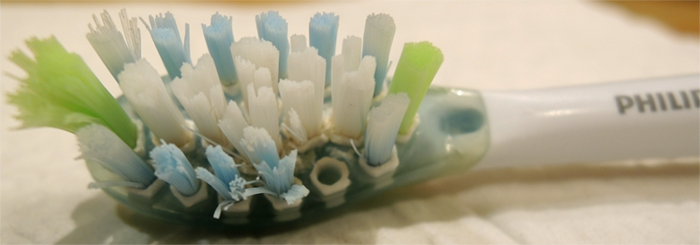
Cluster of bristles removed and swallowed.
Mouth guard
We kept suggesting a mouth guard to our son, but he had a severe gag reflex, so we gave up on that idea. He gagged if anything touched his tongue until around the last year of his life, and then the gagging reflex slowly disappeared.
Dentists will charge big bucks for a mouth guard, but I’ve bought them in our supermarket for around $20–$30. See an example below. The instructions always say to mount them on the upper teeth, but I have one of my own and I prefer the bottom teeth.
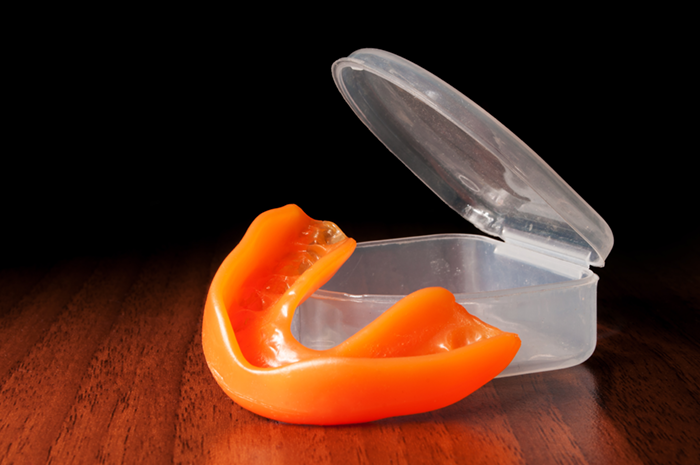
Example of a mouth guard sold in supermarkets and pharmacies.
If it’s mounted correctly, you shouldn’t have to worry about choking because it’s pretty bulky. You can trim it with scissors if necessary. The supermarket ones are U-shaped, so you simply put the new one in hot water, and while it’s still soft, place it on your teeth and gently bite down to shape it.
The technology keeps changing for prepping the mouth guard. Some say to microwave it in water, others to heat up some water and dunk it. Some directions are confusing. The better brands are made so the two layers of the rubber don’t peel apart. If the ALS sufferer can wear a mouth guard, I recommend it.
A biting solution
We found a fairly decent solution to our son’s biting habits. It required vigilance, but there was always someone around him anyway, so the chances of preventing a bite were pretty good.
We bought a large bag of the silicone spatulas shown in the photo below. You can pick them up at Walmart. I don’t remember where we bought the large bags of them.
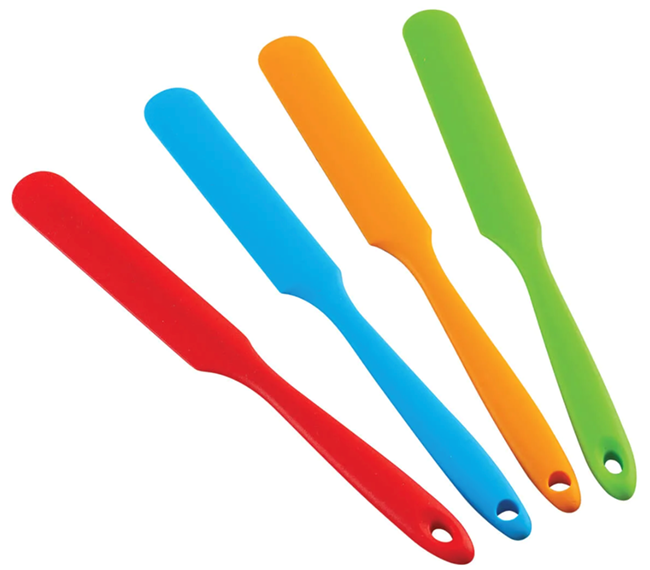
Silicone spatulas. Available at Walmart.
Whenever we saw our son beginning to yawn, we would insert the first half inch of the tip of the spatula into his mouth just past his lower teeth (see photo below), and then, very importantly, tilt the handle downward about 45 degrees.
At the end of his yawn, he would bite down harmlessly on the spatula tip. (I couldn’t draw the spatula flat, but if you try this, turn it flat side up.) The reason we tilted the spatula down was that if the spatula was completely horizontal, the bite would flip the handle downward.
Please note: The silicone is a soft rubber and tends to crack very easily from all the biting. A metal rod inside the silicone gives it stiffness. Once it’s cracked or split, throw it away because you don’t want bacteria building up in the crack.
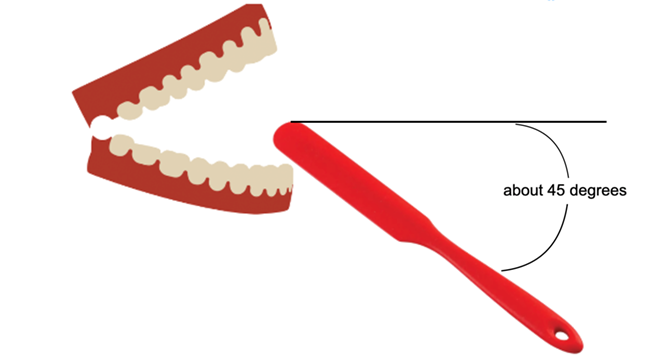
Position of spatula for bite prevention (the flat side should be facing up).
