
Our son Jeremy, who passed away 10.29.21 from ALS, wrote a book (published June 2022), “Never Say Invisible” (https://www.neversayinvisible.com/book/ ). The book discussed discrimination against the disabled and the difficulties that he encountered as a wheelchair-bound, paralyzed, non-verbal person. Here are some of his and our own personal observations and experiences.
Here’s a very brief video entitled “Oh” that I found on my favorite website, Imgur.com. The video upends the whole narrative about people with disabilities coping in the real world: https://imgur.com/gallery/oh-GCpmglW.
In Case of Fire, what would you do?
This is not a real posted sign; I created this from existing signs. As they say, “One picture is worth a thousand words.” I would hate to see anyone in this predicament.
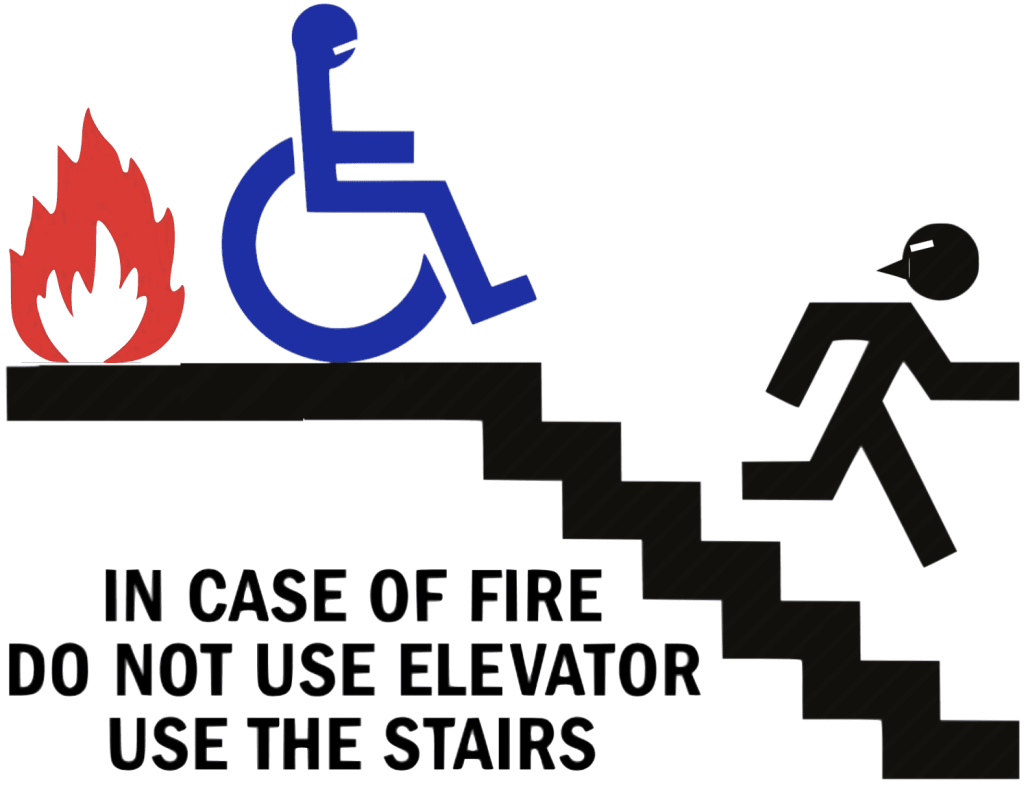
I posted the drawing above on the Facebook group “ALS – Patient and Caregiver tips for every day living”. The following is a response (including the two images below) from Zara Zweig, an ALS sufferer, with her permission, but I’ve inserted some of my own observations bolded and in brackets:
“If you look in most modern stairwells, there is a designated waiting space for wheelchair users to use in an emergency, like a fire. The stairwell is concrete and fireproof, so you are safer there than hanging out elsewhere on the floor you’re on. Be sure to close the door [if it doesn’t close by itself and if you’re physically able]. They usually have a button you push or a phone you pick up and it lets first responders know you are there and waiting for them to come and carry you down [see my photo below of a medical office building in my town with no communication options].
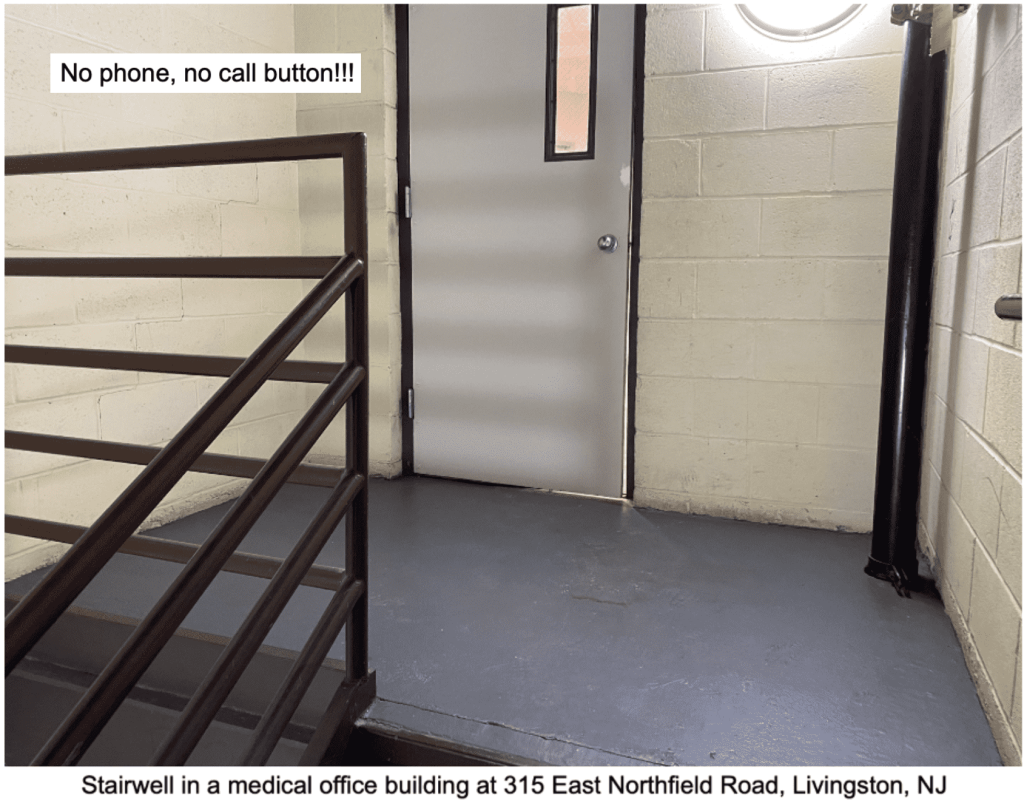
If no button or phone, call 911 [if you’re physically able] and tell them [if you’re physically able] where you are and they will pass that info on to the fire department. If you’re in a big electric wheelchair like most PALS [ALS victims], rescuers aren’t able to carry that kind of chair downstairs, so they’re going to carry just you… they have various lifting techniques they are trained to use depending on how many rescuers are participating, needs of the patient, and urgency of the situation. So if it’s problematic to be carried by those types of lifting techniques, tell them [if you’re physically able] to bring a stretcher when you pick up that phone [if you’re physically able] (and it’s [a] policy with some fire departments that they go to retrieve a wheelchair user with a stretcher). It’s also not a bad idea to have a manual chair to use in an emergency so that you have something to sit in when you get downstairs… your CALS [caregiver of ALS], a neighbor, or a firefighter can carry it down the stairs in the folded position. There are manual chairs that have high backs that recline and can support a PALS in an emergency… get one of those if you would require that kind of support and a regular chair wouldn’t work.
If you live somewhere that you’re on an upper floor, you definitely need plans in advance for a fire. Know where your safe waiting space is… most likely the stairwell, as described above, but some really huge skyscrapers have a concrete room on every floor that you are supposed to wait in and you can call for help [if you’re physically able]; there will be signs that tell where you should go. But it’s your responsibility to find out what you should do when you move in… don’t wait for an emergency. You might even want to talk to some neighbors and have a plan in place where they meet and help get you down the stairs instead of waiting for the firemen. (See images below for idealistic features.)
My reply: Our son wouldn’t even have been able to enter a stairwell by himself because he could not use his hands to open any door, nor would he have been able to press any buttons or use any phones in the stairwell. If I weren’t there, someone would have had to carry our son, who had head drop, down the stairs while keeping his head upright so he didn’t choke. What’s the chance anyone would understand head drop? And, there’s a good chance his eye-gaze Tobii device would have been left behind, so he wouldn’t have been able to communicate at all.
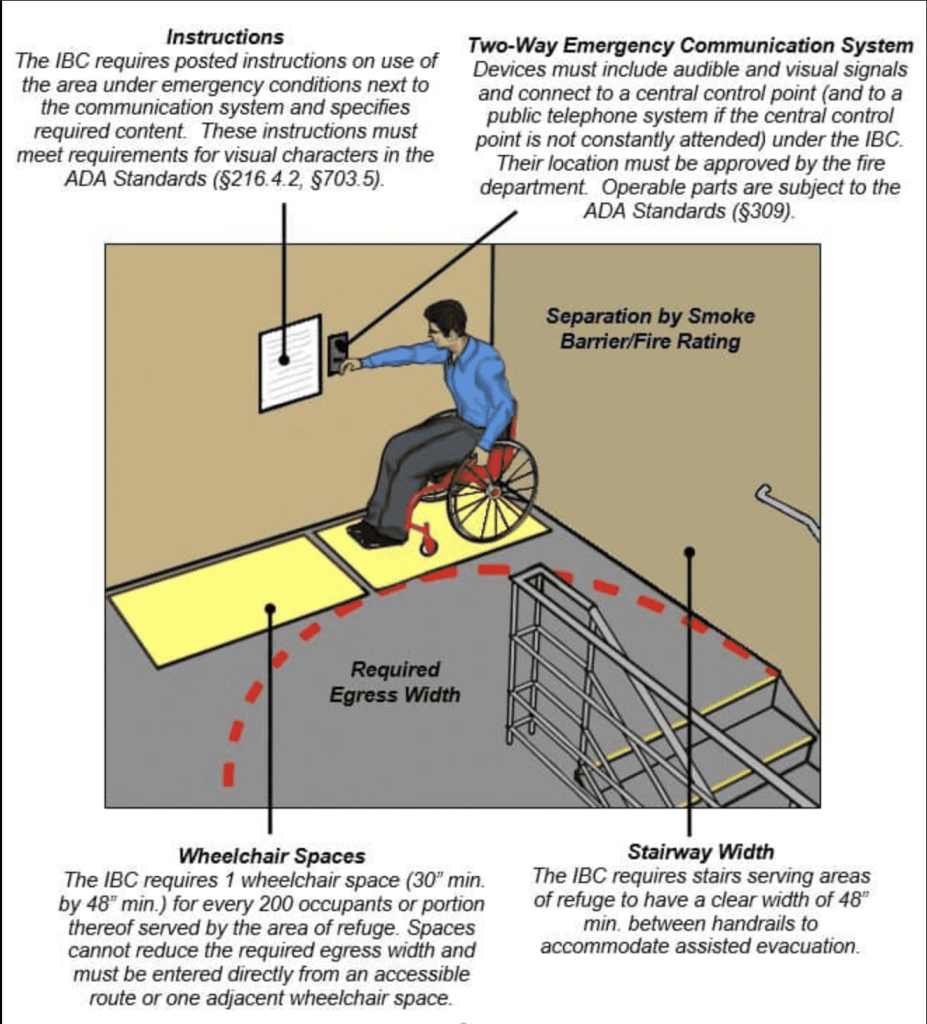
(Note: the following URL was attached to the above image, but it has disappeared from that website): https://www.map-strategies.com/blog/2019/4/3/these-five-changes-in-the-illinois-accessibility-code-impact-residential-design.
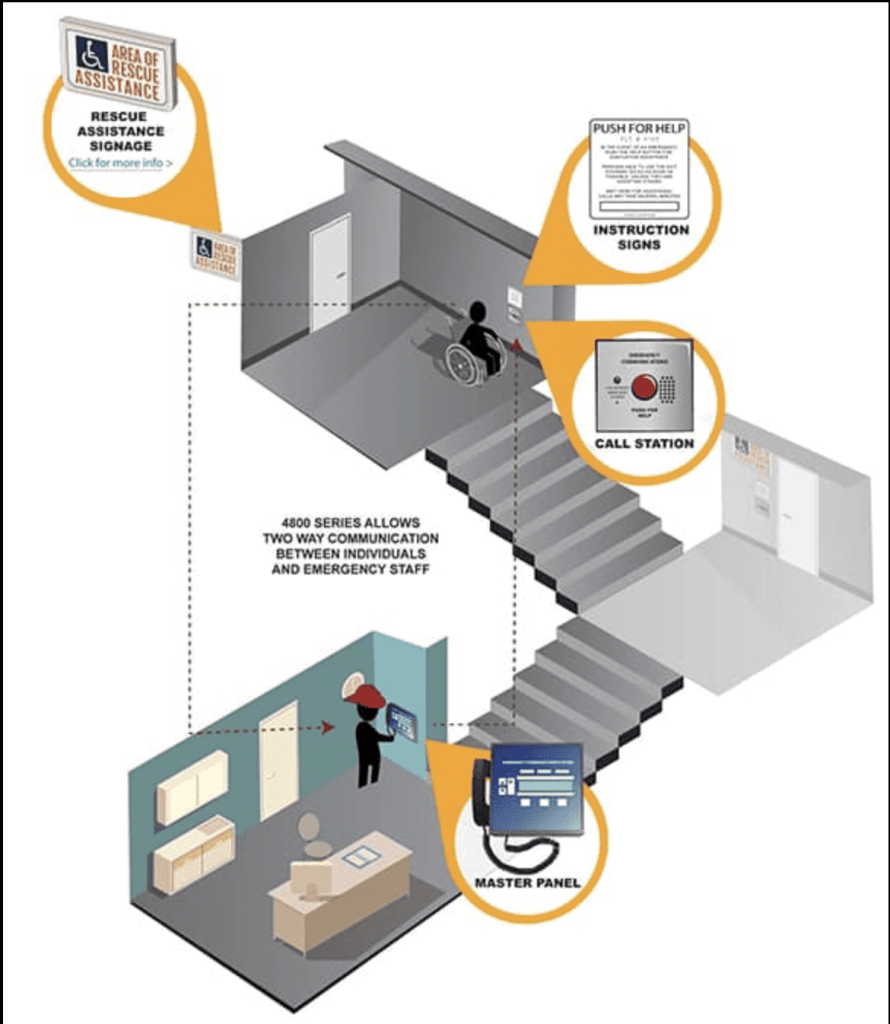
https://www.cornell.com/MedicalAlertSystems/EmergencyAssistance
When our son was enrolled in Brainstorm Cell Therapeutics’ Nurown Clinical Trials (https://brainstorm-cell.com), we had to travel many times from our home in New Jersey to the UMass Memorial Medical Center in Worcester, Massachusetts because Worcester was the closest location from our home for the clinical trial treatments. We stayed at the Beechwood Hotel across the street from the hospital, sometimes both before and after the sixteen or so spinal taps so he could rest. The hotel had so-called “ADA-compliant” rooms on all the floors of the hotel. But the ground-floor room wasn’t always available. Our son was almost completely paralyzed by that time and also was wheelchair-bound in his 450-pound power chair. Although the situation never happened, if we were in one of the hotel rooms on an upper floor, and if there were a fire or other emergency, how were we supposed to evacuate him when all the signs stated “use the stairs”? Was I supposed to carry my son down the stairs? I probably could have, but it would have been difficult. I never asked whether there was a team of employees who could have carried him.
Some wheelchair-bound people were carried down the stairwells by decent citizens during the attacks on the World Trade Centers in 2001. Our son had head drop and would have choked if his head tilted back even a few degrees.
My wife and I were in the Sanofi Pharmaceutical building in Cambridge, Mass after our son had passed away. I asked an employee there what they would do if there were a disabled person in a stairwell on an upper floor. The guy said their stairwells are fireproof and they always have a team of 4 that will carry a person down the stairwell in an emergency. That’s great, but that’s probably the exception.
The term “ADA-compliant” is a JOKE!
We stayed in a supposedly ADA-compliant room in a hotel in Washington, DC in 2019 or 2020. Once our son rolled through the doorway into the room, he encountered a sharp right-hand turn into a narrow passageway to get to the bedroom itself. Because the beds were very high (2.5-3 feet!), we could not easily get our handicapped 40-year-old son into the bed. I figured out a procedure by using his chair’s elevator function like a forklift:
- I stood him up on the foot rests of his power chair while we supported him.
- We used the chair’s iLevel elevator function to raise him as high as possible (18” rise).
- I “bear-hugged” him from the front, cradled his head, lifted him up off the foot rests, pivoted to the bed, and laid him down.
ADA-compliant my ass. That was not an ADA-compliant room. There was also a lip on the floor separating the bedroom from the bathroom, which made going to and from the bathroom difficult.
We stayed in a hotel in Costa Rica that had only a couch for our son to sleep on because the bed was too difficult for him to access. The couch was low, so I had great difficulties getting him on and off the couch.
The bathroom in another hotel had a “vanity panel” (see image below) in front of the sink’s plumbing for absolutely no reason. Our son’s knees kept hitting the panel when he tried to roll up to the sink.
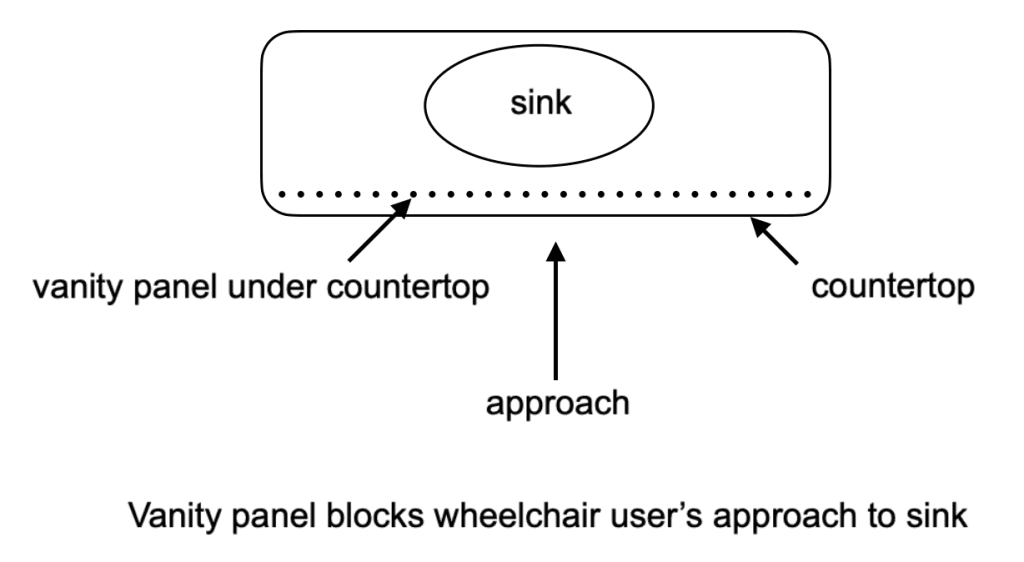
The bathroom in another hotel had sink faucets so far from the front edge of the sink that our son couldn’t reach them from his wheelchair. It also had a towel rack mounted on the wall behind and above the toilet, so I kept hitting my head on the towel rack while trying to stand our son up at the toilet.
I never saw a bidet in any hotel.
A hotel bathroom in Israel had a shower/bench combo between the toilet and the tub so the water just ran all over the floor and into a floor drain. (See image below). What a mess.
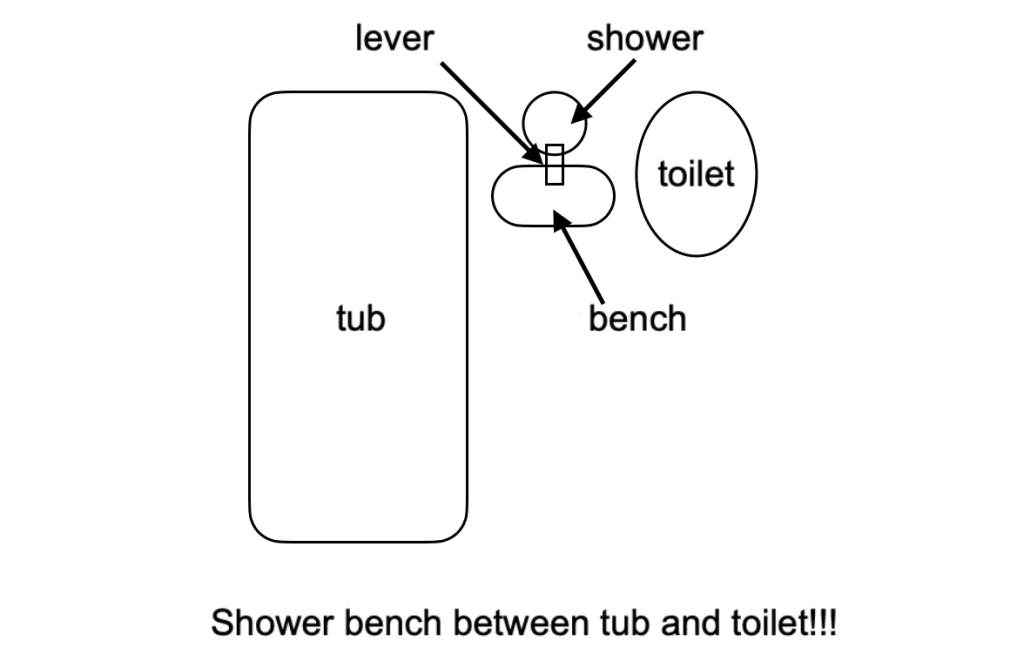
Also, the on/off water lever (not a knob) was located directly behind the bench so our son couldn’t avoid leaning against the lever. The water shut off each time I tried to sit him up straight. This same bathroom had a tub instead of a roll-in shower which he couldn’t get into at all. The same bathroom had a toilet too low for me to be able to stand him up easily afterwards. There was also a raised threshold that we had to drive his wheelchair over even to get into a bathroom.
Some bathrooms had very cramped floor areas that were difficult to navigate with our son’s 6-wheeled powerchair.
”ADA-compliant” is a mere suggestion, besides a joke. Jeremy’s book talks about this, too. A facility only has to meet the bare minimum to claim ADA. Jeremy stated in his book, “There’s no positive return on investing in another grab bar or a push-button door opener. Forget about the disabled. How many could there possibly be anyway?” I, myself, have always said that the best punishment for an architect is for the architect to be forced to live in what he or she has designed.
A new sidewalk in Livingston, NJ (2025)
New apartments were built in our town, Livingston, and were completed in early 2025. The photo below shows the traffic light poles standing in the middle of the sidewalk. The square pole in the foreground has sufficient space on both sides of it for powerchairs and walkers. The square pole in the background only has 32” between it and the edge of the sidewalk. Our son’s powerchair was exactly 24” wide, so, yes, he would have been able to fit between the pole and the edge of the sidewalk if he had centered himself (but with only 4” clearance on both sides). There are wider wheelchairs, so the clearance would be smaller. However, his hand was very unsteady; he once lost control of his powerchair while navigating the sidewalks in New York City in 2018 and steered into the side of a building. That gravelly area to the right of the sidewalk in the photo below is not finished yet, but it will either have grass or some loose material to complete it. I’d hate to see someone drive off the right side of the sidewalk onto that. The architect could have simply made the sidewalk go right up to the brick wall; then there would have been plenty of space. The gap between the rear pole and the street corner is much larger than 32”, so anyone could go to the left of the pole, but for someone with an unsteady hand, like my son, there was a risk of losing control and driving into the street.
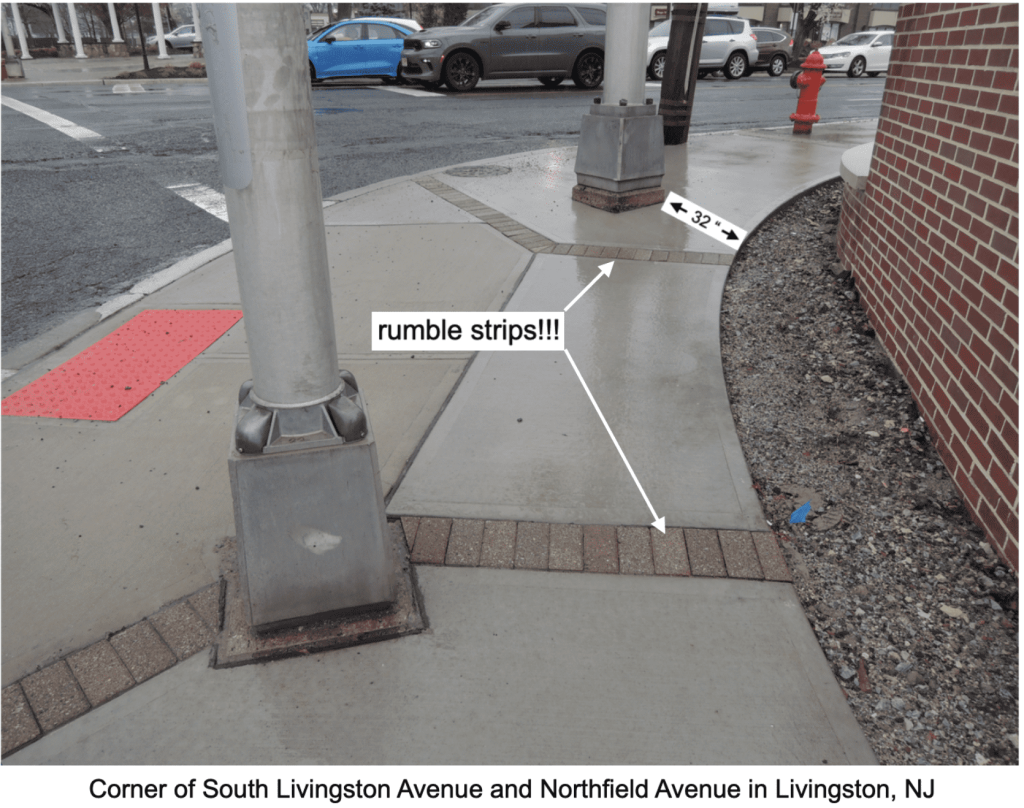
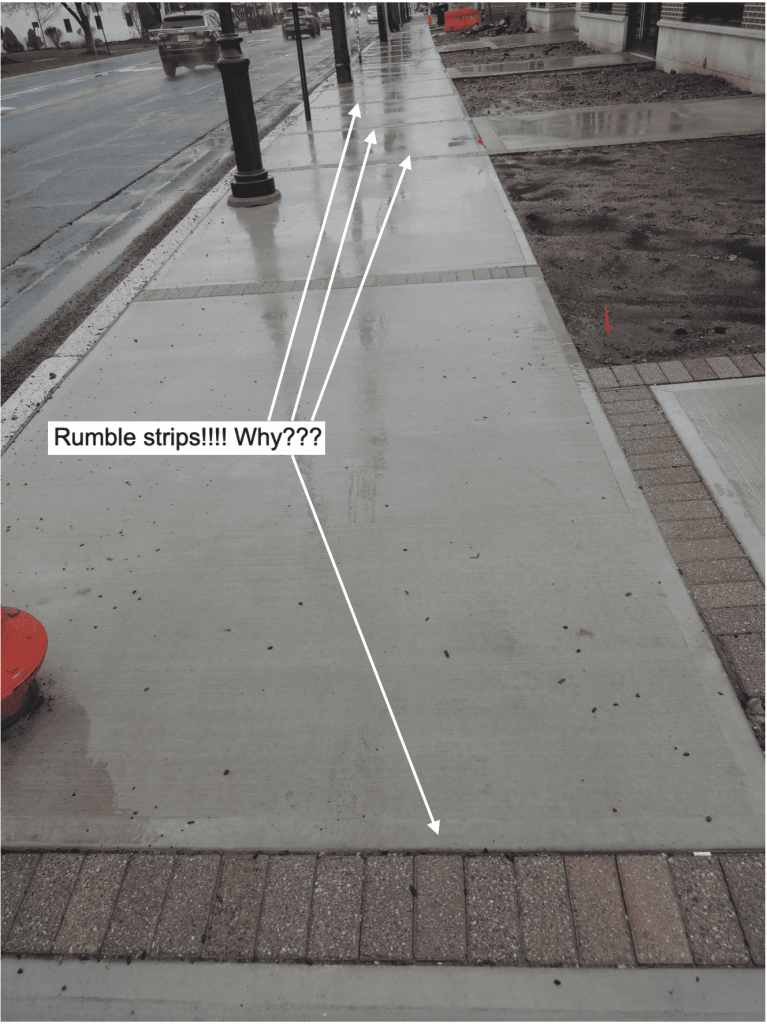
There is another issue with this sidewalk (see photos above and below). The architect put brick strips, which I call “rumble strips” in the sidewalk for no apparent reason. These are rougher areas than the concrete. Traversing them with any kind of cane, walker or wheelchair will be slightly more challenging. Way to go!!!!
Inaccessible to accessible
Early in our son’s diagnosis (2018), one of his friends created a GoFundMe site for him. (https://www.gofundme.com). (It was taken down after he passed away). He got approximately $153,000 in donations. This money was used to add a fully-accessible wing onto our house for him, including an elevator (https://www.guidetoals.com/motion-and-assistive-devices/) and a ceiling lift (https://www.guidetoals.com/patient-lifts/). We used an architect who specialized in accessible designs and he worked with a builder whom we chose based on a recommendation. The architect came up short on numerous issues (some of them accessibility issues), which I didn’t discover until much later. The architect also didn’t check the builder’s work well, either. The builder and his sons, who worked for the builder, were not the brightest bulbs in the package. I keep discovering shoddy work and shoddy materials. Some of these problems cost me big bucks to fix. (A lawyer had told me it wasn’t worth taking them to court, so I footed all the repairs later on.) There were some major structural errors under the entire floor of the new addition that I didn’t discover until years later. When I asked an engineer why the town inspector didn’t catch this, his answer was that a young inspector would have gone into the crawl space under the new addition, but an older inspector would not necessarily have wanted to crawl around under there. Guess which inspector I had?
Here are some annoying things that either I fixed, or had the builder fix, or I didn’t notice until after the builder had finished up and was long gone:
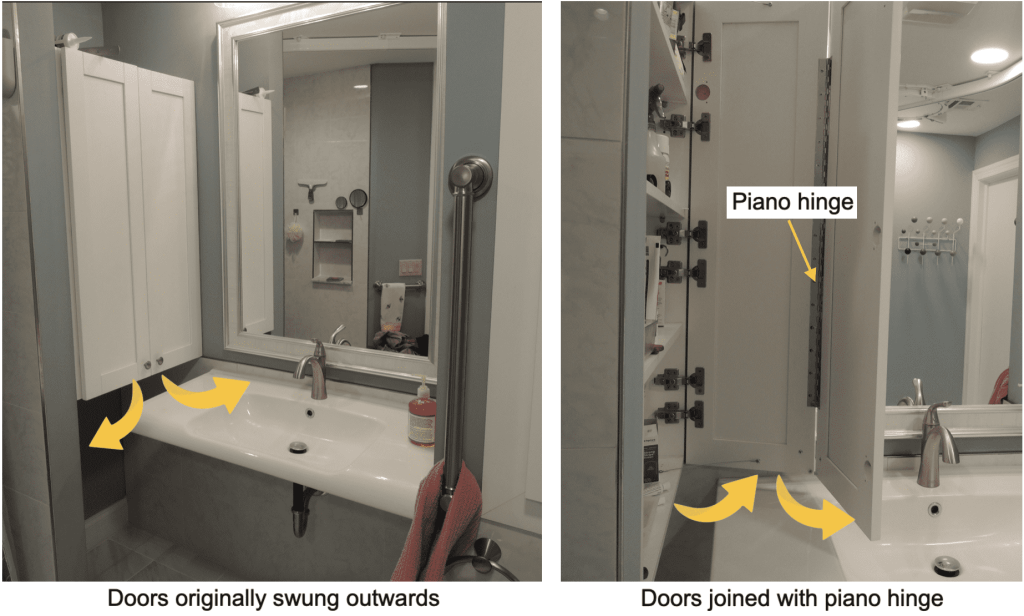
Our son’s bathroom cabinet originally had a pair of doors with 3 European hinges on each door (left-hand photo below), each door of which swung outwards from the middle of the cabinet. My son couldn’t reach around the left-hand door because he was in his wheelchair. I removed both doors and their hinges. I joined the two doors to each other with a piano hinge (right-hand photo below), thereby giving me a folding door. I then mounted all the original hinges on the right-hand door for good support. No sense throwing out good hinges. Now our son had unhindered access. Why didn’t the architect or builder pick up on this?
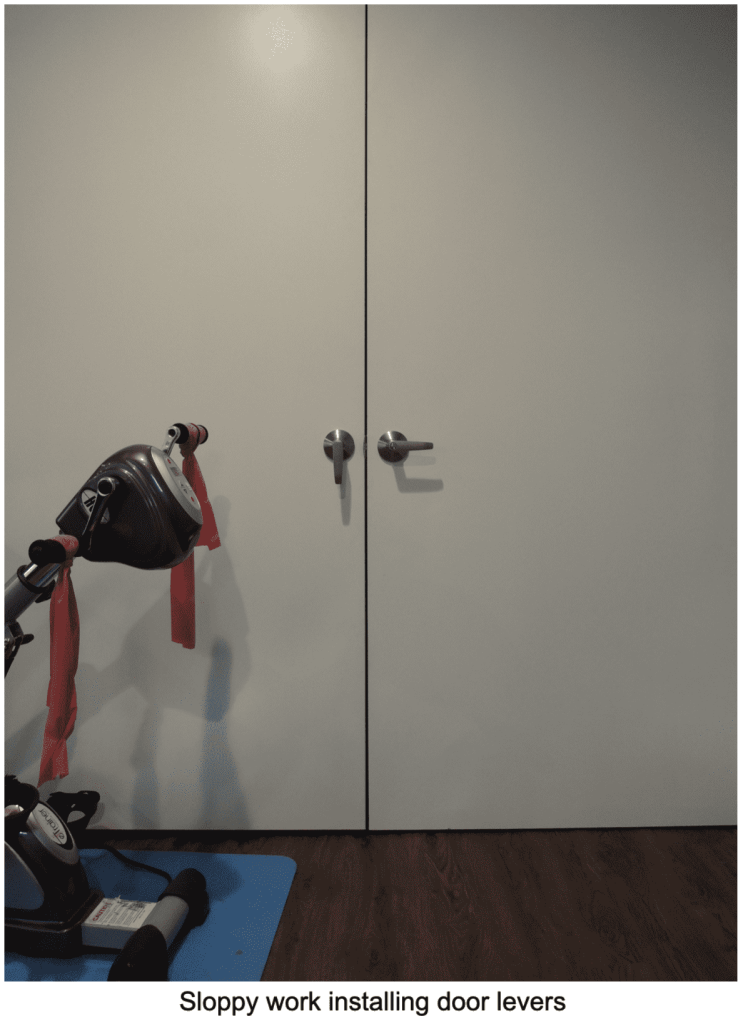
We had a second accessible bathroom (photo below). The idiot builder installed the pair of levers unevenly.
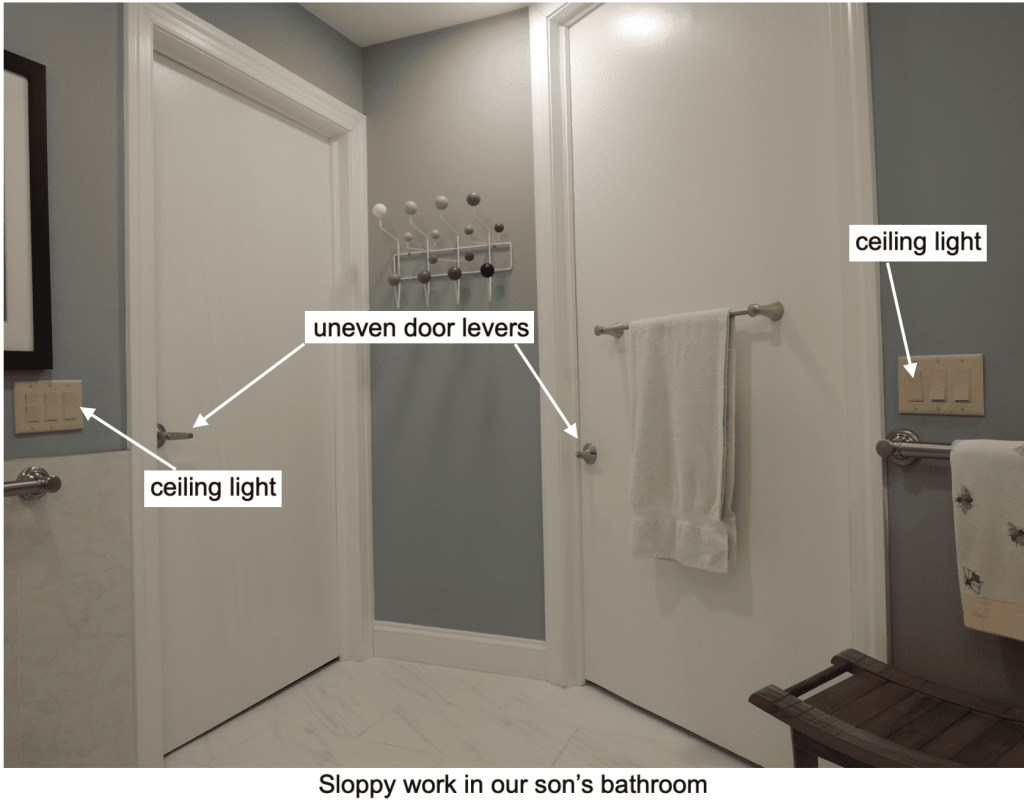
The photo below was taken from inside my son’s accessible bathroom and shows the two entry doors. The left-hand door goes to a hallway and the right-hand door goes to his bedroom. Our son had told the builder that he wanted the lever handles low down so he could reach them while in his wheelchair. You can see that the idiot builder only put the lever handle on the right-hand door lower.
Also, you can see that there are two panels of electrical switches in the bathroom. One switch on each panel controls the ceiling light. So, think about it: if it’s totally dark and you enter this bathroom, what’s the first switch you want to find in the dark (and even during the day) when entering from either door: the heater switch? the ceiling vent switch? or the ceiling light switch? After I tested the actual switch panels and saw the switches were in the wrong order, I asked this question to the electrician who had already installed the switch panels. He couldn’t answer the question. Seeing that he was clueless, I told him to rearrange the switches so both ceiling light switches were closest to the room entries. This was not rocket science.
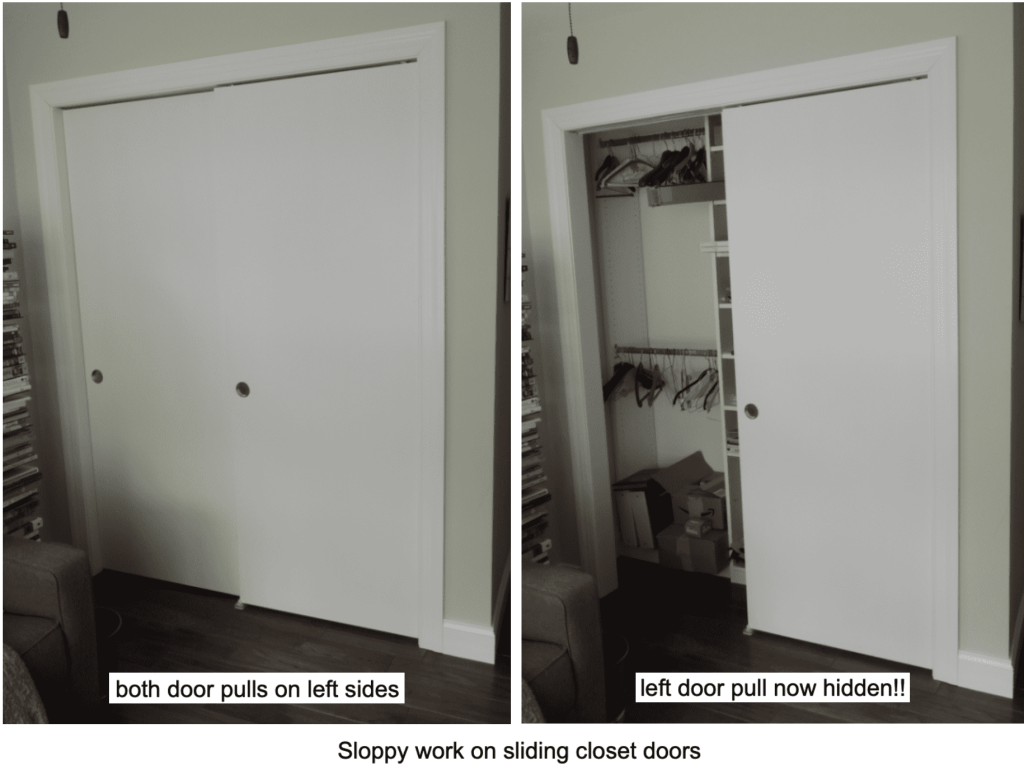
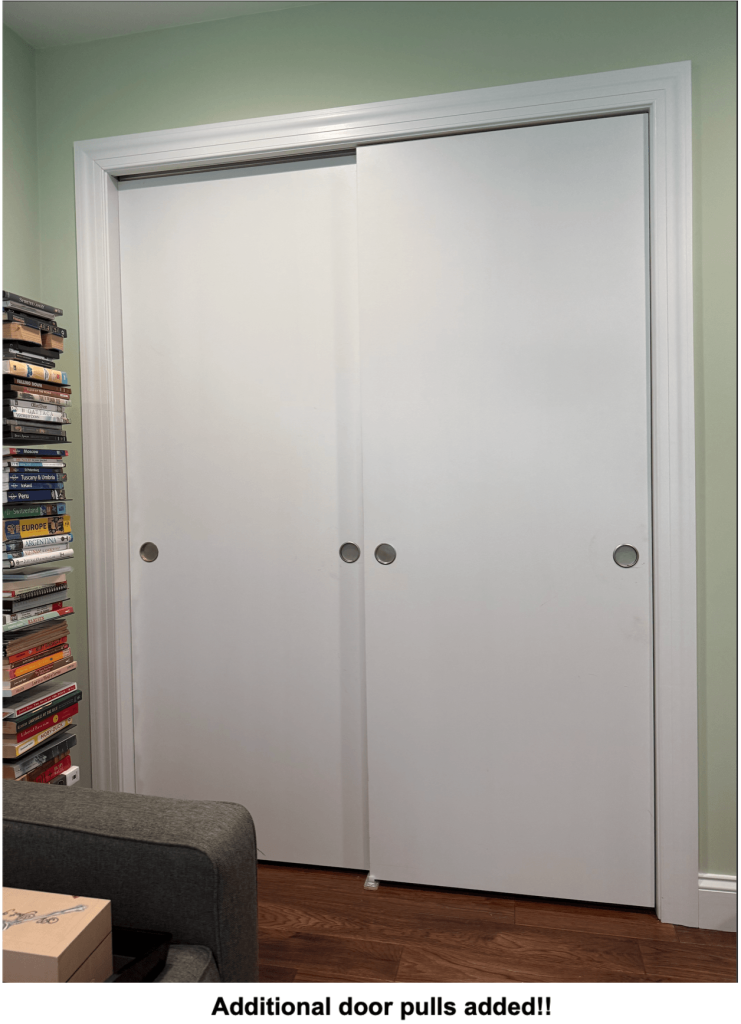
And then there was the issue with the sliding closet doors in a bedroom in the new addition. The photos below show that the idiot builder did not install a door stop for the left door. When the left door is fully opened to the right (as in the right-hand photo) the recessed door pull goes completely behind the right-hand door. Even I have trouble closing the left-hand door when that happens. How was my son supposed to deal with that?
I finally added additional door pulls (see photo below) several years after our son had passed away. Now, it doesn’t matter which door is on the left or on the right – there will always be a door pull available. How much extra could the two additional door pulls have cost?
The lesson to be learned: Inspect all the work and don’t pay up until you like everything. Also, don’t trust the town inspectors to do a decent job, either.
Insurance and employment discrimination
Before our son was stricken with ALS, he was employed and covered by his employer’s health insurance. When he had to resign and go on disability, he was fully covered by COBRA and disability insurance. He never had to deal with government coverage.
However, think twice before getting genetic testing to see if you have ALS markers on your genes. A health insurance company will not cover you if you have a pre-existing condition. Likewise, you will not be able to get long-term care insurance, nor life insurance. Also, if a potential employer finds out you have the ALS marker, it might not hire you.
