
Quite a number of people have asked on the Facebook group “ALS – Patient and Caregiver tips for every day living” what “the end” of an ALS sufferer’s life is like. It depends on whether the person has a feeding tube, and/or trache, or has refused one or both. It depends on how much care the person is receiving. There is a whole spectrum of what happens at the end of the life of an ALS sufferer. Here’s what our son and people we knew experienced.
Our son’s last two weeks
Our son, a victim of ALS, was in bad shape the last couple of months of his life. His mind seemed to be clear most of the time, but there were periods in which he just stared into space. During those quiet periods he did not or could not communicate. He could not use his eye-gaze device; we even had trouble getting him to spell out words on a letter chart. Physically he was a mess.
He began having breathing difficulties on 10/17/21, so he was taken by ambulance to the ER. He had an emergency tracheostomy, but he seemed to take a turn for the worse right after. They kept having to suction mucus out of his throat and lungs with a long flexible wand and it felt to him like they were shoving a stick down his throat. It was very disturbing to watch. His neck kept bleeding where the trache entered his throat.
The doctors ran numerous tests and found that he had a lung infection, a collapsed lung, and mucus in one of them. He had no dignity left, no privacy, and relieving himself was a physical nightmare. He hadn’t had a bath in two weeks. He hadn’t had a shave in two weeks either, even though I kept offering. The hospital staff was in no way qualified to handle an ALS patient, and my wife and I had to be on constant alert for unsafe handling by the staff. Every pill seemed to need a doctor’s okay. We even brought our own rolling patient lift because if we wanted to transfer him, the staff had to call a team with its own lift, but that took hours. However, we weren’t allowed to use our own lift.
The doctor had put him on oxygen after the trache. The staff determined that he could not breathe on less than 40% oxygen fed into his trache (normal air is 21% oxygen). Our son saw that there was no quality to his life. While he was still in the hospital, he began begging to die for almost 2 weeks after the trache. We wanted him to come home, but he knew his time had come. He was very brave.
On 10/29/21, I told the doctor our son was ready to end it all. The doctor gave the hospital staff the order to begin the hospice protocol. We were at his bedside when they began. The nurses switched from the oxygen feed to plain air. They fed large doses of morphine in through an IV in his arm. That put him into a deep sleep. After about an hour, all the color very suddenly drained from his face and his heart stopped. We were all crying our eyes out. I covered my son’s face and he was gone.
I remarked to one of the hospice staff that was overseeing the morphine dosing that I was witnessing an execution. She was upset hearing that, but how else could I have described this?
A few days later, I had to identify my son for certification for the death certificate. It was extremely disturbing to me, but it was the first time I had seen my son relaxed and at peace since his suffering began. Hospice could have lasted months and months, but in our son’s case, only about an hour.
ALS sufferers and spouses we knew
Before our son passed away, we had belonged to an ALS support group run by the ALS Association and was located in Fairlawn, NJ. We attended these group meetings before the Covid pandemic forced it all online. We became friendly with three women in the group, all of whose husbands were ALS sufferers. Over the course of about 1 year since we had met these women, each one had put their respective husbands to bed at night, but when the women awoke the next morning, they all discovered that they had all become widows. Their husbands all died in their sleep. It was merciful and quick.
As you may have gathered from what I just wrote, there is no typical “end” to an ALS sufferer’s life.
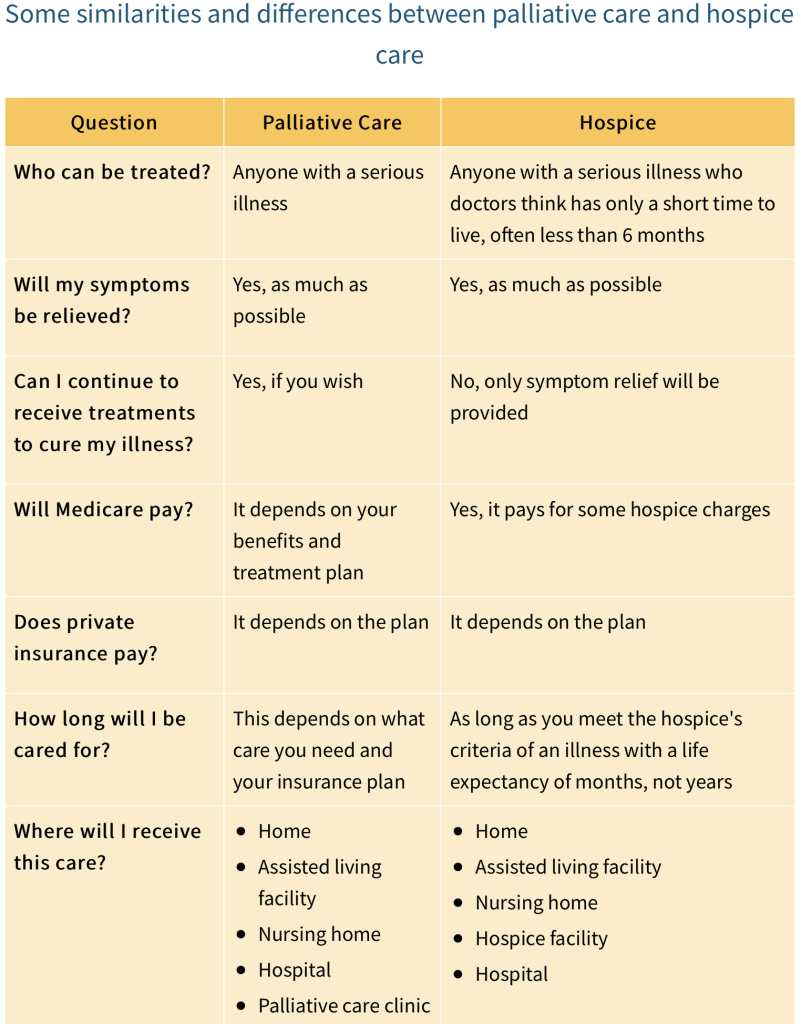
The following two sections in italics “Palliative care” and “Hospice care” are taken from the National Institute on Aging at: https://www.nia.nih.gov/health/what-are-palliative-care-and-hospice-care
Note: I have copied most of the following content verbatim from the link above because the current so-called president (2025-?) is destroying the government department-by-department, so I wanted the following information available here before it likely would be taken down. There is no guarantee that even the above link would survive this current incompetent government.
Palliative care
“Palliative care is specialized medical care for people living with a serious illness, such as cancer or heart failure. Patients in palliative care may receive medical care for their symptoms, or palliative care, along with treatment intended to cure their serious illness. Palliative care is meant to enhance a person’s current care by focusing on quality of life for them and their family.
Palliative care is a resource for anyone living with a serious illness, such as heart failure, chronic obstructive pulmonary disease, cancer, dementia, Parkinson’s disease, and many others. Palliative care can be helpful at any stage of illness and is best provided soon after a person is diagnosed.
In palliative care, a person does not have to give up treatment that might cure a serious illness. Palliative care can be provided along with curative treatment and may begin at the time of diagnosis. Over time, if the doctor or the palliative care team believes ongoing treatment is no longer helping, there are two possibilities. Palliative care could transition to hospice care if the doctor believes the person is likely to die within six months (see What does the hospice six-month requirement mean?). Or, the palliative care team could continue to help with increasing emphasis on comfort care.”
What is palliative care?
“Palliative care is focused on improving quality of life for people with serious illnesses and their care partners. It is available to people of any age who need it, not just older adults. The major elements of palliative care include managing a person’s symptoms effectively and ensuring that their care is coordinated.”
“Palliative care is interdisciplinary, which means that it involves multiple types of doctors and other care providers. These providers work together with patients and their families and care partners to ensure that the treatment plan reflects the person’s goals and values.”
“Palliative care can start as early as a person’s diagnosis or not until later in their illness, and it can occur alongside other types of treatment for the disease. This form of care includes, but is not limited to, advance care planning, end-of-life care, hospice care, and bereavement support.”
Who can benefit from palliative care?
“Palliative care is a resource for anyone living with a serious illness, such as heart failure, chronic obstructive pulmonary disease, cancer, dementia, Parkinson’s disease, and many others.”
“In addition to improving quality of life and helping with symptoms, palliative care can help patients understand their choices for medical treatment. The organized services available through palliative care may be helpful to any older person having a lot of general discomfort and disability very late in life.”
Who makes up the palliative care team?
“A palliative care team is made up of multiple different professionals that work with the patient, family, and the patient’s other doctors to provide medical, social, emotional, and practical support. The team is composed of palliative care specialist doctors and nurses, and includes others such as social workers, nutritionists, and chaplains. A person’s team may vary based on their needs and level of care. To begin palliative care, a person’s health care provider may refer him or her to a palliative care specialist. If he or she doesn’t suggest it, the person can ask a health care provider for a referral.”
Where is palliative care provided?
“Palliative care can be provided in hospitals, nursing homes, outpatient palliative care clinics and certain other specialized clinics, or at home. Medicare, Medicaid, and insurance policies may cover palliative care. Veterans may be eligible for palliative care through the Department of Veterans Affairs. Private health insurance might pay for some services. Health insurance providers can answer questions about what they will cover.”
“Visit the National Hospice and Palliative Care Organization website at: https://allianceforcareathome.org to find palliative care near you.
“In palliative care, a person does not have to give up treatment that might cure a serious illness. Palliative care can be provided along with curative treatment and may begin at the time of diagnosis. Over time, if the doctor or the palliative care team believes ongoing treatment is no longer helping, there are two possibilities. Palliative care could transition to hospice care if the doctor believes the person is likely to die within six months (see What does the hospice six-month requirement mean?). Or, the palliative care team could continue to help with increasing emphasis on comfort care.”
“For more information, check out NIA’s article on Frequently Asked Questions About Palliative Care. https://www.nia.nih.gov/health/hospice-and-palliative-care/frequently-asked-questions-about-hospice-care“
Hospice care
“Increasingly, people are choosing hospice care at the end of life. Hospice care focuses on the care, comfort, and quality of life of a person with a serious illness who is approaching the end of life.”
“At some point, it may not be possible to cure a serious illness, or a patient may choose not to undergo certain treatments. Hospice is designed for this situation. The patient beginning hospice care understands that his or her illness is not responding to medical attempts to cure it or to slow the disease’s progress.”
“Like palliative care, hospice provides comprehensive comfort care as well as support for the family, but, in hospice, attempts to cure the person’s illness are stopped. Hospice is provided for a person with a terminal illness whose doctor believes he or she has six months or less to live if the illness runs its natural course.”
“It’s important for patient to discuss hospice care options with their doctors. Sometimes, people don’t begin hospice care soon enough to take full advantage of the help it offers. Perhaps they wait too long to begin hospice and they are too close to death. Or, some people are not eligible for hospice care soon enough to receive its full benefit. Starting hospice early may be able to provide months of meaningful care and quality time with loved ones. It is important to remember that stopping treatment aimed at curing an illness does not mean discontinuing all treatment.”
What is hospice care?
“Increasingly, people are choosing hospice care at the end of life. Hospice care focuses on the care, comfort, and quality of life of a person with a serious illness who is approaching the end of life.”
“At some point, it may not be possible to cure a serious illness, or a patient may choose not to undergo certain treatments. Hospice is designed for this situation. The patient beginning hospice care understands that his or her illness is not responding to medical attempts to cure it or to slow the disease’s progress.”
“Like palliative care, hospice provides comprehensive comfort care as well as support for the family, but, in hospice, attempts to cure the person’s illness are stopped. Hospice is provided for a person with a terminal illness whose doctor believes he or she has six months or less to live if the illness runs its natural course.”
“It’s important for a patient to discuss hospice care options with their doctor. Sometimes, people don’t begin hospice care soon enough to take full advantage of the help it offers. Perhaps they wait too long to begin hospice and they are too close to death. Or, some people are not eligible for hospice care soon enough to receive its full benefit. Starting hospice early may be able to provide months of meaningful care and quality time with loved ones.”
Where is hospice care provided and who provides it?
“Hospice is an approach to care, so it is not tied to a specific place. It can be offered in two types of settings — at home or in a facility such as a nursing home, hospital, or even in a separate hospice center.”
Read more about where end-of-life care can be provided.
“Hospice care brings together a team of people with special skills — among them nurses, doctors, social workers, spiritual advisors, and trained volunteers. Everyone works together with the person who is dying, the caregiver, and/or the family to provide the medical, emotional, and spiritual support needed.”
“A member of the hospice team visits regularly, and someone is usually always available by phone — 24 hours a day, seven days a week. Hospice may be covered by Medicare and other insurance companies. Check to see if insurance will cover the person’s particular situation.”
“It is important to remember that stopping treatment aimed at curing an illness does not mean discontinuing all treatment. A good example is an older person with cancer. If the doctor determines that the cancer is not responding to chemotherapy and the patient chooses to enter into hospice care, then the chemotherapy will stop. Other medical care may continue as long as it is helpful. For example, if the person has high blood pressure, he or she will still get medicine for that.”
“Although hospice provides a lot of support, the day-to-day care of a person dying at home is provided by family and friends. The hospice team coaches family members on how to care for the dying person and even provides respite care when caregivers need a break. Respite care can be for as short as a few hours or for as long as several weeks.”
What are the benefits of hospice care?
“Families of people who received care through a hospice program are more satisfied with end-of-life care than those who did not have hospice services. Also, hospice recipients are more likely to have their pain controlled and less likely to undergo tests or be given medicines they don’t need, compared with people who don’t use hospice care.”
What does the hospice six-month requirement mean?
“In the United States, people enrolled in Medicare can receive hospice care if their health care provider thinks they have less than six months to live should the disease take its usual course. Doctors have a hard time predicting how long an older, sick person will live. Health often declines slowly, and some people might need a lot of help with daily living for more than six months before they die.”
“The person should talk with their doctor if they think a hospice program might be helpful. If he or she agrees, but thinks it is too soon for Medicare to cover the services, then the person can investigate how to pay for the services that are needed.”
“What happens if someone under hospice care lives longer than six months? If the doctor continues to certify that that person is still close to dying, Medicare can continue to pay for hospice services. It is also possible to leave hospice care for a while and then later return if the health care provider still believes that the patient has less than six months to live.”
Do your homework!
Have you explored hospice yet? Beware! Think before you act! Our son was seen in early 2020 by a very famous ALS doctor, Dr. Richard Bedlack, who told our son that he had better get his affairs in order. So, I spoke to a nearby hospital that offered a hospice program. I had an unsettling experience during the conversation:
The hospice rep said that the program would provide an aide for only 1.25 hours twice a week, a nurse for about 15 minutes twice a week and a doctor on call 24/7. Great coverage or what? Wait, it gets worse. The rep said that if we signed on to the program, we could not see any other doctor, no matter what, including having our son taken in an ambulance to the ER because that would terminate the hospice program, and we’d have to start all over again. No blood samples, no urine samples allowed. The hospice’s responsibility was only to give comfort, nothing else. How would I know if our son had a urinary tract infection if I couldn’t get a urinalysis? (He already had had two infections, plus kidney stones). What about the Botox he needed every three months to keep fasciculations and saliva under control? Nope. They would also go over all his meds and decide which they would allow. There are even medical instruments that would be excluded. After all my objections, the rep told me our son wasn’t ready for hospice. Their job was to hold back almost every treatment and let our son just wither away. Screw them.
Agencies
We spoke to a number of hospice care agencies prior to our son going to the ER. Depending on which agency was administering hospice (hospital, private facility, etc) dictated what prescriptions, treatments, tests, outside doctors, etc., would be allowed or denied. It sounded very cruel, but when there is no quality to someone’s life, it’s probably better than trying to prolong life.
The following quote was from a member of the ALS Facebook group “ALS – Patient and Caregiver tips for every day living” that I belong to, (I no longer have the contributor’s name):
“Medicare regulations are the same no matter what state you live in. The difference is how a particular hospice operates. Many for-profit hospice agencies will deny certain equipment and medications that they feel are not palliative. All comfort items SHOULD be covered. Most hospices will wean patients off riluzole and radicava because they “prolong” life expectancy. They may do so with other medications as well (statins, etc.) Bottom line is that you should make up a list of questions and interview 2-3 hospices in your area to find out which one might suit your needs.”
Death with Dignity
The website for this organization can be found at https://deathwithdignity.org. It gives state-by-state information about the current status of laws related to the right to die with dignity.
M.A.I.D. (Medical Aid in Dying)
(The following law applies in New Jersey, where our son, my wife and I lived. You will have to check your own state’s laws). The Medical Aid in Dying for the Terminally Ill Act (sometimes referred to as “MAID”) became effective in New Jersey as of August 1, 2019. See: https://www.nj.gov/health/advancedirective/maid/
M.A.I.D. allows an adult New Jersey resident, who has the capacity to make health care decisions and who has been determined by that individual’s attending and consulting physicians to be terminally ill and is within 6 months of death to obtain medication that the patient may self-administer to end the patient’s life. (Note all the requirements, plus the words “self-administer” in the preceding sentence.)
There are a lot of restrictions and conditions imposed on a patient’s decision and actual actions to end his or her own life. This act allows a terminally ill patient to end his or her own life, but nowhere in the documentation does it talk about patients like our son who were completely paralyzed and who didn’t have the physical ability to take any medication or steps without assistance. The law as it was enacted in 2019 is useless for paralyzed people. There are so many legal and medical restrictions on this procedure that it almost looks like the law was written by people who were hell-bent on preventing the implementation of the procedure.
A Webinar that we attended in mid-2025 discussed the M.A.I.D. program. It was presented by the Academy of Aid in Dying Medicine, and its website URL is: AADM.org. The speaker was Dr. Robin Plumer.
“The Academy of Aid-in-Dying Medicine is the foremost source of evidence-based best-practice information and teaching for clinicians working with patients considering or completing medical aid in dying. [T]he Academy is the leading national organization that advances, teaches, and supports clinicians to provide expert, attentive care in the states where the practice is now legal.”
The other New Jersey website that was mentioned in the Webinar was: compassionateendingsnj.com.
This second website states that the organization is “The only medical practice in New Jersey specializing in Medical Aid in Dying (MAiD)”. “Enabling terminally ill people to achieve death with dignity”
Here is some information about New Jersey’s M.A.I.D. program from this website:
What is MAiD?
The New Jersey End of Life Options Act was passed in August of 2019. The law provides that a person who has six months or less to live, and is mentally capable of making medical decisions, has the option to request a prescription for medications which they can take in order to end intolerable suffering and to die peacefully. This empowers qualified individuals to end their lives in a dignified and compassionate manner, in line with the principles of self determination and autonomy.
Requirements
The individual must be:
- 18 years or older, and a current resident of the state of New Jersey.
- Terminally ill with a six-month or less prognosis.
- Mentally competent to make medical decisions for themselves without coercion.
- Physically able to self ingest approximately 3 ounces of liquid medications.
What Qualifies as a Terminal Illness?
Examples of terminal illnesses include:
- Metastatic cancer
- Neuromuscular diseases including Parkinson’s disease and ALS
- Advanced heart, lung, liver and kidney disease
Although dementia is considered a terminal illness, this diagnosis does not qualify for MAiD. Mental Health diagnoses also do not qualify for MAiD under New Jersey law.
An interesting question:
I asked Dr. Plumer specifically how someone who is completely paralyzed, like our son was, could end his life if no one is legally allowed to help. She said they get “creative”, while still staying within the law; She said, for instance, that a doctor could give a palliative sedative to help sleep (which is not assisting with terminating a life), but the patient might die as a side effect.
Euthanasia
A palliative nurse wrote to me in September 2025 about her experience with terminally ill patients. She gave me a link in her email to a website that talked about euthanasia and also the legal policies regarding euthanasia in various countries and US states.
Here is her email. It contains an link to a website about euthanasia.
“My name is Brianna, I’ve been a palliative nurse for over a decade, and in that time, I’ve held the hands of countless terminally ill patients in their final days, witnessing them suffer far beyond what any human being should have to bear. I’ve seen eyes staring at me with a silent, desperate plea to make the suffering stop.
“These experiences stay with me. They’re why I believe so deeply in the importance of open conversations about end-of-life choices. Many people don’t realize where euthanasia or assisted suicide is legal, or what it truly means in practice. That’s why I want to share this comprehensive guide I found: https://www.dnaweekly.com/blog/complete-guide-euthanasia-where-how-when-legal/
“If you could feature this resource on your site here: https://www.guidetoals.com/palliative-care-hospice-care-opting-to-end-ones-life/, it might help families facing unimaginable decisions find clarity, comfort, and, most importantly, dignity.
“With respect and gratitude,
Brianna”
V.S.E.D. (Voluntarily Stopping Eating and Drinking)
The following article can be found behind a paywall at: https://www.nytimes.com/2016/10/25/health/voluntarily-stopping-eating-drinking.html
Here’s the full article:
The VSED Exit: A Way to Speed Up Dying, Without Asking Permission
By Paula Spaan, The New York Times, Oct. 21, 2016
“Del Greenfield had endured repeated bouts of cancer over four decades, yet kept working as a peace activist in Portland, Ore., into her 80s. “She was a powerful force,” said her daughter, Bonnie Reagan.
But in 2007, Ms. Greenfield was struggling. She had been her husband’s caregiver until he died that year at 97, never telling her family she was feeling miserable herself. She’d lost much of her hearing. She required supplemental oxygen.
When she fell and broke an arm, “that was the final straw,” her daughter said. “She was a real doer, and she couldn’t function the way she wanted to. Life wasn’t joyful anymore.”
At 91, Ms. Greenfield told her family she was ready to die. She wanted a prescription for lethal drugs, and because she had active cancer, she might have obtained one under Oregon’s Death with Dignity statute for people with terminal illnesses.
Then her son-in-law, a family physician who had written such prescriptions for other patients, explained the somewhat involved process: oral and written requests, a waiting period, two physicians’ assent.
“I don’t have time for that,” Ms. Greenfield objected. “I’m just going to stop eating and drinking.”
In end-of-life circles, this option is called VSED (usually pronounced VEEsed), for voluntarily stopping eating and drinking. It causes death by dehydration, usually within seven to 14 days. To people with serious illnesses who want to hasten their deaths, a small but determined group, VSED can sound like a reasonable exit strategy.
Unlike aid with dying, now legal in five states, it doesn’t require governmental action or physicians’ authorization. Patients don’t need a terminal diagnosis, and they don’t have to prove mental capacity. They do need resolve.
“It’s for strong-willed, independent people with very supportive families,” said Dr. Timothy Quill, a veteran palliative care physician at the University of Rochester Medical Center.
He was speaking at a conference on VSED, billed as the nation’s first, at Seattle University School of Law this month. It drew about 220 participants — physicians and nurses, lawyers, bioethicists, academics of various stripes, theologians, hospice staff. (Disclosure: I was also a speaker, and received an honorarium and some travel costs.)
What the gathering made clear was that much about VSED remains unclear.
Is it legal?
For a mentally competent patient, able to grasp and communicate decisions, probably so, said Thaddeus Pope, director of the Health Law Institute at Mitchell Hamline School of Law in St. Paul, Minn. His research has found no laws expressly prohibiting competent people from VSED, and the right to refuse medical and health care intervention is well established.
Still, he pointed out, “absence of prohibition is not the same as permission.” Health care professionals can be reluctant to become involved, because “they want a green light, and there isn’t one of those for VSED,” he added.
The question grows much murkier for patients with dementia or mental illness who have specified VSED under certain circumstances through advance directives. Several states, including Wisconsin and New York, forbid health care surrogates to stop food and fluids. (Oregon legislators, on the other hand, are considering drafting a bill to allow surrogates to withhold nutrition.)
The question intrigues bioethicists. Can your current competent self cut off nutrition and hydration for your future demented self? In a handful of court decisions, judges have declined to enforce such directives.
Can VSED be comfortable and provide a peaceful death?
“The start of it is generally quite comfortable,” Dr. Quill said he had found, having cared for such patients. The not-eating part comes fairly easily, health professionals say; the seriously ill often lose their appetites anyway.
Coping with thirst can be much more difficult. Yet even sips of water prolong the dying process.
“You want a medical partner to manage your symptoms,” Dr. Quill said. “It’s harder than you think.”
Keeping patients’ mouths moistened and having aggressive pain medication available make a big difference, health professionals say.
At the conference, the Dutch researcher Dr. Eva Bolt presented results from a survey of family physicians in the Netherlands, describing 99 cases of VSED. Their patients (median age: 83) had serious diseases and depended on others for everyday care; three-quarters had life expectancies of less than a year.
In their final three days, their doctors reported, 14 percent suffered pain, and smaller percentages experienced fatigue, impaired cognition, thirst or delirium.
Still, 80 percent of the physicians said the process had unfolded as the patients wanted; only 2 percent said it hadn’t. The median time from the start of their fasts until death was seven days.
Those results mirror a 2003 study of hospice nurses in Oregon who had cared for VSED patients. Rating their deaths on a scale from 0 to 9 (a very good death), the nurses assigned a median score of 8. Nearly all of the patients died within 15 days.
The slower pace of death from fasting, compared with ingesting barbiturates, gives people time to say goodbye and, for the first few days, to change their minds. Several conference speakers described patients who had fasted and stopped a few times before continuing until death.
That’s hard on families and caregivers, though. And slowness won’t benefit people who are dying with severe shortness of breath or pain. “Two weeks is a lifetime in that situation,” Dr. Quill said.
Other obstacles could restrict VSED. A quiet choice in a private home, it could be derailed in nursing homes and assisted living facilities where administrators fear lawsuits or regulatory sanctions. Physicians might decline to participate; home care aides might quit.
Moreover, major religious groups have yet to declare whether they consider VSED an acceptable act of self-determination or a suicide, anathema in most faiths.
Phyllis Shacter and her husband, Alan Alberts, a computer scientist who received a Alzheimer’s disease diagnosis in 2011, had few doubts, however. VSED allowed him to escape the disease that had slowly killed his mother.
No state allows a person with dementia to use a “death with dignity” law, but with support from his wife, doctor and two caregivers, Mr. Alberts, 76, died peacefully at home in 2013 after a nine-day fast.
“I’m glad my husband fulfilled his desire not to live into the final stages of Alzheimer’s,” Ms. Shacter said.
On the other hand, Judith Schwarz, clinical coordinator of End of Life Choices New York, told of an 81-year-old attempting VSED with inadequate pain medication, crying out to his wife at night, “I’m dying of thirst.”
“And of course, he was, but slowly,” Dr. Schwarz said. “This was a horror show.”
Del Greenfield fared better. “She didn’t use any medicines, just some oxygen,” her daughter said. Ms. Greenfield’s children, grandchildren and great-grandchildren came to see her, and “she was completely peaceful, chatting and joking and telling people she loved them.”
She announced that she had one regret. “We all leaned in,” Bonnie Reagan said. “And she said, ‘I wish I’d seen the Rolling Stones the last time they came to Portland.’”
On the fifth day of fasting, “she just fell asleep,” and died about 36 hours later.”
V.S.E.D. causes death by dehydration, usually within seven to 14 days. To people with serious illnesses who want to hasten their deaths, a small but determined group, V.S.E.D. can sound like a reasonable exit strategy.
Unlike M.A.I.D., legal in only five states, V.S.E.D. doesn’t require governmental action or physicians’ authorization. Patients don’t need a terminal diagnosis, and they don’t have to prove mental capacity. They do need resolve. The slower pace of death from fasting, compared with ingesting barbiturates, gives people time to say goodbye and, for the first few days, to change their minds. The advantage of V.S.E.D. is that a patient who is paralyzed, like our son was, can chose this method.
End of Life Option Act (in California)
There are probably many other states with similar laws. https://www.cdph.ca.gov/programs/chsi/pages/end-of-life-option-act-.aspx
A cautionary tale
A woman who belonged to the CCALS (Compassionate Care ALS) ((https://ccals.org) support group (for those who have lost loved ones to ALS) told us a disturbing story. Her husband was an ALS victim and was on hospice care at home when he died overnight with just the two of them at home. She called the authorities who brought the police to her home. The police immediately assumed she had killed her husband and began questioning her. Not until she had brought in some people who knew the circumstances of her husband’s illness did they drop the accusations.
A scary question
So here is a scary, unsettling question for those who are, or were, caregivers to victims of ALS. As I wrote at the beginning of this document, we lost our 42-year old son to this horrible disease on 10/29/21 and we saw what he went through. So, knowing what YOU now know about the physical, emotional, and mental suffering of ALS victims, and the toll it also takes upon the caregivers, and that there is no cure, what would YOU do if you woke up tomorrow with ALS symptoms?
Related articles on this website
Get Your Affairs in Order:
https://www.guidetoals.com/get-your-affairs-in-order-gyaio/
Organ and Brain Tissue Donations:
https://www.guidetoals.com/organ-and-brain-tissue-donations/
Patient Advocates:
https://www.guidetoals.com/patient-advocates/
