
The ALS patient is dependent on numerous pieces of medical equipment (oxygen generators, suction equipment, ventilators, cough assists, nebulizers, dialysis equipment, refrigerators for meds and food, etc.). What options for backup electrical sources could you have in place to keep electrical equipment operating before you lose power during an electrical outage?
(In addition to keeping electrical equipment running, you should already have contingency plans in place that have notified the police, power company, neighbors, family, friends, etc., that there is someone who will need help during an outage.)
Types of generators
There are three basic types of generators:
- whole house generators,
- portable generators,
- inverter generators.
The following text is from:
https://www.homedepot.com/c/ab/generator-buying-guide/9ba683603be9fa5395fab9054dc2520:
Whole house generators (home standby generators) are the best generators for home use. They are designed to provide ample power for your appliances and HVAC systems.
Portable generators are often used on job sites to power air compressors, nail guns, saws, hammer drills and other equipment. Most are loud, but there are quiet portable generators too.
Inverter generators are ideal for camping, boating and other recreational activities. They operate more quietly than other generators and provide power for lights, heaters, fans, radios, smart phones and more.
Here’s a link to a December 2025 Consumer Reports article about the first two types of generators that gives the pros and cons (It didn’t discuss inverters):
Whole-house standby generators
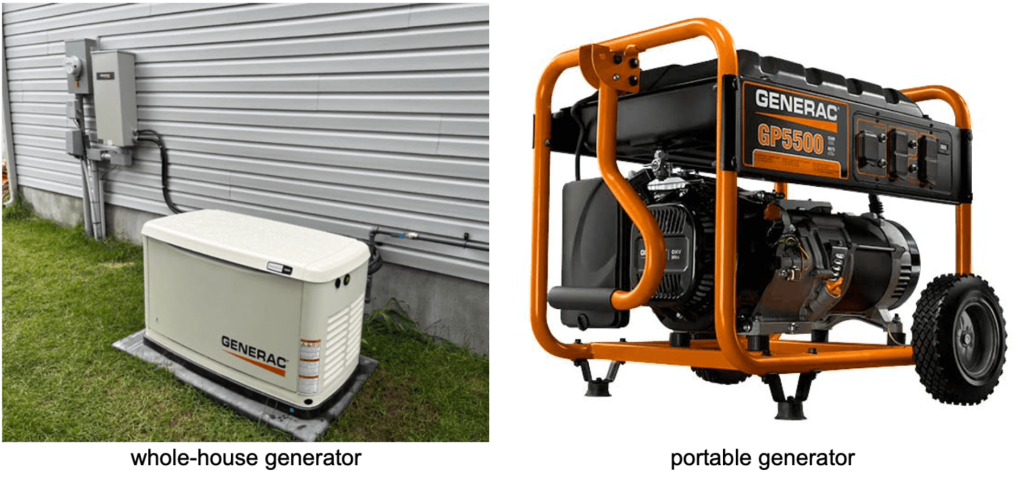
In the fall of 2012, we were hit by the full wrath of Hurricane Sandy (our house is in NJ, about 20 miles west of New York City). My wife and I were without electricity for a week. Early in 2013, we had a Generac whole-house standby generator installed in our yard on the side of house, https://www.generac.com/residential-products/standby-generators/. Ours provides 20kW (20 kiloWatts), which can also be expressed as 20kVA (20 kiloVoltAmps). (I don’t see that model on Generac’s website anymore.)
Generator output
Note: For those of you who don’t understand the output ratings of the generators in the link above (for example: 10kVA, 10kW, 14kW, 18kW, and much higher), here’s a brief explanation of the first two ratings: 10kVA and 10kW I just listed:
The “10kVA” means “10 kiloVolt-Amps”, and the “10 kW’ means “10 kiloWatts”. The “k” simply means “kilo”, which is just the value 1000.
A simple formula will help you with this:
10kVA = 10kW
This can also be written as:
10 x kilovolts x amps = 10 kiloWatts
This means that 10kVA is exactly the same as 10kW.
Overloading a circuit
An electric circuit is rated by its amperage; the symbol is “A”. Most of the circuits in our house supply 15 amps (15A); some supply 20A for big appliances. Appliances (radios, microwaves, light bulbs, hair dryers, toasters, electric heaters, computers, etc) should have labels on them telling how many volts and amps or watts they need.
Have you ever tripped a breaker or blown a fuse in your home immediately after running something like a hair dryer and didn’t know why? You don’t want to trip a breaker on your generator, so here’s how to avoid overloading it:
First example: My radio needs 2.8 amps to run. Can I plug it into a 15 amp outlet? Yes. A 15 amp outlet will easily run that radio because 2.8 amps is much less than 15 amps. I could even run 5 of those radios on that same outlet (if I could plug that many in) because 5 x 2.8A = 14A, which is still less than 15 amps. If I tried to operate 6 radios on the circuit, the breaker will trip because 6 x 2.8 = 16.8 which will overload the circuit.
Second example: if you are using a 10 amp hairdryer on a 15 amp circuit, that’s OK, because the breaker won’t trip, (unless the hairdryer has a problem). But if you then also plug a 15 amp toaster into the same circuit and turn it on, the breaker will trip because 10 amps + 15 amps = 25 amps, which is a more than the circuit can handle.
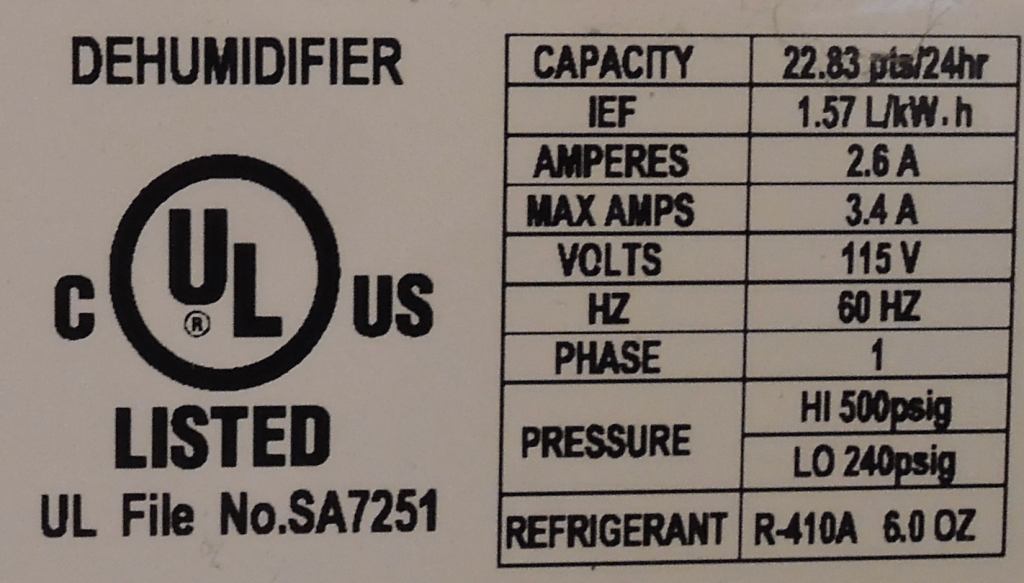
Third example: Reading an appliance label: In the photo below, you can see part of the label from my basement dehumidifier. The unit runs on 115 Volts and needs a minimum of 2.6 amps, but it can draw a maximum of 3.4 amps. It can safely run on 10-, 15-, and 20 amp circuits. For those who are interested, the maximum wattage it needs is 115 V x 3.4 A = 391 Watts, which is only 0.391 kW! So a generator could easily run my dehumidifier, but during an outage, I would turn off this appliance.
Choosing a whole-house generator
Generators become very expensive as their power outputs increase, so you have to discuss your needs with the sales rep. My wife and I discussed our needs with a Generac sales guy and realized there were large appliances we didn’t have to run (or could do without) during a power outage, so our generator doesn’t cover the whole house. For instance, we didn’t need to use our electric oven during an outage; we could still cook in our microwave and on our gas stovetop. Our bidets won’t work during an outage because the generator is not connected to those circuits, either, but the toilets still work. If I did want my electric oven connected, I might have needed a bigger, more expensive model. Not connecting those appliances and circuits kept the purchase price down. We paid $12,000 for everything back in early 2013. (Our generator was installed about five years before our son got ALS and had to move in with us in mid-2018.)
Our generator uses the same natural gas that our water heater and stove use, not liquid gasoline, so I never have to run to a gas station, wait on lines, fill gasoline cans, rush home, and then pour the gasoline into a tank to run the generator. I don’t have to keep gasoline-filled jerry cans at my home.
One cautionary statement I heard when we were purchasing our whole-house generator was that as more and more homes have generators installed, the demand for natural gas during a power outage may overwhelm the ability of the gas companies to supply natural gas to the homes.
The Generac was “hard-piped” to the house, meaning gas fed the generator through iron pipes running from our gas supply in the basement out through the basement wall to the generator. I didn’t have to run electric cords in through a window to connect a portable generator to some appliances. The Generac was set up to self-start every Sunday at 1 PM and run for 10 – 15 minutes.
The Generac will start up automatically within a few seconds of a power outage. The Generac has since kept us powered through numerous outages, some of them quite lengthy. It is noisy, regardless of what the Consumer Reports article says. Maybe newer models are quieter. On the Generac website, I learned that some of the models need apps or WiFi to run, but my generator doesn’t. I don’t know if an app or a WiFi router still has to be operational to control a generator during an outage. If I had to replace my generator, I still would not like one controlled by an app.
I needed a permit from my town prior to having it installed, and the installation had to conform to electrical- and building codes and had to be inspected by the town after installation. It must be placed correctly so it’s not too close to the house, and should not annoy neighbors, but the placement also is dictated by where the main electrical panel and natural gas source are in the house so the installers can use the shortest connections possible. I would have preferred the generator to be installed behind my house and out of sight, but the iron piping and wiring would have been very long.
I strongly suggest you get a maintenance contract and yearly inspections from an authorized service company because the generator is essentially a car engine, so parts will wear out and need replacement. My Generac enclosure has two lockable covers. There is a small lockable door covering an outlet so I can plug something into it when it’s running. The service guys have keys to unlock the main enclosure when they have to work on it. I have the same keys, too. The main enclosure is opened just like my car’s hood is opened.
Maintenance
You still have to be vigilant about the inspections and check the work afterwards, (which I never did), much to my chagrin. We had a power failure in mid-, or late-, 2025, but our Generac didn’t kick on, so I called the service company. The service guy discovered that the casing of the generator’s battery, which was just plastic, had cracked open sometime after my last inspection in early 2025 and all the battery acid had leaked out! Fortunately, the battery stood in a plastic tray, so the acid didn’t run all over the place. The battery and the tray were completely empty, so I have no idea where the acid went, because sulfuric acid can’t evaporate or dry up. Incredibly, one of the two battery cable clamps was not even on the battery post. That could not have happened without human intervention. The service guy was the only one who ever worked on it. The battery was the original one from 2012, so it was already 13 years old when the Generac failed. I’ve never had a car battery last more than 4 – 5 years. If even one of the maintenance guys over the past 13 years had been on the ball, I should have been told it had to be replaced years earlier.
Theft of electricity
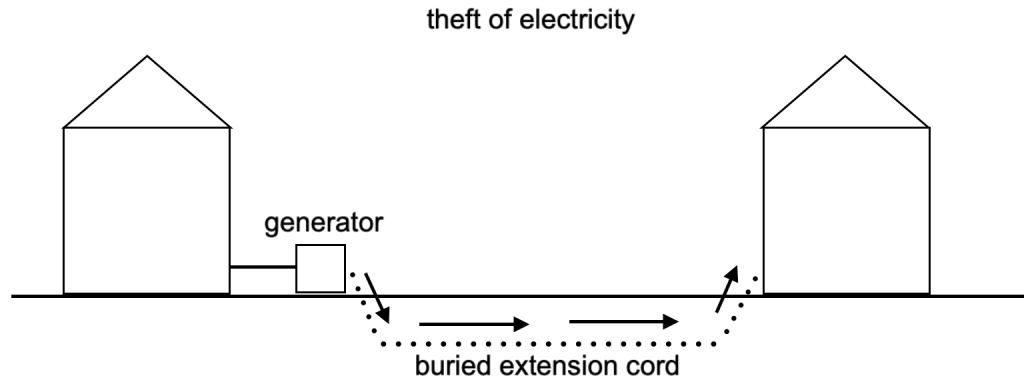
A friend told me about a homeowner who owned a whole-house generator. The homeowner had discovered that his next-door neighbor had surreptitiously connected his own house to the homeowner’s generator with a long extension cord. (See drawing below). The neighbor even buried the cord in the ground to hide most of it. The neighbor was stealing electricity from the homeowner’s generator during power outages, and it was costing the homeowner money, plus wear and tear. The neighbor always had power during an outage! The homeowner cut the cord as soon as he discovered that. Nice, huh? That’s theft. Our generator’s outlet is covered by a lockable door, and I’ve always had a weatherproof padlock on it.
Portable standby generators
There are many brands of portable generators available. They are rated by how much power they can supply and the size of the tank. Before you get a portable one, look for reviews on the Web. Try to figure out how much electricity you will need to run all the essential equipment in your house. Remember, the generator will need fuel, just like a vehicle. The more equipment you run on it, the faster the fuel will be consumed.
Portable generator options
Here are some features to consider when buying a portable generator:
| Customer ratings | What do buyers or testers think of the model? |
| Power Source | Single fuel (propane, gasoline, diesel)? Dual fuel? (both propane and gasoline) Solar? Backup battery option |
| Output Power Wattage | For example: 4000W peak, 2000W running Option of 120V/240V |
| Run Time | How many hours? |
| Fuel | What size tank does it have? |
| Outlets | Does the generator have AC, DC, USB, USC outlets and how many of each? |
| Parallel Capable | Yes (tThis means you can couple two identical generators together in parallel to get more power.) |
| Weight | How heavy is it? |
| Dimensions | How big is it? |
| Kind of portable generator | Inverter or not? |
| Wheels? | Yes or no |
Transfer switch
From Consumer Reports: https://www.consumerreports.org/home-garden/generators/portable-generator-needs-a-transfer-switch-a1069571021. “The generator should have a transfer switch—a device that allows you to use your generator to power entire circuits in your house—without the hassle and potential dangers of relying on extension cords. “It’s not only less safe to run a generator without a transfer switch, but you limit the devices your generator can power. A transfer switch will let you power things on your circuit breaker panel, including hardwired appliances like a water heater or well pump.”
In-Vehicle inverters
I had never heard of an inverter until our son bought a used accessible Dodge Caravan from a dealer in Fairfield, NJ (https://drivemastermobility.com) and had an inverter installed. (See photos of the van in my article: https://www.guidetoals.com/transportation-and-als/). He very wisely had an inverter with two 110-volt AC receptacles installed under the driver’s seat for all his ALS-related equipment (cough assist, suction device, nebulizer, and ventilator) and other contingencies. This was very handy. The van had to be running to operate the inverter. For instance, our son’s ventilator had a backup battery in it so it could run on its own, but the battery drained very quickly, so we were glad we were able to plug the ventilator into the invertor and run it on 120 Volts AC when we were on the road, or in a parking lot.
Hybrid and fully-electric vehicle sources
I’ve heard stories about people who own hybrid vehicles who connected their cars to appliances in their homes so they had some power during outages. If the gas tank ran low, the owner could just drive to a gas station and refill the car’s tank, or if a patient required equipment to be running, the car owner could refill the car’s tank from a gas can. I don’t know if fully-electric vehicles are equipped to do that because eventually the car’s batteries would just run down and the cars would just stop running.
Here’s a question I found on the website Quora:
Question: Can I run my household off the battery in my hybrid SUV?
Answer: “Most older hybrids aren’t capable of bi-directional charging, so for the vast majority of them, the answer is no, except through the workaround detailed in one of the other answers (inverter in 12V socket with vehicle in Neutral to keep engine coming on when the battery gets low). The newest generation of hybrids (2020 on) will just allow you to run a cord to a handy outlet in the bed or the back, or allow you to reverse the charge flow at the charger. One thing that you need to make sure of is that power is not flowing back into the grid. Electrocuting a lineman who’s not expecting an energized circuit is a bad outcome. It’s worth it if you plan to have a generator, battery, or any other kind of power backup in place to have a cutoff switch. This is only if you’re attempting to run the house on your car or a generator in some way. If you’re just plugging a fridge in via a converter, then the circuit involved isn’t connected to the power grid anyway.
