
Accessible bathrooms in public and commercial places
The so-called accessible bathrooms and stalls out there are usually jokes:
- Many are dirty and poorly lit.
- The toilet paper is usually unreachable.
- In some, the grab bars are poorly placed.
- Some stalls are too small for a powerchair.
- Many toilets are too low.
- Some are difficult to approach.
- There are no bidets.
Related links
Here are links to related articles I wrote for this website:
Constipation, elimination, and urination:
https://www.guidetoals.com/constipation-elimination-and-urination/.
Bidets, washlets, and bathrooms:
https://www.guidetoals.com/bidets-washlets-and-bathrooms/
Before you flush any toilet, back away from the area so you won’t be hit with any spray. Even if you can’t see the spray, it is there. Some of the bacteria in the toilet become airborne. Unfortunately, in public bathrooms, there usually are no lids.
My son’s personal experiences
One “accessible” restroom I took my son into didn’t have enough room in front of the toilet to approach it easily.
While using some public urinals that didn’t have grab bars, our son had to hold onto the piping on top of the urinal while I braced him from behind.
A doctor’s office I once took him to had such a tiny restroom that my son couldn’t fit into it at all in his push wheelchair. When I told the doctor, he just said to ask one of his staff to help hold my son up at the toilet. Nice, huh?
A piano bar in New York City had a very tiny men’s room. When my son needed it, I had to stand him up and hold him from behind with one arm wrapped around his waist, while he stood there and peed. I couldn’t even close the door behind me to give him some privacy. Nice.
Our son’s book, “Never Say Invisible”, available at: https://www.amazon.com/Never-Say-Invisible-Memoir-Living/dp/195486101X , detailed the difficulty he had using the restroom on an El Al flight: his walker wouldn’t fit well between the rows of seats as he made his way to the restroom. Once he got to the restroom, I had to hold him up from behind, unzip him, and aim, but I couldn’t close the door behind me while he was peeing because I couldn’t fit in the restroom with him; I was in the hallway. The book also told about the time our son had to use the restroom in a hotel lobby (he was still on crutches). One crutch slipped out from under him because the floor was wet. He fell and hit his head on a urinal. He had trouble getting his cellphone out of his pocket because his hands were already curled from ALS.
There were times our son just “held it in” until we got home if he couldn’t use the restroom.
For using public, so-called accessible stalls, I had a routine to help our son urinate while he was still able to stand (with my assistance; see image below):
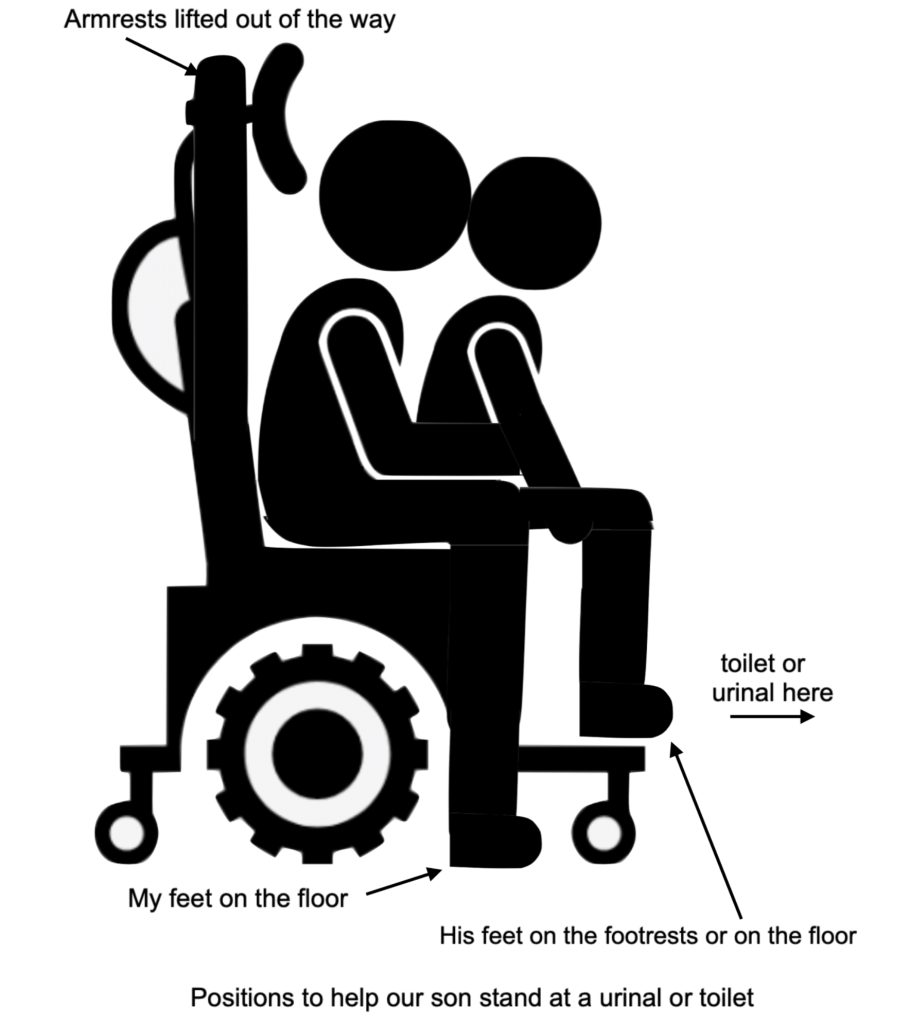
Steps:
- I drove him and his power chair into the stall. I also brought his walker into the stall in case there were no grab bars. (Some stalls had grab bars on both sides of the urinal or toilet, so he could hold those, while I steadied him from behind).
- I straddled the walker around the toilet (if it fit) because the grab bars in the stalls were usually too far apart.
- I then drove him while he was still in his chair up to the walker.
- I folded the footrests of the powerchair up and out of the way so I could place his feet on the floor.
- I lifted the chair’s armrests out of the way.
- Then the hard part came: While he was still seated, I slid him forward slightly if possible to make a space behind him for me to get in there.
- I straddled his powerchair just behind him and sat down.
- I lifted him up from behind in a bear hug.
- I placed his hands on the top rails of the walker. (His hands were so weak that he could not actually grip the walker; he just rested his hands there). I had to make sure his hands didn’t just collapse and rotate off the top rail of the walker.
- I stood right behind him with one arm wrapped around his waist for support while I unzipped his pants and helped him pee.
- When he was finished, I closed his pants, sat him down, climbed out from behind him, lowered the footrests, and placed his feet on them, and lowered the arm rests.
I sometimes had to help him use one of those typical wall-mounted urinals in a public restroom. There was no privacy. Standing him up was the same as I described above, but I could not position a walker for him to use and it was more difficult keeping him steady when we were dealing with a urinal. Sometimes I was able to wrap his hands around the pipes mounted at the top of the urinal, but he hated that and it was dirty.
I took our son into an airport restroom once. The handicap stall was occupied and we waited quite a while for the customer to come out, but the bastard was not handicapped. We were both pissed off.
Our son tried a urinal bottle, but he was usually too tensed up to pee. We also had a portable battery-operated bidet by Toto that we used for his #2 and it was very difficult to get it behind him and aim it. See photo below. There are other brands on the market now besides this one.

Caregivers helping in restrooms
There are printed signs (see below) that a caregiver can hang on the outside of a stall door in a public restroom for the opposite sex to notify the other patrons in that restroom that a woman is in there helping a male or vice versa.
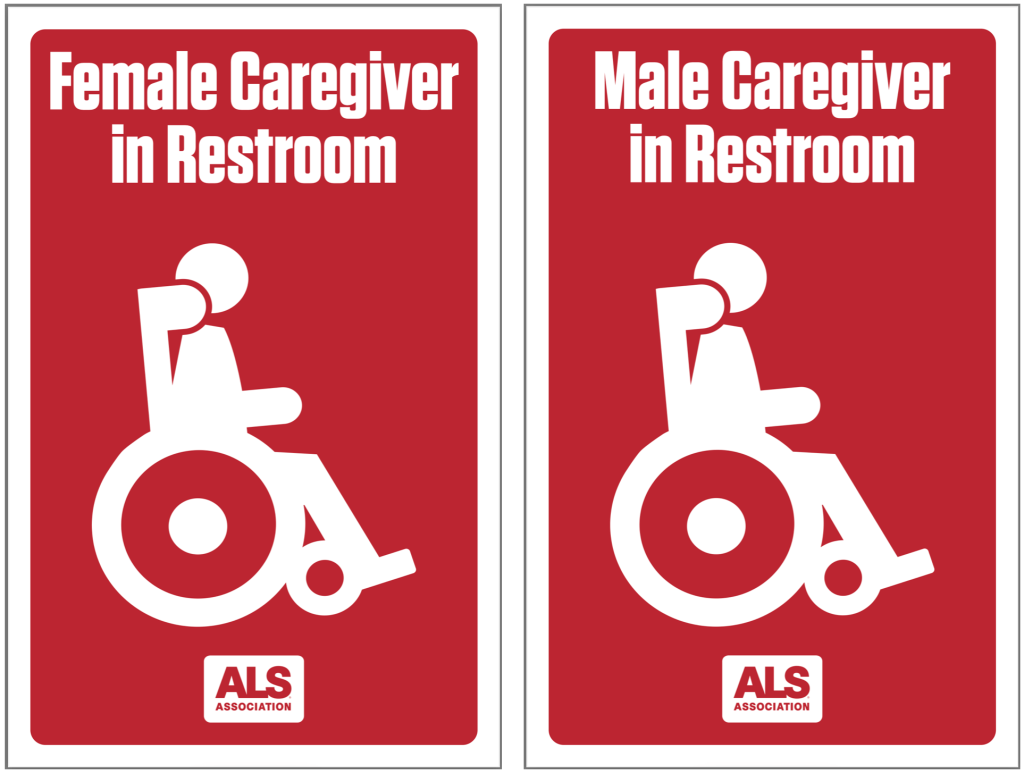
https://www.als.org/sites/default/files/2022-04/Restroom-Sign_Male.pdf
https://www.als.org/order-portal/material/caregiver-restroom-sign-female
Our son had flown with a female friend to Colorado early in his diagnosis (while he still used a push wheelchair). She actually took him into men’s rooms to help him pee. He had also flown to Florida with two other female friends before he got his power chair and they also took him into men’s rooms to help him. Very early in our son’s ALS journey, and while he was still using a push wheelchair, he went with two female friends to DisneyWorld in Florida. When he had to use the restrooms there, one of his friends had to take him into the men’s room and help him.
I was once on a long-distance trip with our son and he needed a restroom. I found a gas station with a restroom that was in a separate building from the gas station. It was accessible, but it only had a one-seater and one urinal. While I was helping him, some individual needed the restroom but I could not let go of my son, nor unlock the door. The guy became angry and began banging on the door. I shouted “we will be finished soon”, but I realized he must have misinterpreted that and left. Just as well. I didn’t need any kind of confrontation.
ADA websites
Here links to ADA websites. Below the links are some excerpts from that site.
https://adata.org/factsheet/ada-and-caregivers
“Can caregivers accompany a person of the opposite gender into a public restroom?”
“Caregivers of the opposite gender may be able to accompany a person with a disability into a gender-specific public restroom, but it may depend on a number of factors, and may require getting employees at the location to help by checking on whether the restroom is occupied, waiting until it is empty, and ensuring that no one else enters while it is being used by the individual and the caregiver.”
“This may be easier where there are single-user restrooms, or where the facility is not very crowded or busy. However, it may be more challenging at busier facilities, those with multiple toilet stalls and/or urinals, or those that include changing or showering elements (such as at a fitness facility) where users spend more time in the space.”
