
Definition of Constipation (Mayo Clinic)
From: https://www.mayoclinic.org/diseases-conditions/constipation/symptoms-causes/syc-20354253:
“Constipation is a problem with passing stool. Constipation generally means passing fewer than three stools a week or having a difficult time passing stool. Constipation is fairly common. A lack of dietary fiber, fluids and exercise can cause constipation. But other medical conditions [my bolding] or certain medicines may be the cause.”
“The muscles that hold up organs at the bottom of the torso are called the pelvic floor muscles. The ability both to relax these muscles and to bear down are necessary to pass stool from the rectum. Problems with weakness or coordination of these muscles can cause chronic constipation.
“Symptoms of constipation include:
- Fewer than three stools a week.
- Hard, dry or lumpy stools.
- Straining or pain when passing stools.
- A feeling that not all stool has passed.
- A feeling that the rectum is blocked.
- The need to use a finger to pass stool.”
ALS is one of the “other medical conditions” mentioned above. ALS weakens or destroys the muscles necessary to pass stool. Some or all of the symptoms mentioned above may occur.
For information on bidets and medications we gave our son for relieving constipation, please go to my website article at: https://www.guidetoals.com/bidets-washlets-and-bathrooms/.
For information on medicines we tried for eliminating #2, please go to my website article at: https://www.guidetoals.com/real-and-fake-medications-and-treatments/.
Our son’s issues with constipation
As our son’s ALS worsened, he had trouble eliminating both #1 and #2. He had read a lot about ALS and knew it was due to weakened muscles in his intestines and bladder area; his body just could not move the waste along, and he could not exert pressure to help move it out, either. Hardened stool wasn’t the issue for him. (Some ALS sufferers and their caregivers who have posted on the FaceBook group “ ALS – Patient and Caregiver tips for every day living“ encounter the opposite problem: wetting and/or soiling clothing because the patient’s muscles can’t keep anything in until the patient can get to the toilet). We had that issue with our son only once, and with our SureHands ceiling lift (see discussion and photos further down), we were able to move him into his accessible shower and rinse him completely clean.
Our son once spent six hours in the bathroom waiting either for gravity to help move the waste downwards, or, for the food higher up in his stomach converting to waste to help push things along. Caregivers and ALS sufferers have attributed the inability to eliminate to hardened stool, so they give laxatives, suppositories or stool softeners, but these were ineffective for our son.
Our son was only given meals (pureed food from https://www.realfoodblends.com, not chemicals) through his feeding tube. We added to each meal two over-the-counter stool softener/sennoside pills. Also, in every meal he got prune juice, plus other liquids such as Gatorade, tomato juice (not V8: too salty), kefir (to supply needed microbial stuff) and water. Breakfast, lunch, and dinner usually had plenty of water present. Our son almost never had hard stools; his intestinal muscles were just shot.
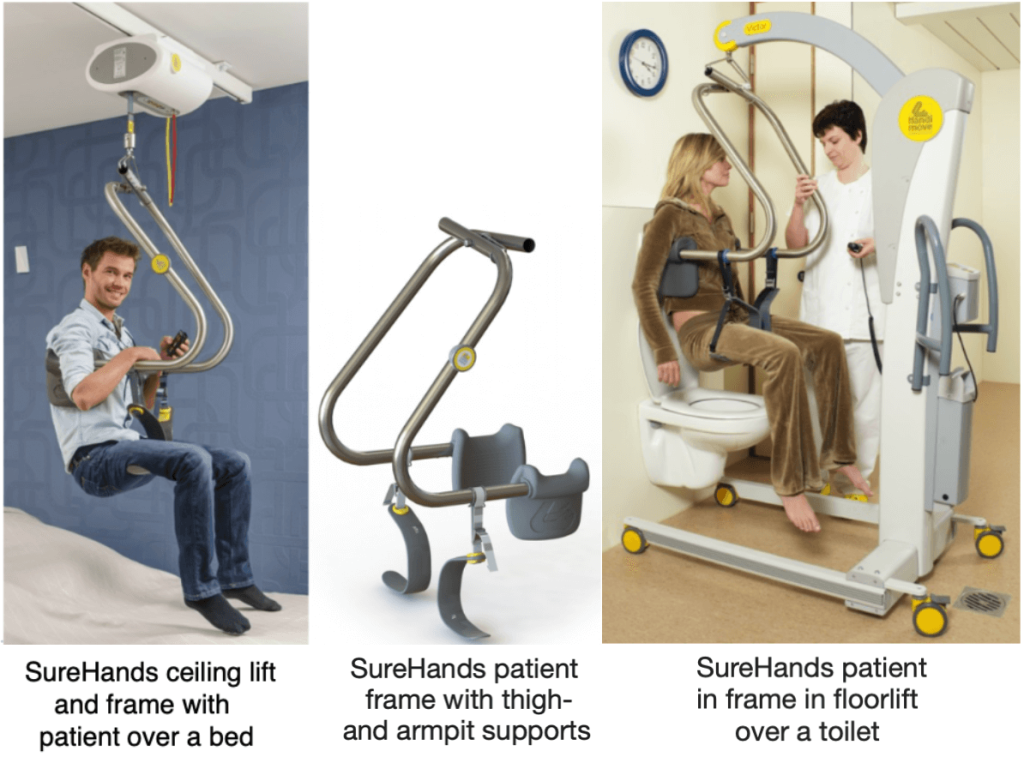
Some ALS sufferers and their caregivers on the FaceBook group mentioned above have complained that the ALS sufferers, besides being constipated, have no appetites, regardless of the reason. If the waste is not being eliminated, the intestines are full, so food in the stomach can’t get into the intestines. This is just like trying to get into or through a tunnel full of stopped cars which aren’t moving because there’s an accident ahead. No cars can enter until the cars ahead in the tunnel can exit. Almost every time our son had troubles passing waste, we gave him enemas while he was suspended on the SureHands ceiling lift with the metal frame assembly. (More information about our ceiling lift can be found on this same website at: https://www.guidetoals.com/patient-lifts/.)
The ceiling lift and metal frame we had are shown in the left- and center photos from the SureHands website below. (A rolling SureHands floor version of the ceiling lift is shown in the right-hand photo). I don’t know if a non-SureHands rolling lift would hold the SureHands frame correctly. (Just like you probably can’t use Chevy parts in a Dodge.) You can see how the patient’s butt area is fully available for manual- or bidet cleaning, Note: Our son had found that the thigh supports were not comfortable for long periods of time and because our son could not sit upright in the frame, a lot of his weight sagged onto the two armpit supports. Not like the smiling guy on the left.
Water requirements with laxatives, stool softeners, fiber-containing foods, medicines
The trouble with laxatives, stool softeners (such as Miralax and the much cheaper generic versions of this) and even fiber-containing foods like dates, prunes, raisins, prune juice, etc., is that all of these treatments need liquid in the stomach and intestines to work. Some of these work by absorbing water, then swelling up while mixing with the food in the stomach, so the waste is softened. Some are medicinal, so they don’t absorb water, but they still need water to work. If you don’t take enough liquids with these foods and treatments, they end up drying out all the waste and making the waste harder and more difficult to pass. You have to make sure the patient is getting enough liquid. An analogy: if you put a very dry sponge into a bowl containing some cereal mixed with just a little water, the sponge will soak up everything and leave a thick or dry paste or mud. Now it will be difficult to clean out the bowl. But, if you put a very dry sponge into a second bowl containing some cereal mixed with a lot of water, the sponge will soak up water until it can’t soak up even one more drop, and there will still be plenty of water in the bowl to keep the cereal soft and moist. You can clean out the bowl easily.
It could also be that one of the ALS patient’s meds is causing constipation. If the patient is in a facility of some sort, you probably should review what the staff is feeding the patient. If they’re just pouring those cartons of white watery chemical concoctions into a gravity feeding bag, or syringing it through a feeding tube, that might be part of the problem, too. No one at these facilities cares other than to be paid.
Suppositories work at the other end of the digestive tract, so they don’t necessarily need water to work.
Urination
Female urination devices
We obviously had no experience with female urination problems or equipment, so I can’t critique any devices, but from my search on the Web, I’ve found and listed two female invasive (“indwelling”) devices and three female non-invasive (external) devices.
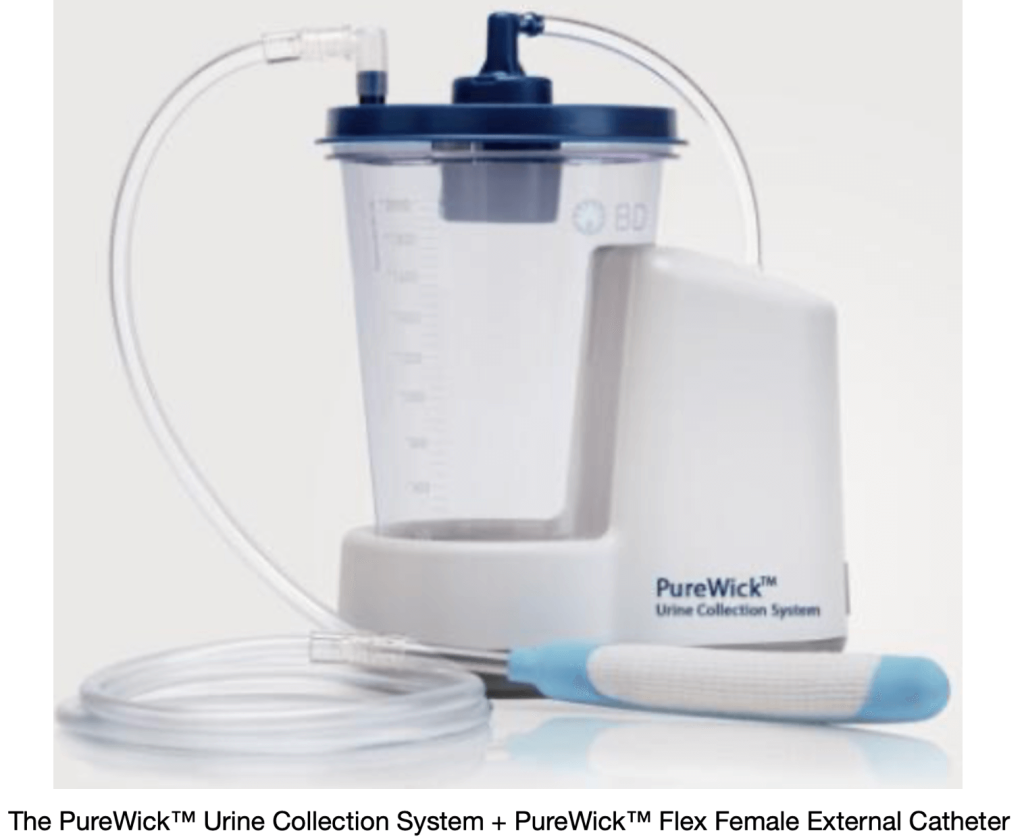
The PureWick™ Urine Collection System with the PureWick™ Flex Female External Catheter
This device is probably for home use only because of its size and bulkiness. (See photo below.). https://www.purewickathome.com/purewick-for-female.html. (Sorry for the graininess of the photo; the website only had a small photo of it.)
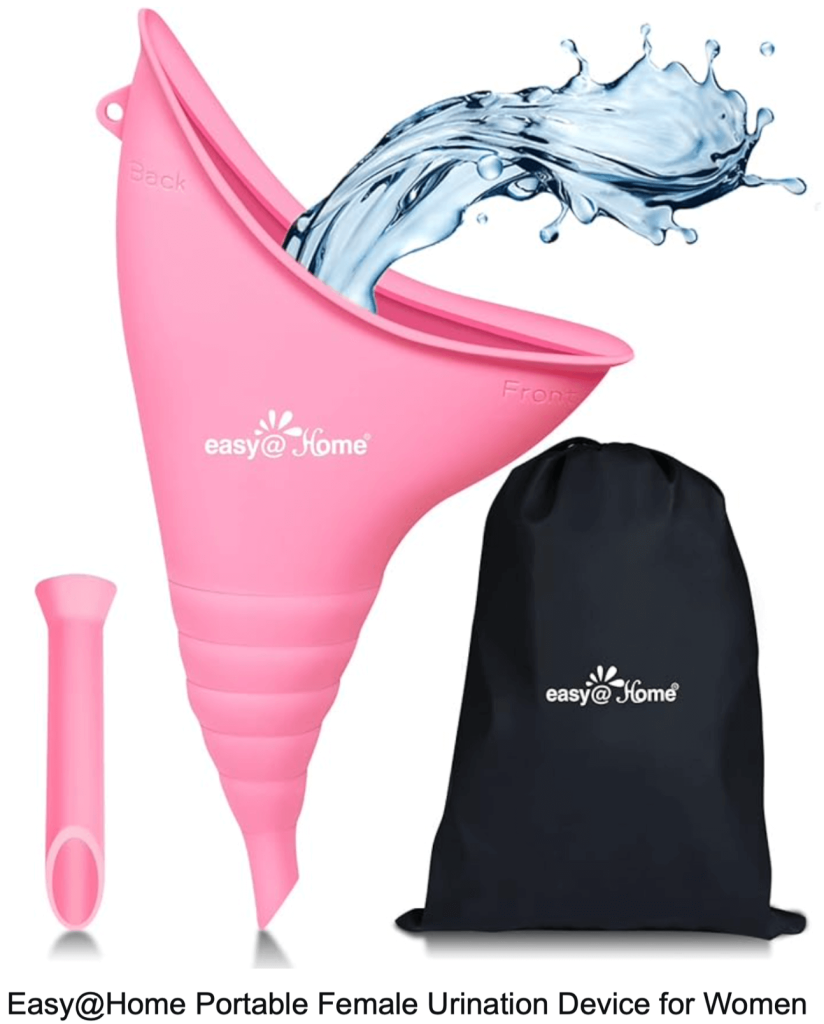
The Easy@Home Portable Female Urination Device for Women
https://www.amazon.com/Portable-Female-Urination-Device-Women/dp/B09SHHM136. (See photo below.)
There seemed to be many similar devices like one below that are essentially funnels that allow urine to be directed into a receptable, or even onto the ground while standing up, etc. Many of the ads for these even show a woman standing and peeing, but for a female ALS sufferer, the device must be usable while sitting.
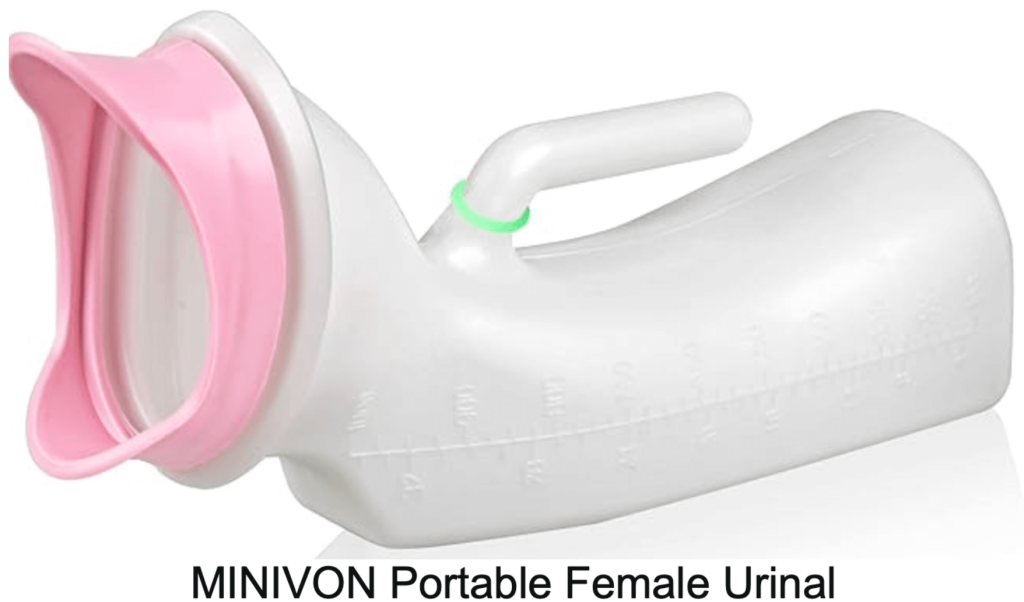
The MINIVON Portable Female Urinal
I saw only a few urine collection devices on the web. The online advertisement claims this device is usable while lying in bed. https://www.amazon.com/Portable-Elderly-Urination-Contoured-Collection/dp/B099Z42Z1Q.
Invasive urination devices for females
Intermittent
From: https://www.nhs.uk/conditions/urinary-catheters/types/:
“In most cases, intermittent urinary catheters are recommended. These catheters are inserted several times a day, for just long enough to drain your bladder, and are then removed. You should be taught how to insert the catheter yourself. It’s usually inserted into your bladder through the urethra (the tube that carries urine out of your body). The sterile catheter is usually pre-lubricated, to reduce the risk of any discomfort when you insert it. One end of the catheter is either left open-ended, to allow drainage into a toilet, or attached to a bag to collect the urine. The other end is guided through your urethra until it enters your bladder and urine starts to flow. When the flow of urine stops, the catheter can be removed. A new catheter is used each time.”
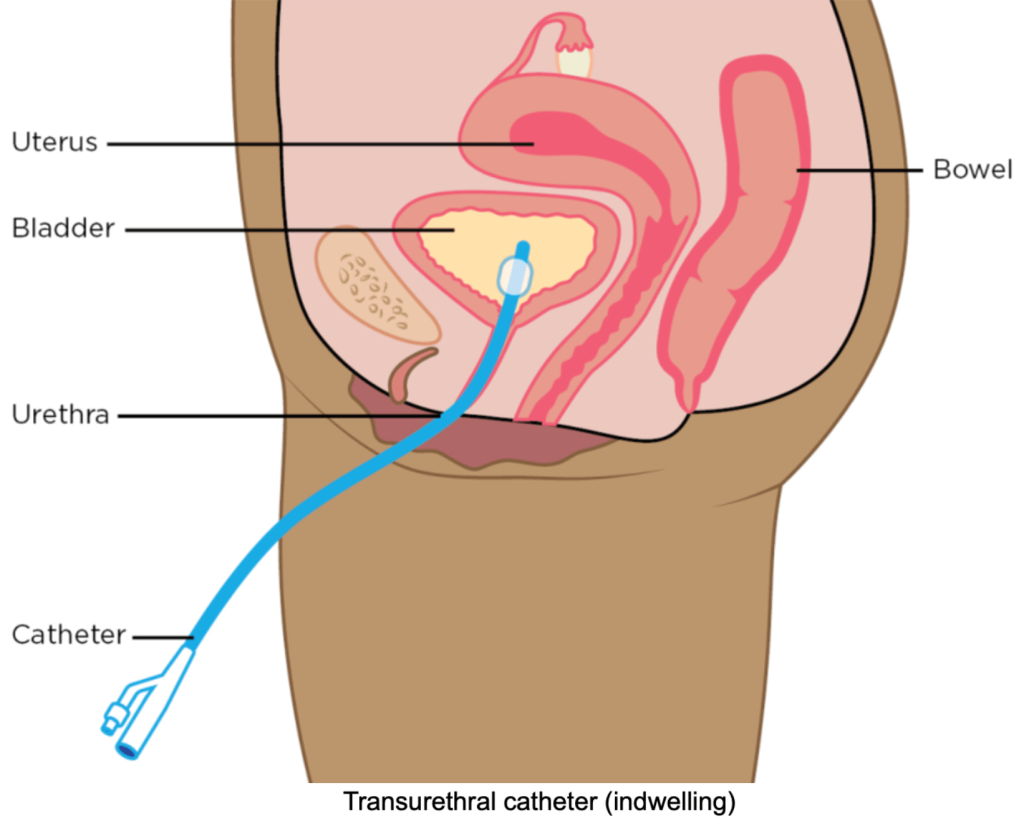
Transurethral (indwelling)
From: https://www.nhs.uk/conditions/urinary-catheters/types:
“An indwelling urinary catheter is inserted in the same way as an intermittent catheter, but the catheter is left in place. The catheter is held in the bladder by a water-filled balloon, which prevents it falling out. These types of catheters are often known as Foley catheters. Urine is drained through a tube connected to a collection bag, which can either be strapped to the inside of your leg or attached to a stand on the floor. Indwelling catheters are sometimes fitted with a valve. The valve can be opened to allow urine to be drained into a toilet, and closed to allow the bladder to fill with urine until drainage is convenient. Most indwelling catheters need to be changed at least every 3 months.”
Diagram below is from: https://www.nursingtimes.net/childrens-nursing/indwelling-urinary-catheter-insertion-1-children-and-young-people-20-02-2023/
Suprapubic
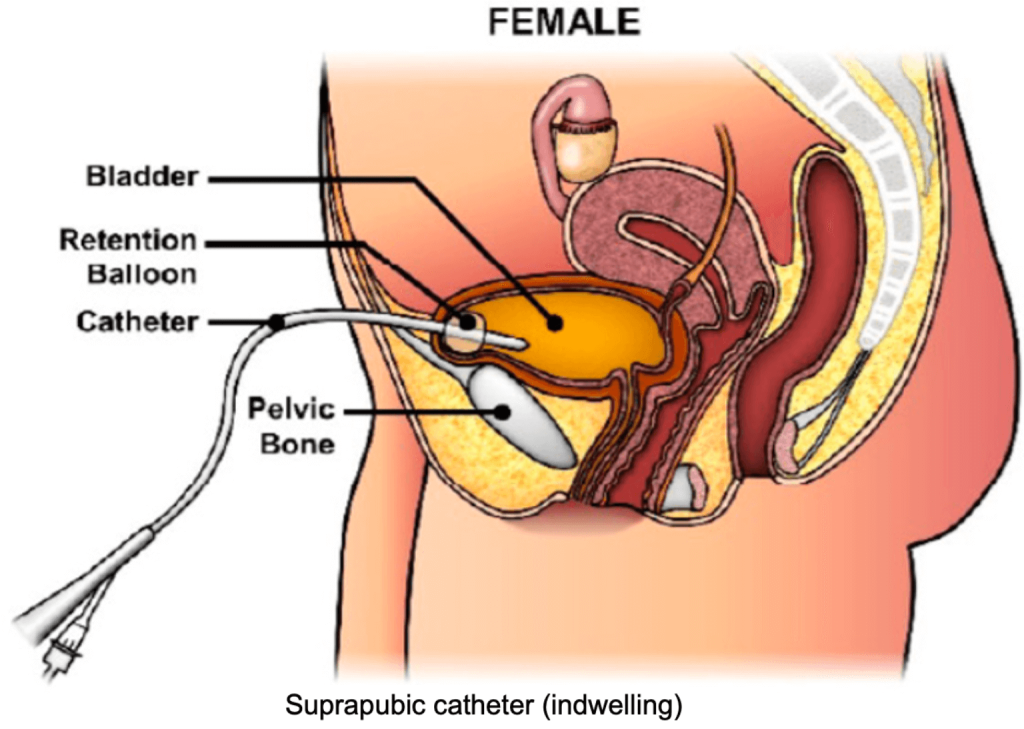
A suprapubic catheter is one that is left in place. Rather than being inserted through the urethra, the catheter is inserted through a hole in the abdomen and then directly into your bladder. See diagram below from: https://www.urotoday.com/library-resources/suprapubic-catheter/144192-suprapubic-sp-urinary-catheter-spc-or-sp-tube-spt.html
Male urination devices
Wearable Urinal for Men
Our son tried one of these in the very beginning of his ALS suffering, but it was very difficult to use. He tensed up and couldn’t pee. Wearing something made of rubber on a body part that’s already warm and damp faciltated moisture buildup, which wasn’t sanitary. The device was also uncomfortable to wear and very clumsy. We dumped it.

https://www.amazon.com/Wearable-Reusable-Protable-Collection-Bedridden/dp/B0BZZKN38X. Notice that the word “portable” is misspelled as “protable” in both the URL and online ad!!!
While in bed or in a wheelchair
We tried using a urinal bottle like the one in the photo below while our son was in bed and also while he was in his wheelchair so he could pee without going to a toilet, but he was either too tensed up to use it, or he couldn’t release anything, so nothing flowed. Only once or twice was he able to pee: When he was in bed (always propped up), and told us he had to pee, I put on a glove, pulled down his underwear, aimed him, and held him in place. I’m sure that was very uncomfortable while I was holding him in place, and this was probably the main reason he couldn’t pee. It was awkward and we both worried that it would spill, especially the one time the bottle was almost completely filled. He always had bladder control, so he never had a problem in bed or in his chair. We gave up trying to use the urinal bottle, so we always had to take him to the bathroom instead.
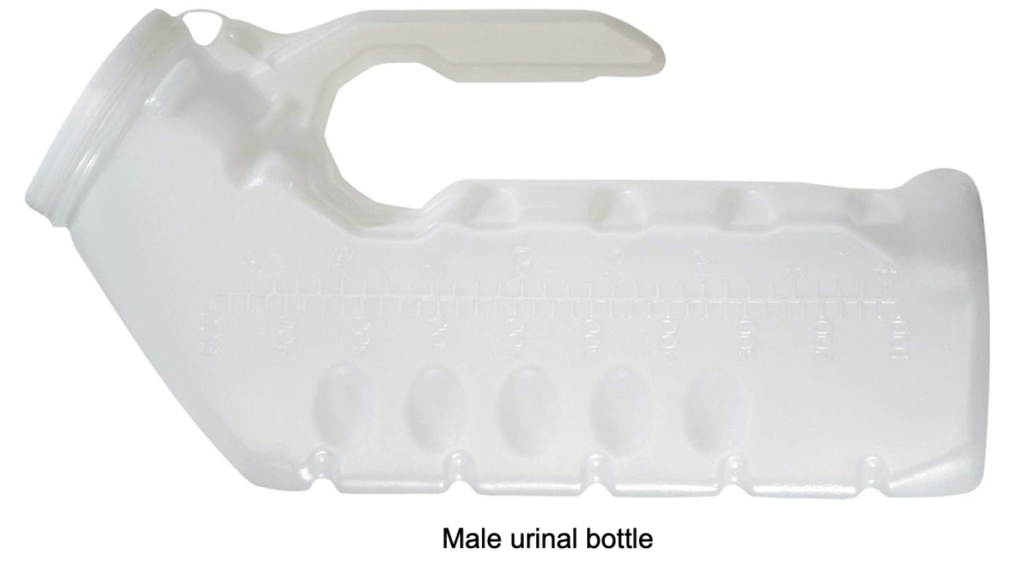
https://www.amazon.com/McKesson-Male-Urinal-32oz-1000mL/dp/B01N4S998D
While standing
While traveling, he tried to “hold it in” until we got somewhere, because taking our son to a public restroom was a great challenge. Early in his disease he went with some female friends to DisneyWorld in Florida. They actually took him into public men’s rooms to help him pee. The friends just made their presence known.
There are signs that can be put on the stall’s door to let the opposite sex know what’s going on. (See below.) There really wasn’t any need for a urine collection device while our son was standing, because he just peed into a urinal or toilet.
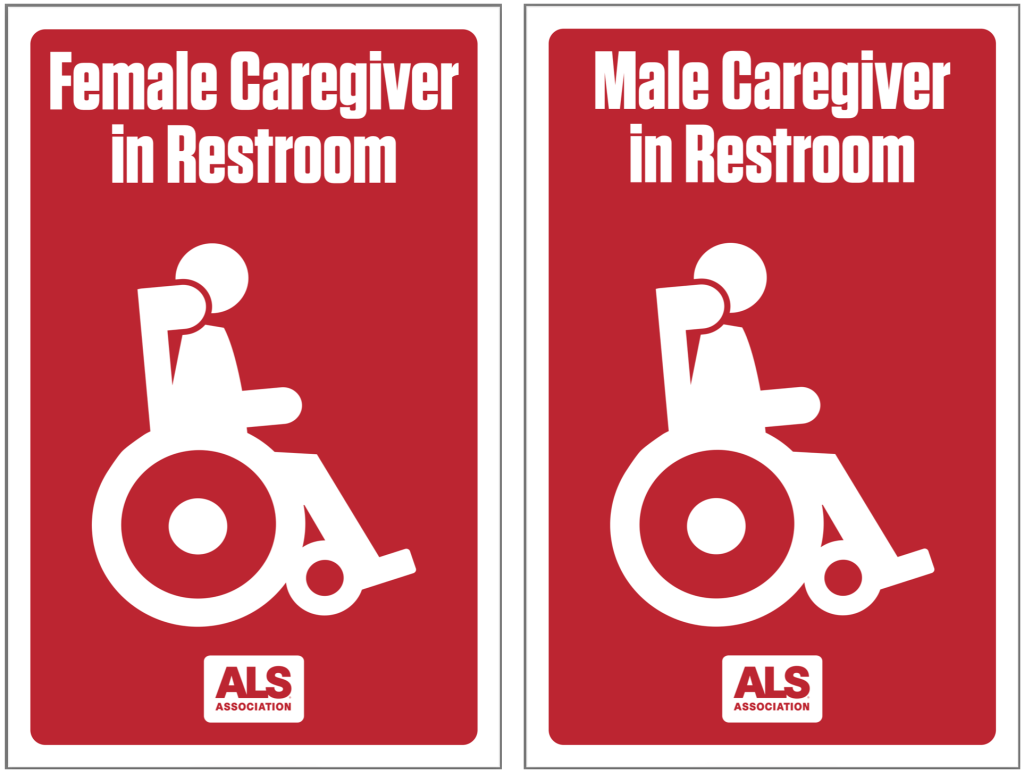
For males:
https://www.als.org/sites/default/files/2022-04/Restroom-Sign_Male.pdf
For females:
https://www.als.org/order-portal/material/caregiver-restroom-sign-female
Early in our son’s ALS disease, he was still able to stand up from his push wheelchair with help. He didn’t have the strength to hold grab bars (if there even were any in public rest rooms). Sometimes I stood him up very close to a urinal and he was able to hold on to the metal pipes mounted on top of the urinals, but they were filthy and he hated that. I usually held him in a gentle one-armed bear hug from behind to hold him up, then unzipped him, and helped him pee while he held the pipes.
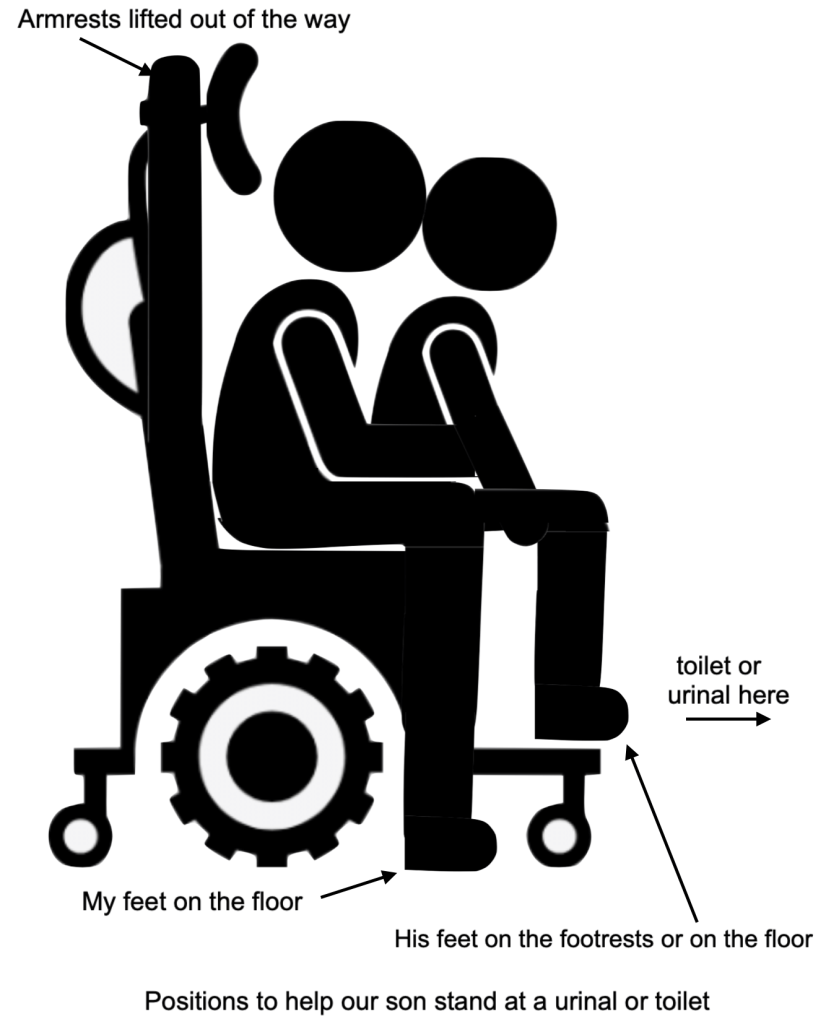
Once our son had his power wheelchair (and before head drop occurred), the procedure for using public restrooms changed because by that time he was much weaker and could barely stand. I would drive him up to a urinal or toilet while leaving just a little space between his knees and the urinal or toilet. (See image below.) First, I lifted both armrests out of the way. While he was still seated and, depending on the circumstances, I either raised the footrests out of the way or left them in place. Then I slid his butt forward on his seat so there was room for me behind his torso. Then I actually climbed into the space behind him and straddled the seat. I placed my feet on the floor, held him in a bear hug, and lifted him off the seat so he was standing, either on the floor or the footrests. The rest of the procedure was as I described above.
I once was traveling with my son from New Jersey to one of his NurOwn clinical trial visits in Worcester, Mass (a 4 – 6 hour trip) and he had to pee. We got off the highway and found an accessible, large, single-seater outhouse next to a gas station. I wheeled him into the outhouse, locked the door, stood him up, and helped him pee. While this was going on, someone needed the toilet and started banging angrily on the door and cursing. I shouted “we’ll be right out.” That probably gave him the wrong impression, so he left.
Invasive urination devices for males
Intermittent
(Please see the same information as for female intermittent catheters above.)
Transurethral
From: https://my.clevelandclinic.org/health/treatments/foley-catheter
Foley catheter
“A Foley catheter [for males] (see image below) is a device that drains urine (pee) from your bladder into a collection bag outside of your body when you can’t pee on your own or for various medical reasons. Another name for a Foley catheter is an indwelling urinary catheter.
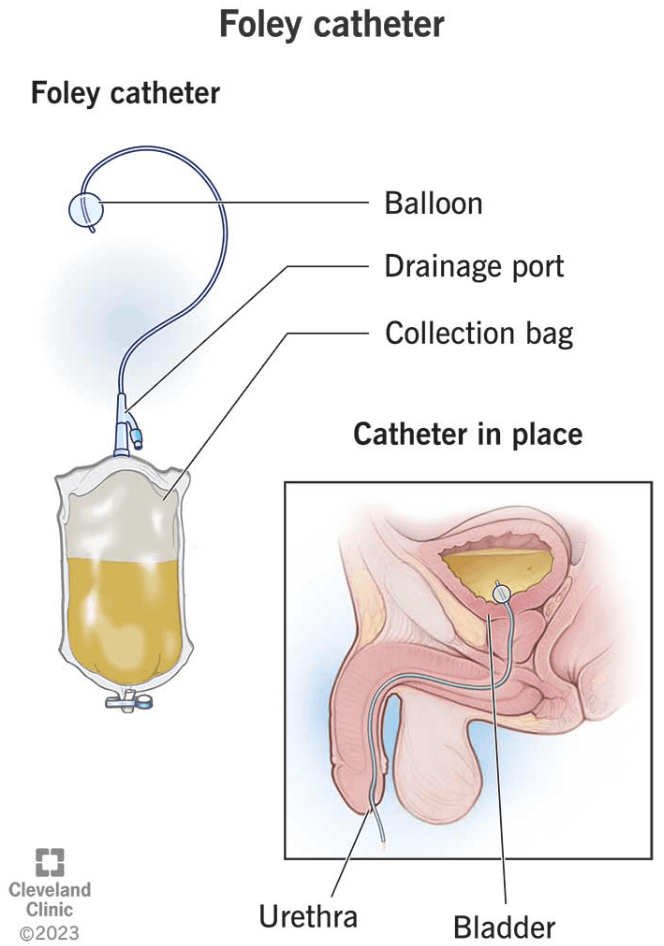
“It consists of a thin, flexible rubber or plastic tube that goes through your urethra into your bladder. There are two separate pathways (channels) that run the entire length of the tube. One pathway is a drainage port. It allows pee to drain from your bladder into a collection bag. The other pathway connects to a balloon at the tip of the tube in your bladder. Healthcare providers use this channel to fill the balloon with sterile water. The full balloon holds the Foley catheter in place in your bladder.
“While you’re awake, the catheter connects to a collection bag that attaches to your leg. While you’re sleeping, you may wear a larger collection bag that hangs from a hook or rests on a flat surface near your bed.
“Foley catheters are safe. They come in different sizes so that people of any age or size can use them.
“What is a Foley catheter used for? Healthcare providers most commonly use Foley catheters to drain pee from your bladder when you can’t pee on your own. This may result from:
- Urinary incontinence.
- Urinary retention.
- Prostate enlargement.
- Surgery on your prostate or genitals.
- An epidural, which can cause you to temporarily lose control of your bladder.
- Scarring.
- Draining a bladder during surgery.
- Getting an exact rate of urine production in a hospital setting.
- Controlling bleeding that occurs from an injury or during surgery.
- Delivering medicine directly to your bladder.
Suprapubic
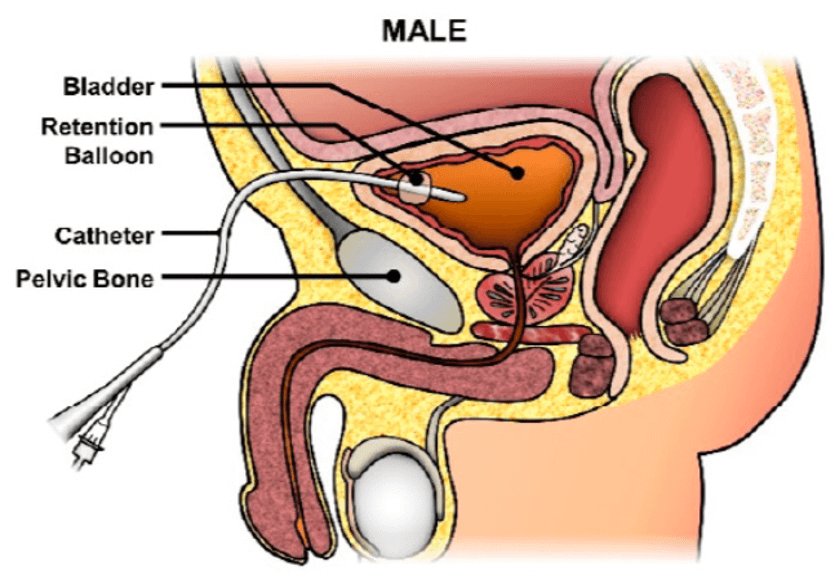
The suprapubic catheter for males is placed similarly as for females. See image below from: https://www.urotoday.com/library-resources/suprapubic-catheter/144192-suprapubic-sp-urinary-catheter-spc-or-sp-tube-spt.html
Urine deflectors
Urine deflectors attached to the toilet seat
Our son eventually could only urinate while sitting on the toilet. To prevent urine from being misdirected onto the floor, we tried two brands of urine deflectors that attached to our toilet seats, but they both had drawbacks. Depending on the deflector design, the toilet seats themselves either allowed or prevented proper mounting of the deflectors.
P-flector
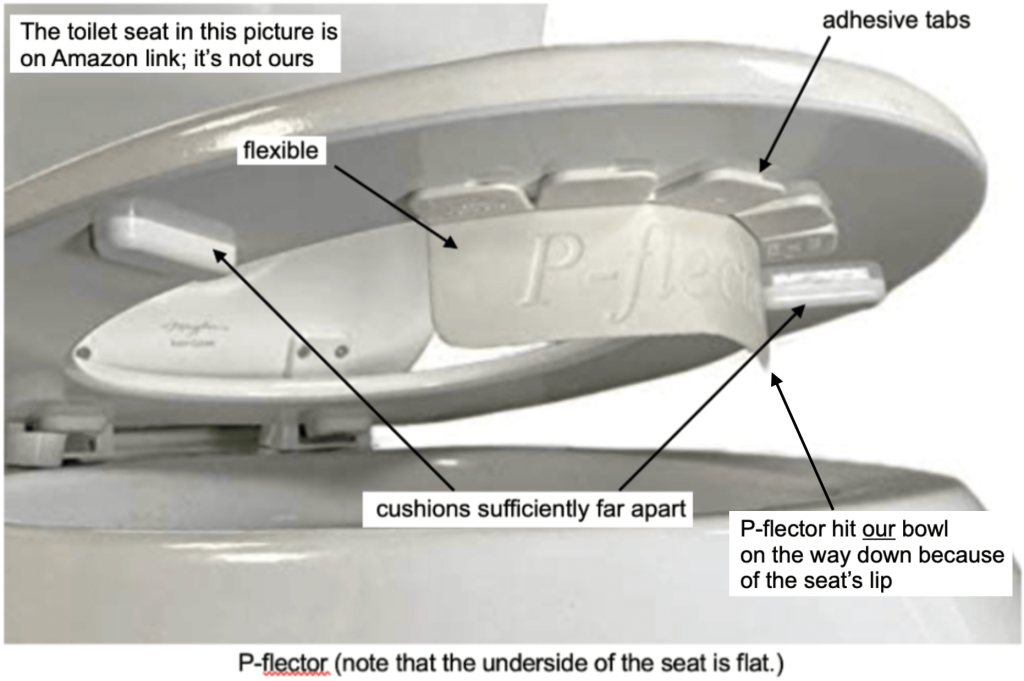
https://www.amazon.com/P-flector-Deflector-Prevents-Training-Through/dp/B07HY57YYB
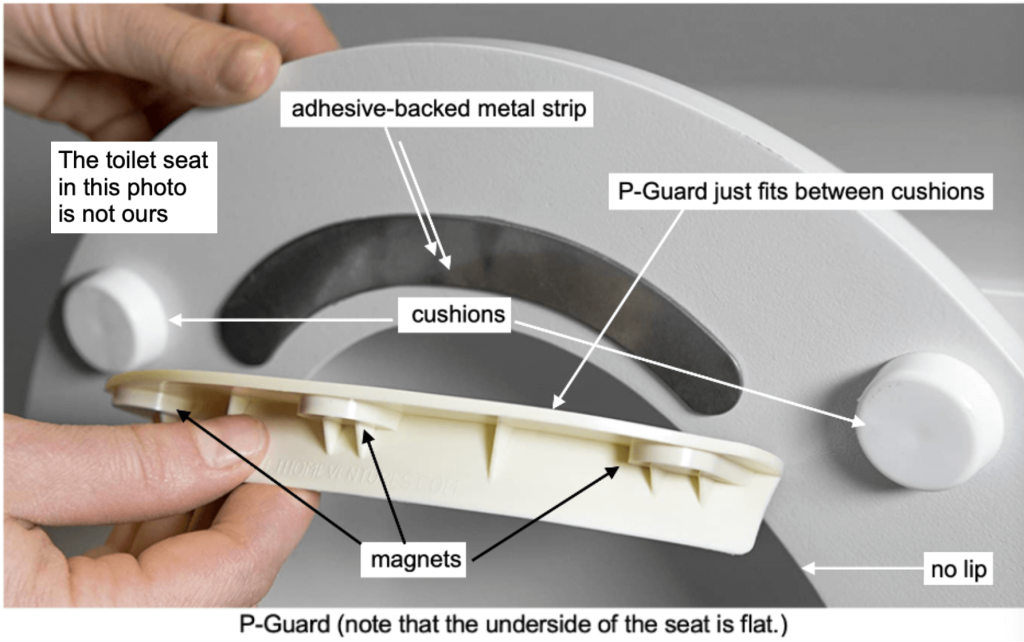
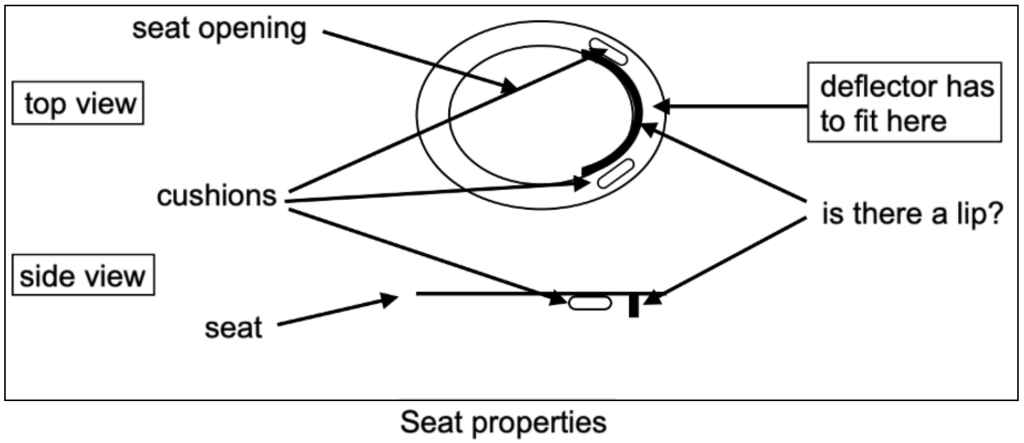
The P-flector (see web photo above; that is not our toilet) was flexible and had adhesive tabs. It adhered to the underside of the toilet seat. Note that the toilet seat in the photo above has no lip on the underside; it’s perfectly flat, so the P-flector can be mounted correctly. Also, the toilet seat cushions in the photo above were far enough apart so that the P-flector could fit between them. The P-flector could not be removed from the toilet seat to be washed, so it became scuzzy. None of these details are mentioned on the website.
The toilet seat of the SmartBidet in our son’s bathroom had a very small deflector lip, maybe ⅛” – ¼” wide, as part of the seat (see photo below). However, late in our son’s ALS, something changed in his ability to urinate downward into the water, and the lip didn’t stop his urine from coming forward and out onto the floor. The lip didn’t form a barrier to prevent this.
The lip on our bidet seat prevented the P-flector from being mounted along the inside edge under the seat, so our toilet seat would not close properly; the P-flector hit the top surface of the toilet bowl when the seat was going down. The P-flector could not hang down easily inside the bowl. Note also in the photo below of our son’s own toilet seat that the two seat cushions are far enough apart that the P-flector could fit between them. We dumped this deflector.
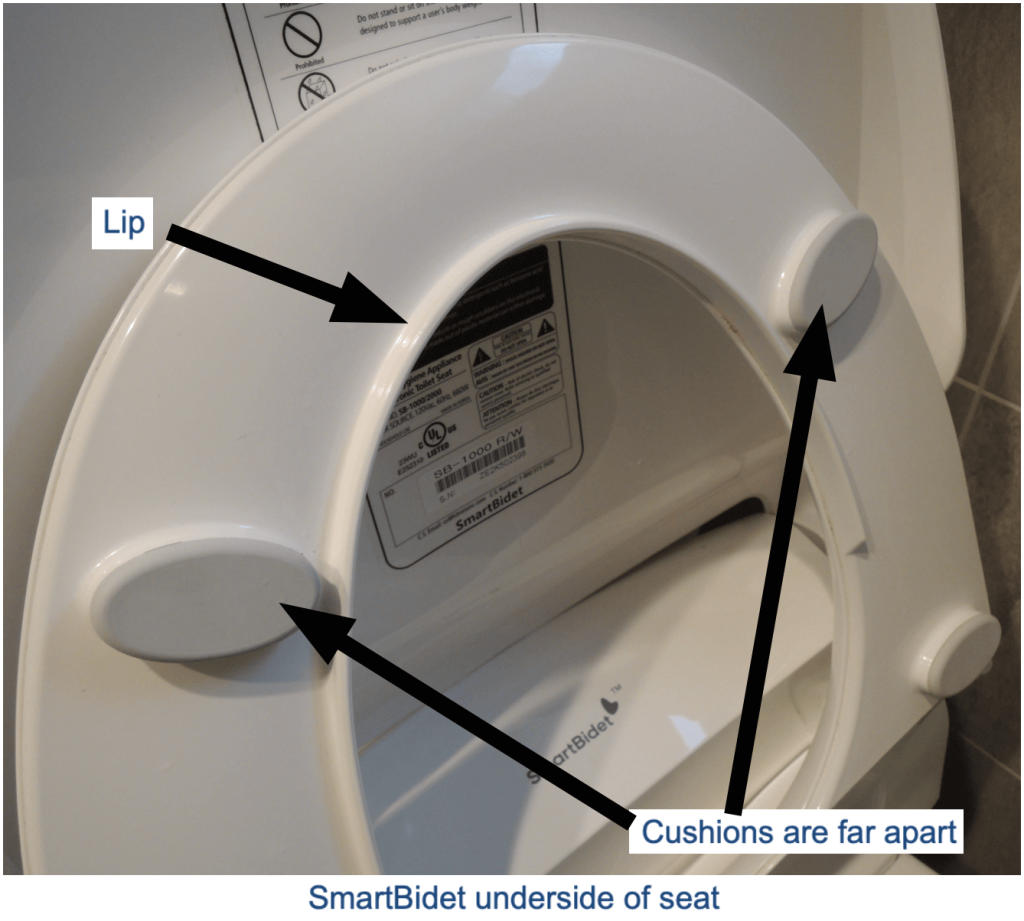 https://www.amazon.com/SmartBidet-SB-1000-Electronic-Temperature-Controlled/dp/B0128T2HQK
Before you consider buying the P-flector measure the distance between the cushions and whether there is a lip under the toilet seat.
P-Guard Urine Deflector
We also tried the P-Guard Urine Deflector (see the photo below). (Link: https://www.amazon.com/Guard-Urine-Deflector-Pee-Splash/dp/B07F2LQ8L5, see also other photos of this product in that link). The curved adhesive-backed metal strip was mounted under the toilet seat, and was supposed to be as close to the inner edge of the seat as possible. We had problems with this one, too. The magnetic piece was supposed to be mounted with the seat down, but this was very difficult to do: I practically had to put my head in the toilet bowl with the seat down to see where to mount the deflector. Our SmartBidet seat’s own deflector lip prevented the P-Guard from being mounted along the very inner edge of the seat, just like the P-flector above. The P-Guard also hit the bowl when the seat was down, but not enough to prevent the seat from going all the way down.
The P-Guard’s removable part itself had some very strong magnets in it. The idea was that the P-Guard could simply be detached from the metal strip for washing. This was a very good idea. However, we found that the P-Guard would not do its most important job: when our son peed, urine still got past the guard, ran down the outside front of the toilet bowl, and ended up all over the floor. I never could understand why that happened because I inspected everything numerous times: when the seat was down, the P-Guard blocked my view when I tried to look between the seat and the bowl. The P-Guard prevented me from seeing in. The other issue with this design is that because urine is acidic, the metal strip began corroding and rusting. The metal strip could not be removed at all for washing, so it could only be wiped down.
The other bidet we had was a Toto. Neither urine deflector would fit on the underside of the seat (see photo below). Even though the underside of this bidet seat was perfectly flat, its two cushions were too close together to allow either deflector to fit between them.
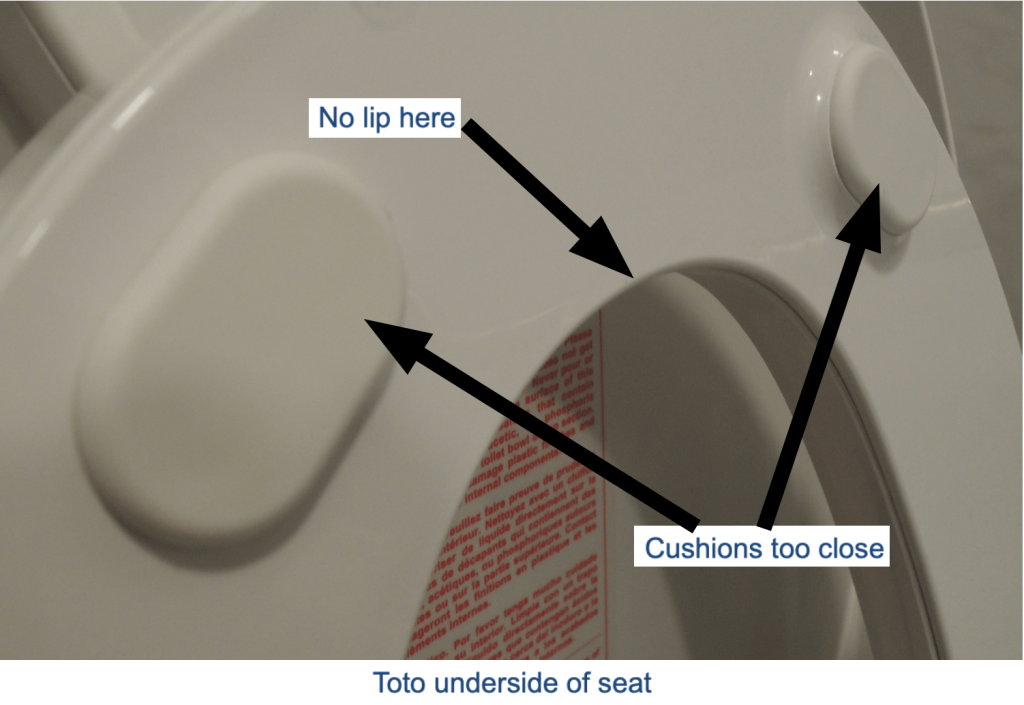
https://www.amazon.com/TOTO-SW3056-01-Electronic-Contemporary/dp/B078H89R6R
Urine deflectors held down by user
Homemade deflector
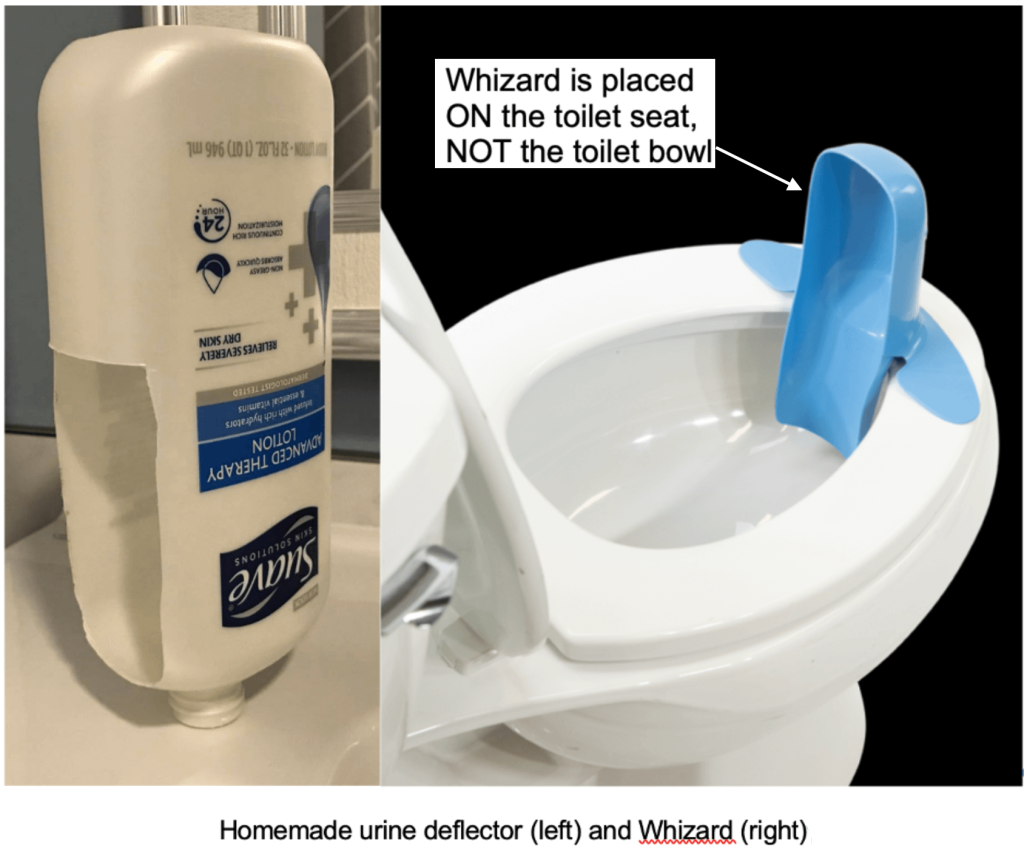
Before we found an alternative to the useless seat-mounted deflectors I described above, I created my own “urine deflector” from an empty lotion bottle (see left-hand photo below). We placed it upside down between our son’s legs while he was on the toilet, aimed him “south”, and he peed into the opening. It worked well.
Whizard
We finally found and bought a urine deflector called the “Whizard” (right-hand photo above, https://www.amazon.com/Raz-Whizard-Deflector-training-10-75InH/dp/B09738GL8D) to help aim our son and keep the urine in the toilet. The Whizard was a nicer version of the one I made. We just had to make sure he was pointing “south”.
The two most difficult things when our son had to pee were: getting him AND the Whizard in place on the toilet seat, and then getting him off the toilet seat and removing the Whizard afterwards. Since we had a ceiling-mounted lift with a SureHands metal frame (not a sling; see https://www.surehands.com), we did the following: we suspended our son over the toilet seat about 2 inches, dropped his pants and underpants, then placed the Whizard between his legs while he was still in the air, then lowered him onto the seat, while making sure he was pointing “south”.
It was too difficult to remove the Whizard while our son was still sitting on the toilet seat. When he was finished, we lifted him slightly, carefully removed the Whizard (it was always wet and many times soiled), placed him back down on the toilet so the bidet could clean him if necessary, lifted him off the toilet again, moved him away from the toilet, cleaned him further if necessary, then raised his underwear and pants. It was very important to clean the Whizard after each use. Another nice thing about the Whizard was that we could travel with it. We couldn’t take the adhesive-backed ones with us.
Whoever invented the Whizard deserved the Nobel Prize. The nice feature was that it was removable for washing. We obviously were not familiar with urination products for women.
(For those who are curious about our ceiling lift, there is an entry in this Guide about patient lifts: https://www.guidetoals.com/patient-lifts/.)
Deflector recommendations
(See diagram below)
Before you buy an deflector that attaches to your toilet seat, try to find answers to the following questions:
- Does your toilet seat have a lip on the underside of the seat that might interfere with mounting?
- Does the deflector fit between the cushions under the seat? (Find out the length of the deflector and the distance between the seat cushions.)
- Does the deflector allow the seat to rest on the bowl?
- Can the deflector be removed for washing?
- Can you just buy the Whizard and skip all the other questions?
Kidney stones and ALS
Our son had kidney stones twice while he had ALS. The first time we didn’t know what was going on because there was no pain, but he could not pee, so we took him to a urologist. A stent and catheter were inserted. No surgery was needed. The stones just turned to dust and passed easily. The second time he was in tremendous pain because some of the stones descended and blocked urination. He went to the ER for that surgery. A stent and catheter were inserted due to swelling and the inability to pee after the surgery. After some initial discomfort, he got used to his catheter, and things actually got a little easier for my wife and me because we didn’t have to take him to the bathroom to pee. Our son actually liked the easier time he had with the catheter in place. We just emptied the urine collection bag wherever he was. When he had to use the toilet, we lifted him up in his SureHands ceiling lift while one of us carried the urine bag and moved him onto the toilet.
