Our son was diagnosed with ALS in January 2018 and moved into our house in New Jersey in June 2018 because his wife didn’t want to take care of him. He lived with my wife and me until his death in October 2021. Our son’s will stipulated that he wished to donate his organs and tissues for transplantation into those needing them, and his brain tissue was to go to ALS research. We encountered stumbling blocks during both attempts.
Organ and tissue donations for transplanting
The following chart and text are from a New Jersey organization that handles all aspects of organ and tissue donations, NJ Sharing Network, https://www.njsharingnetwork.org. Other states and donor organizations may have different laws.
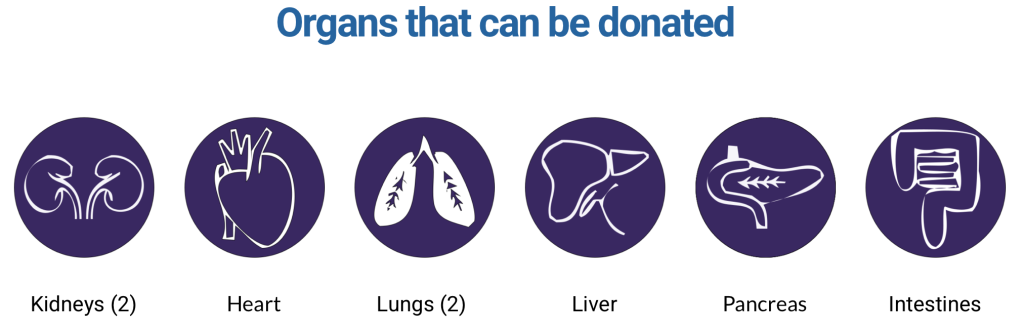
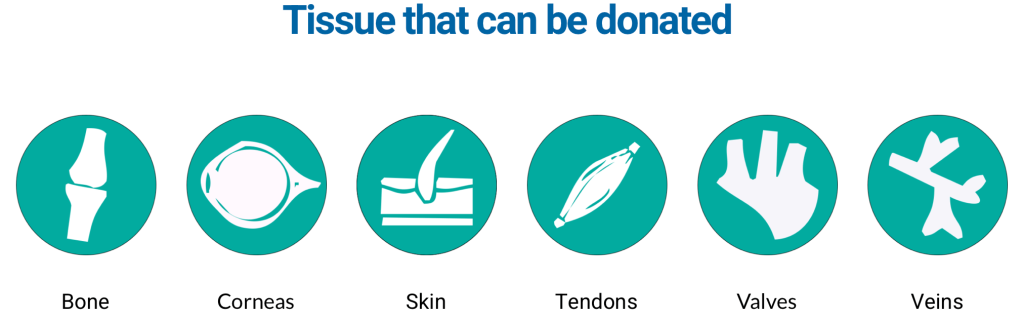
How organ and tissue donation works
The process is time-sensitive and complex, with various partners helping along the way to ensure every opportunity to save lives.
The key steps include:
1. Decision to Donate
Organ and tissue donation begins with an individual (or their Next-of-Kin) making the decision to be a lifesaving donor. People in New Jersey can register as a donor online or when they receive or renew their Driver License. If a patient who is a potential donor is not registered, his or her family will have to make that decision at an already difficult time.
2. Identifying a Potential Donor
As an Organ Procurement Organization (OPO), NJ Sharing Network works closely with the hospitals in our service area and by law, hospitals must contact us when a patient is a potential donor. Our expert staff will evaluate the patient to see if they meet required criteria to donate, and will also confirm if the patient is a registered donor.
3. Authorizing for Donation
If the patient is a candidate for donation and has not registered their decision, NJ Sharing Network must obtain consent for organ and tissue donation, along with the patient’s social and medical history, from the Next-of-Kin.
4. Recovery and Transplant
Working with the patient’s hospital and the recipient’s transplant center, NJ Sharing Network oversees the recovery and placement of organs so that the miracle of transplantation can take place. Recovered tissue is shared with our partners who prepare them as grafts for transplant. If the tissue cannot be used for transplant, certain tissues may still be donated for research.
The procedure takes place with the utmost care and respect and after a moment of silence in honor of the donor.
Note:
The registration is a binding, legal document of gift. The donor affirms the information provided is accurate. The donor agrees upon death to donate all eligible organs and tissue for transplant. The donor can update or remove his or her registration or specify more detailed donation preferences at any time at https://www.registerme.org/access.aspx.
I asked the NJ Sharing Network in March 2025 whether there were any medical conditions or diseases that would exclude a person from being a donor. The response was: “The transplant team will determine what organs and/or tissue can be used at the time of your death based on a clinical evaluation, medical history, and other factors. Don’t rule yourself out from being an organ donor because you have a health condition. You’re always encouraged to register. Even with an illness, you may be able to donate your organs or tissue. Even if there’s only one organ or tissue that can be used, that’s one life saved or improved.
I then asked: If a person has ALS (amyotrophic lateral sclerosis), could the person be a donor if there were no other medical issues? The second response was: “People with ALS are NOT excluded for donation.”
On his last day alive just before hospice protocols were to begin, a team came in from NJ Sharing Network and said they had to take blood and other samples for various testing and paperwork requiring tissue typing, bloodwork, x-ray, medical history, illnesses that precluded donation, and probably more, so they asked us to delay the hospice protocols. We didn’t know at that time if ALS precluded donation. No one told him or us that he had to go through these various testing procedures prior to the donation. We all learned then and there that the potential donor can’t just check off a box on a driver’s license or something that said he or she wanted to donate organs or tissue. Our son was of clear enough mind to throw them out because he was tired of suffering and wanted to die. So much for organ and tissue donation; that never happened.
Brain tissue donation for research
Unrelated to the NJ Sharing Network, our son also wanted to donate a sample of his brain tissue for ALS research to Columbia University (they had an ALS research program). Immediately after his passing, we tried to contact Columbia University, but we kept getting the runaround. One of our son’s friends who was helping us with the trauma of losing him took charge, called Columbia and became aggressive on the phone and got results. It turned out that our son’s own ALS neurologist who had seen him from his early diagnosis was on that Columbia research team and expedited the process. The actual sampling took place in the funeral home just prior to cremation.
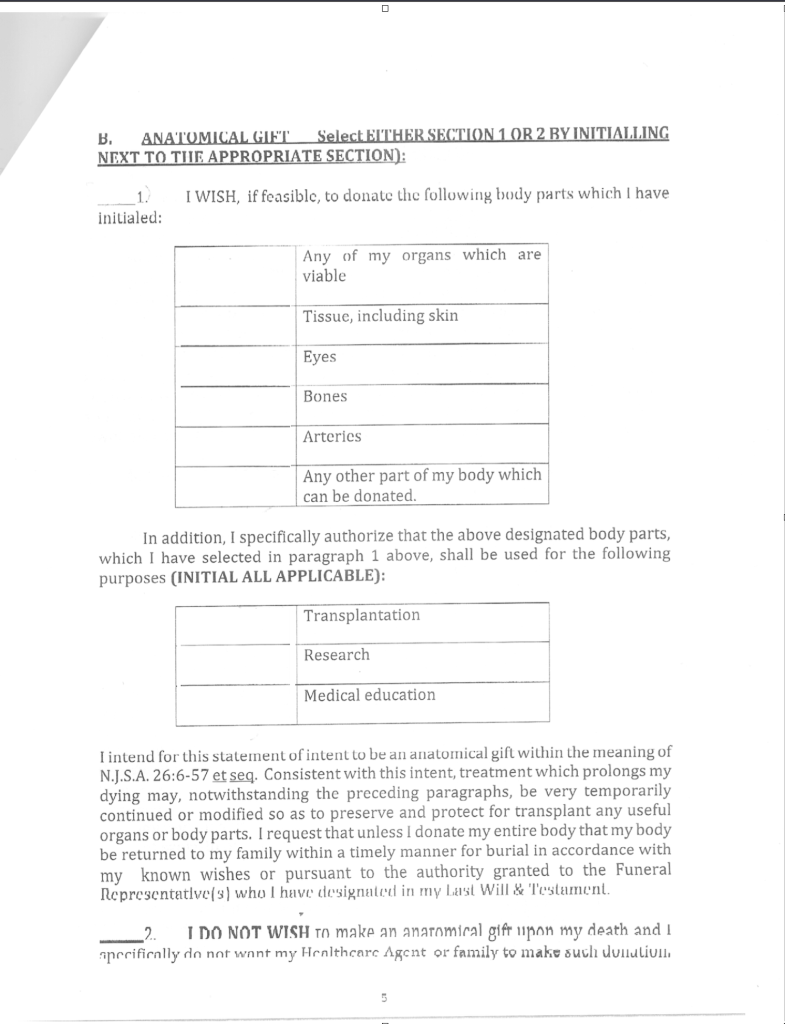
Actual page from my own Healthcare Directive with donation wishes
The following image is a scan (sorry for the low quality) of the actual page from my own Healthcare Directive (with my initials whited out) giving my own wishes for donation of my tissues and organs (upper table), and also three different uses I’ve allowed for said parts (lower table). A word to the wise: from my own experience, my lawyer was sloppy and very inarticulate with her work creating both my wife’s and my directives. It was probably the same manuscript she used for all her clients. I replaced the “Anatomical Gift” section of her original draft with my own completely redesigned and rewritten version (shown below) because hers was so confusingly unclear and organized that it was incomprehensible.
As I described in an earlier section of this article, you might have to go through some kind of tissue sampling and other legwork so some donation agency has everything in place ahead of time. If there’s no intended agency, you’re lawyer may know.
Remember, you’re paying the lawyer, so he or she works for you. You’re in charge; if you don’t like the manuscript, or it’s confusing, reject it, make changes, and insist that it be rewritten. If the lawyer makes mistakes spelling, confusing text, some other client’s private info (yes, that happened to us), tell him or her that fixing the errors is on his or her dime and you will not pay for the time needed to fix the mistakes. I’ve seen all kinds of incompetency with rough drafts.