
After our son RIP moved back into our house in mid-2018 about one-half year after his diagnosis, he realized that with weakening hands, he would need a bidet to help him with personal hygiene in our bathrooms. He purchased two bidets (both SmarBidet SB-2000’s) and I installed them in the two bathrooms he was using. I had no experience with a bidet before these, but after using them myself, I realized that the inventor should have gotten a Nobel Prize. This article discusses what we learned about bidets and washlets.
Bidets
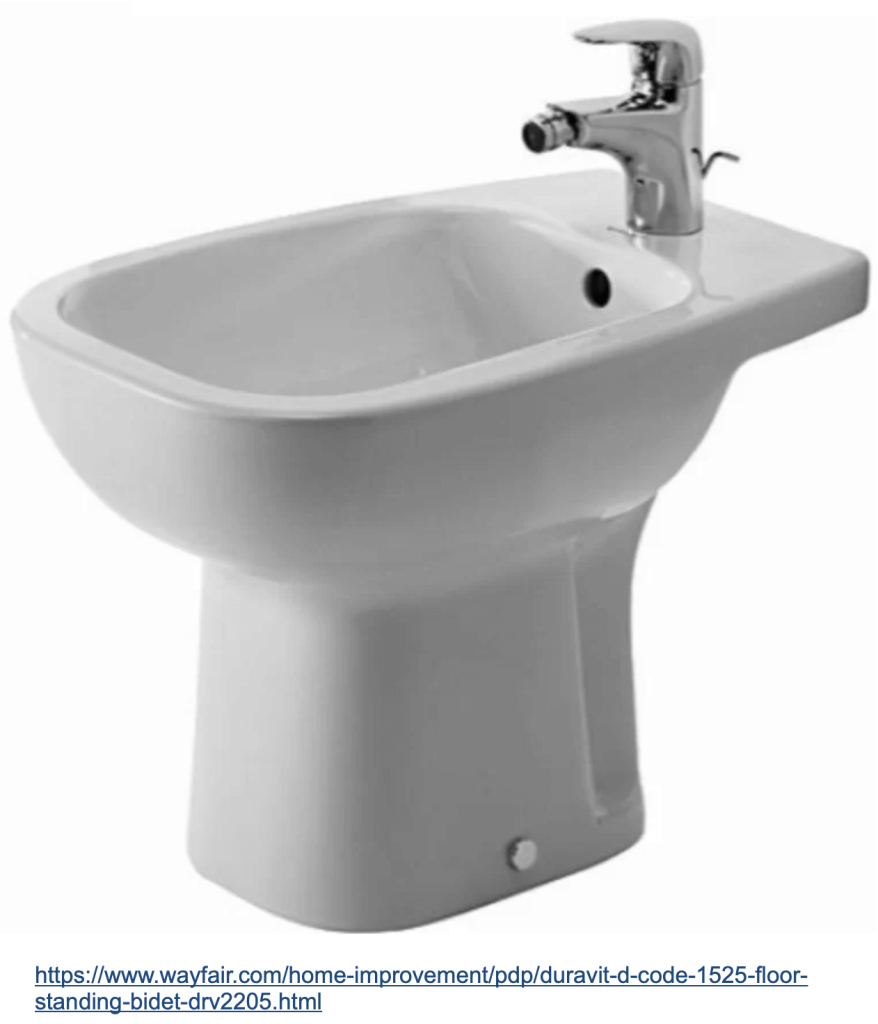
A true bidet is an independent device (see photo below). It is NOT a toilet. (I used a real bidet like the one in the picture below while in Europe, but it was not easy). Many of the washlets (see definition below) I’ve seen on the web are called bidets.
Washlets
A washlet is an add-on to an existing toilet, so it cleans the user, and the toilet can be flushed. We had three different models in our house.
SmartBidet Model SB-2000
https://www.smartbidetusa.com/products/sb-2000
When our son first moved into our house in mid-2018 he was already using forearm braces to walk, so he still had use of his hands. Anticipating difficulty cleaning himself after using a regular toilet, he bought and I installed two SmartBidet Model SB-2000’s, one in each of our two bathrooms (these are actually washlets, see photo below.) The control panel is permanently attached on the right side is operated by house voltage. The cost was under $300. I installed the SB-2000 in the original, older part of our house. This model allowed the user to have heated rinse water, a heated seat, choice of wand positions, and other features. The most important feature, which was not mentioned in the advertising, and didn’t seem to be mentioned in other brands, was a sufficiently long wand (3.75”) that remained retracted until needed, then extended to rinse the behind. During a power failure, the bidet stopped working, but the toilet still worked. Personal settings in the controller had to be reset once the power came back on.
There is a weight-sensor embedded in the seat’s front right quadrant. The bidet could not be turned on unless someone was sitting on it (for childproofing, I guess). A couple of times I had to turn on the washing nozzle for maintenance, so I simply pressed my palm down on the seat where the sensor was hidden, then operated the washlet, but also while using an inverted plastic container to prevent water from squirting me.
Both bidets required nearby 110-volt receptacles. We had to use extension cords in both bathrooms to reach the receptacles because there weren’t any near the toilets.
In the SmartBidet, the large box that you see in the photo below contains the electronic circuitry, the retractable wand, and the heated reservoir of water. Unfortunately, the box had a sharp edge, which rubbed against the pressure sores on our son’s spine all the time.
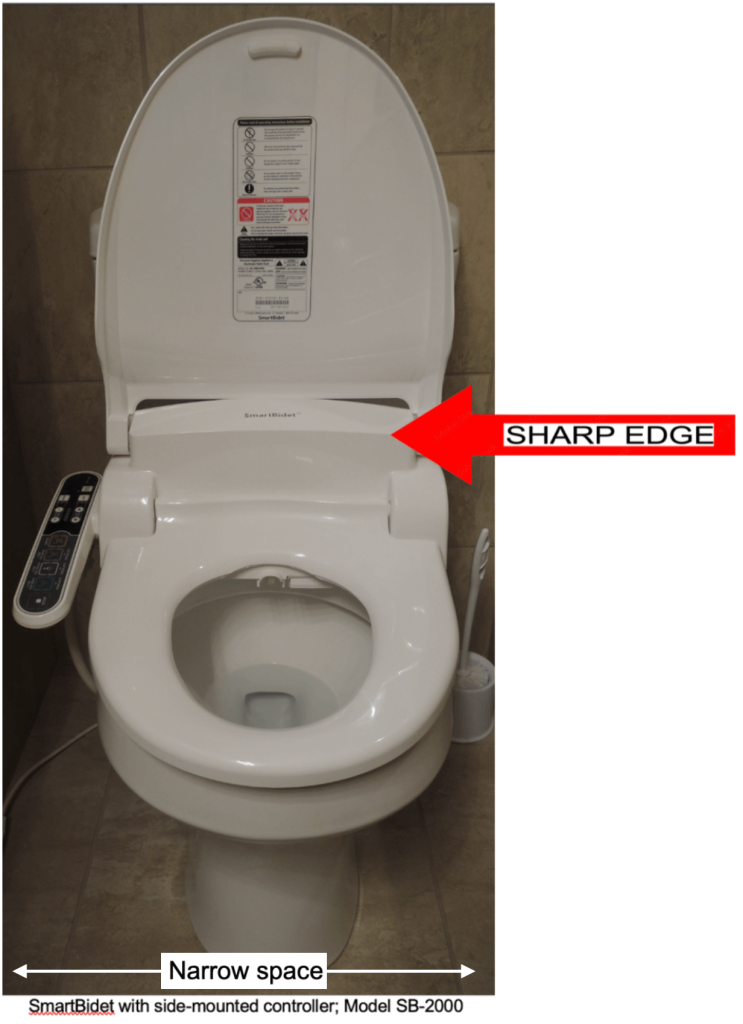
After a short while, however, our son could no longer twist his body nor use his fingers to reach and press the appropriate buttons on the control panel to start and stop the cleansing procedure. (The bidet would turn off by itself after a certain time). He also had lost so much strength in his hands that he had trouble even pressing the buttons, so I usually had to be nearby to start and stop the bidet. Because of the right-side position of the controller, and the narrow confines of the toilet, I had to stand in the bathroom on his left side and lean over him to operate it.
There was not much floor space (maybe a foot) in front of the toilet because the bathroom vanity was there. I had mounted a fold-down grab bar (see photos below) on the vanity facing the toilet, so we could lift it into place when our son needed it. We could fold the grab bar down by pressing the two black buttons. We couldn’t mount a non-folding grab bar there because we needed the space to maneuver our son towards the toilet. The fold-down grab bar is available in several widths and finishes.
Here’s a link: https://www.medicalproductsdirect.com/exhansafgrab.html.
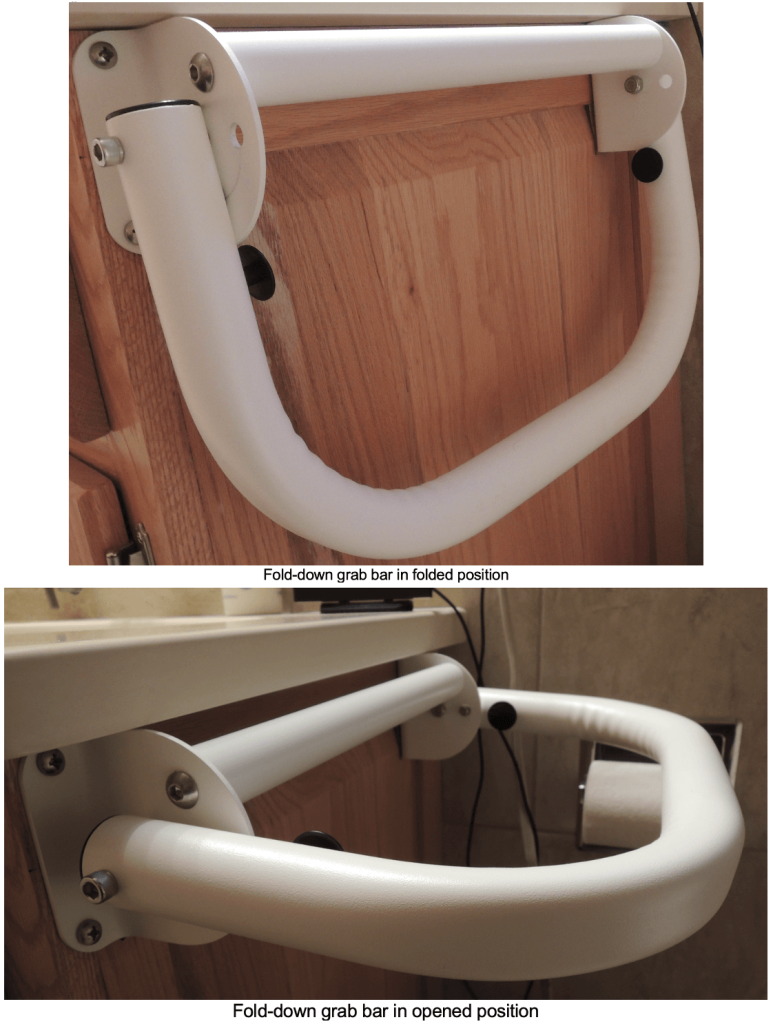
Each time he needed to sit on the toilet, he had to approach it on his arm braces while I was steadying him from behind, then turn him around. He would then hand me his forearm braces. I would place both of his hands on the grab bar. Then I would hold him in a one-armed sideways bear hug with my right arm, drop his pants with my left hand, sit him down, and “aim” him downward. Standing him back up required me placing his hands on the grab bar again, holding him in another sideways bear hug, then lifting him, drying him (paper drying was more efficient than the bidet’s air-dryer), then getting his pants back up and zippered. Once he began using a push wheelchair, we had to position the wheelchair just right so we could stand him up and proceed.
SmartBidet Model SB-1000
https://www.smartbidetusa.com/products/sb-1000
With the money our son received from his GoFundMe site, he and an architect designed and had built a fully accessible addition to the house with a fully-accessible bathroom. (The accessible bathroom is the subject of a separate article on this website.) Our son chose the same SmartBidet brand, but Model SB-1000. This one had a handheld remote (not shown) so he or eventually I could hold it. See photo below. In the new part of the house, he also made sure there was a receptacle close to the toilet so we didn’t need an extension cord. He also made sure there was plenty of space around the new toilet for caregivers to stand and any required handling equipment, like patient lifts, to fit.
During a power failure, the bidet would stop working, but the toilet still worked. Personal settings in the hand-held controller had to be reset once the power came back on.
As mentioned above, the large box that rose up at the back of the seat rubbed against the pressure sores our son had on his spine.
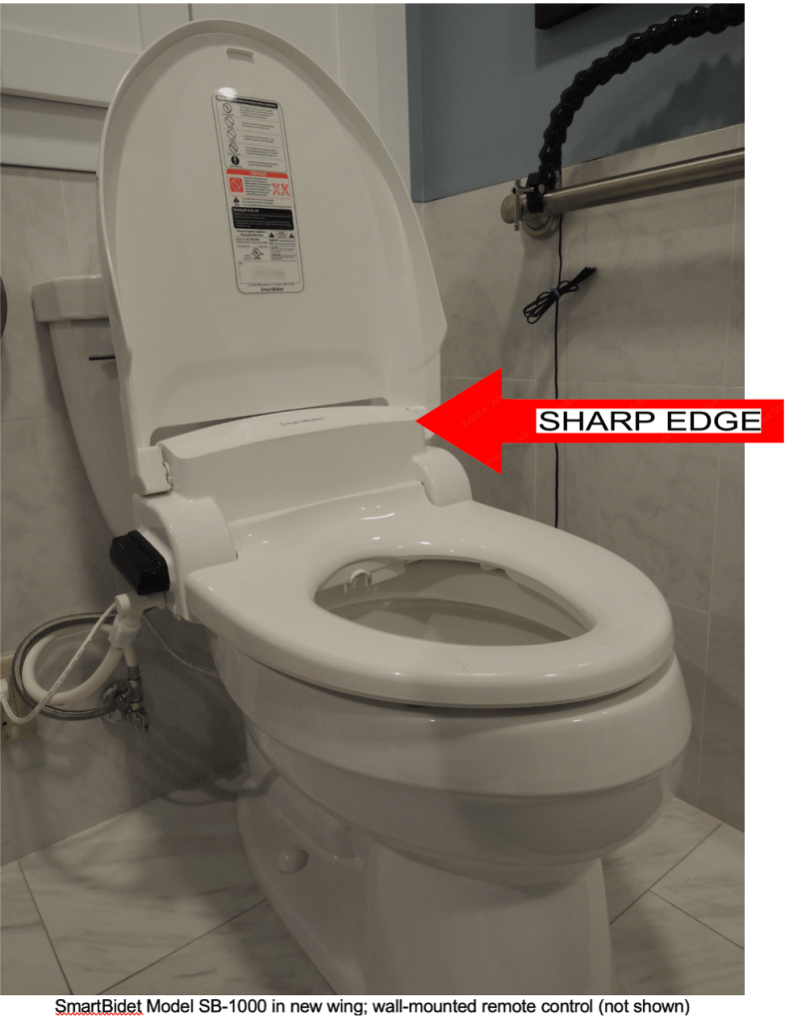
Every time we placed our son on one of the SmartBidets we had, his pressure sores rubbed against the sharp corners at the back of the seats. We hurt our son every time and we endangered the open pressure sore.
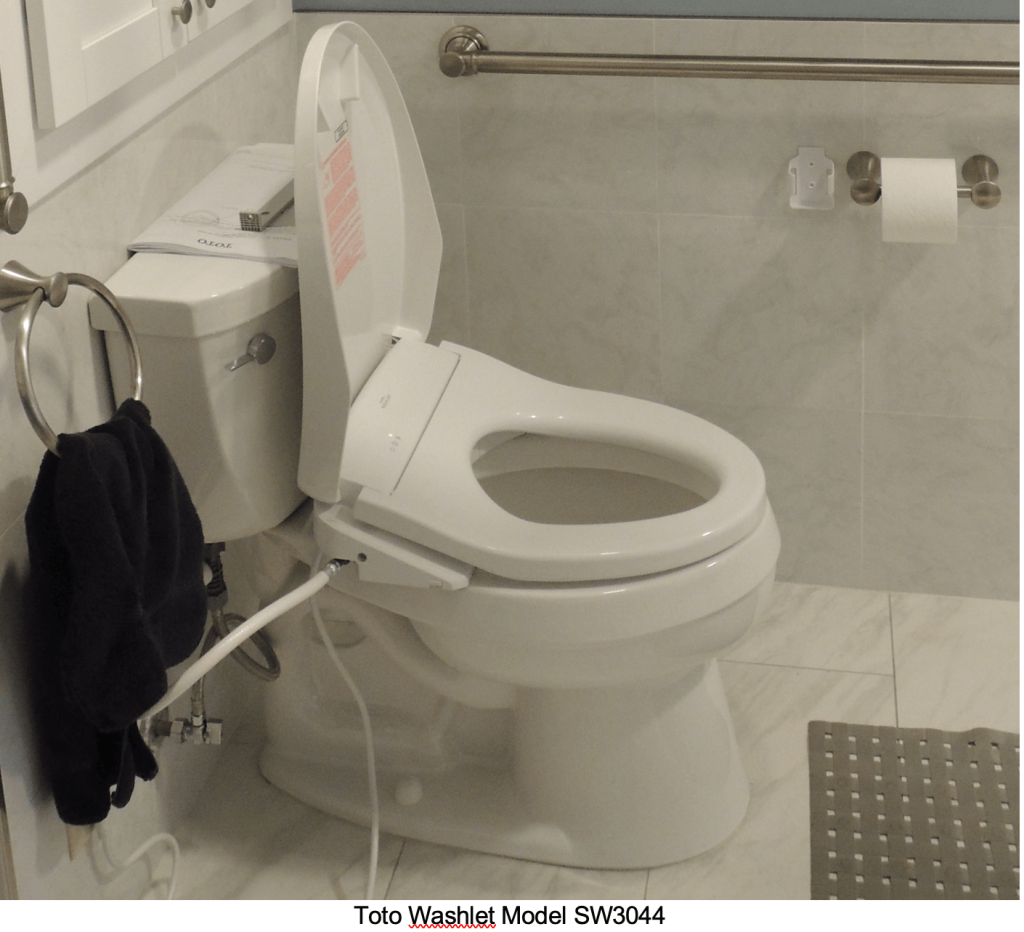
Toto Washlet Model SW3044
https://www.amazon.com/TOTO-SW3044-01-Electronic-Elongated/dp/B078GQHZWZ
Our son found on the web a washlet that had a smooth upwards-sloping surface at the back end of the seat instead of the sharp-cornered box. He bought a Toto Washlet Model SW3044 bidet for around $1500. This model had all kinds of bells and whistles and lights and was much more complicated to setup and to use. The seat sensor was in one of the back quadrants. We were dismayed to observe that our son kept sliding down the sloped seat and away from the sprayer. He obviously could not reposition himself. The spray wand on the TOTO was only 2” long (much shorter than the SmartBidet). It wouldn’t reach him and TOTO wouldn’t take the bidet back. I had to put the SmartBidet back in place. During power failures, the bidet stopped working, but the toilet still worked. Personal settings in the controller didn’t change at all, so there was nothing to reset once the power came back on.
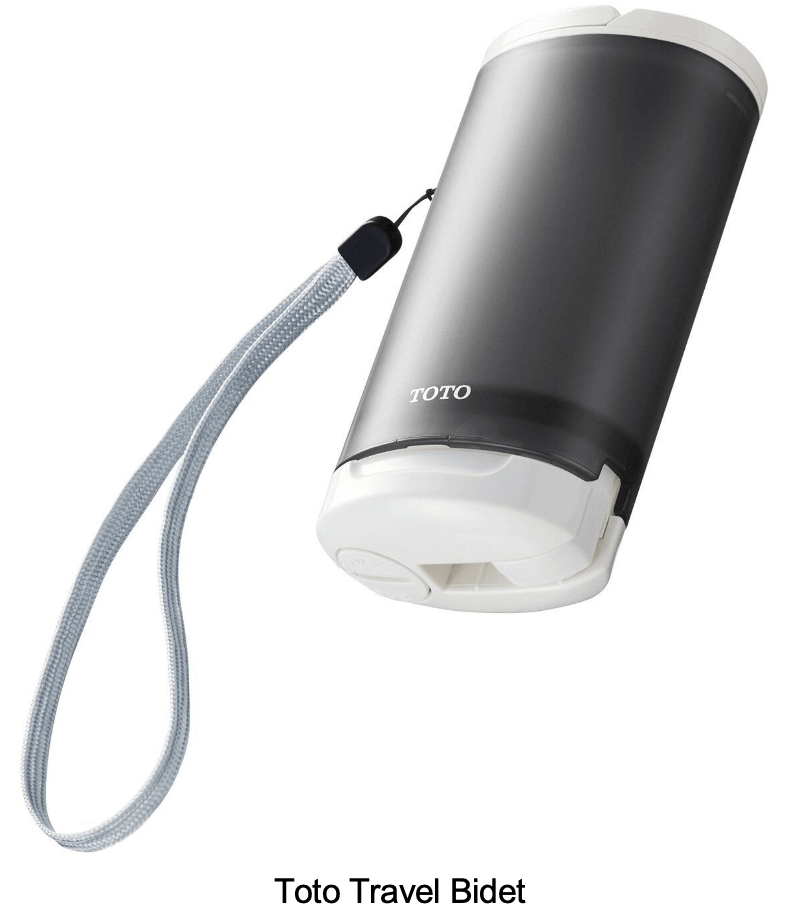
Toto Travel Bidet
Toto (and others) make battery-operated hand-held travel bidets. We bought a Toto, like in the photo below. I believe this model has been replaced by newer Toto versions, but you might still be able to find this one on the web. It worked pretty well, but it required a lot of patience when I had to clean our son. It had a wand that was kept folded inside the case when it was not in use and it had a reservoir that had to be filled before each rinse. To wash our son, I had to slide him forward on the toilet seat to get some space behind him, then lean him forward on the seat, then try to get the Toto bidet into the tiny space just behind his butt, aim the wand, and hope I hit the target. I usually had to do this at least 3 times. It was sort-of like trying to hit a bullseye around a corner. I still needed toilet paper to check for thorough cleaning, and then also drying.
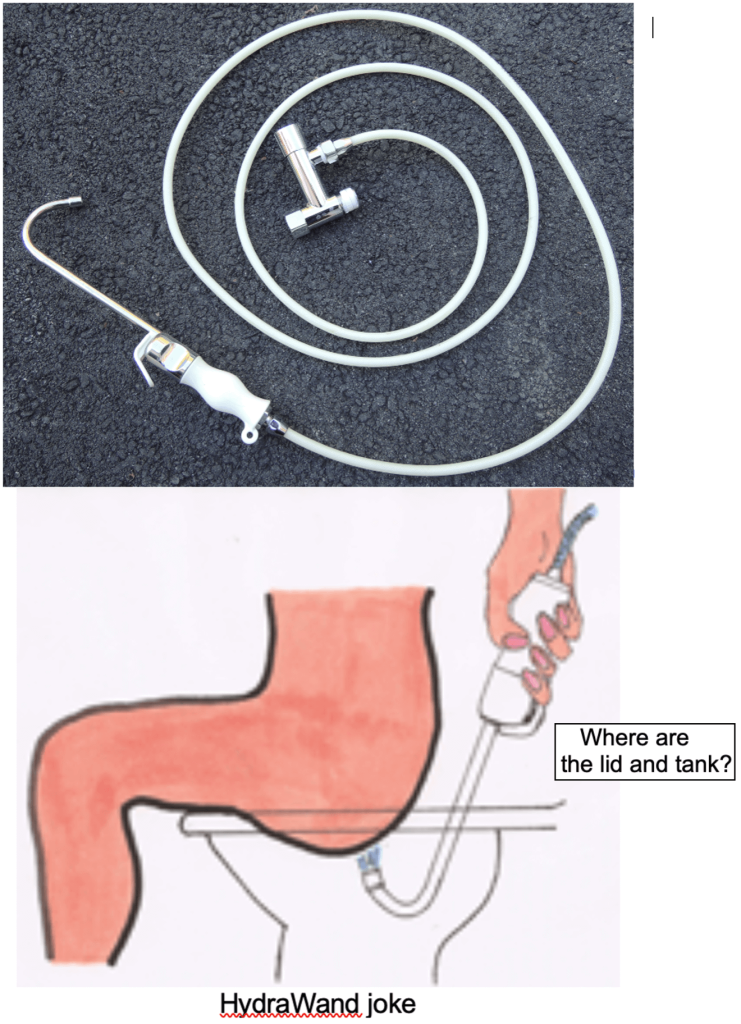
HydraWand
We also bought a HydraWand hand-held bidet, https://hydrawand.com. See photo and drawing below. I connected this idiotic thing to the toilet’s water supply. What a joke. Contrary to the instructions, I couldn’t insert the nozzle behind our son easily because both the toilet lid and tank were in the way (strangely, the drawing doesn’t show any lid or tank!). Plus, there was only a tiny space just behind our son’s backside to insert the wand, and aim it correctly to hit the target. Ditto trying to get in from the front. I couldn’t see where I was aiming and mostly just wet his entire butt. (Try hitting a target in the dark). I even tried using a flashlight to see what I was doing. Also, the water was ice cold because it came straight from the tap. Maybe if I had removed the toilet lid, this would have given me a little more space back there. I dumped it. Caveat emptor.
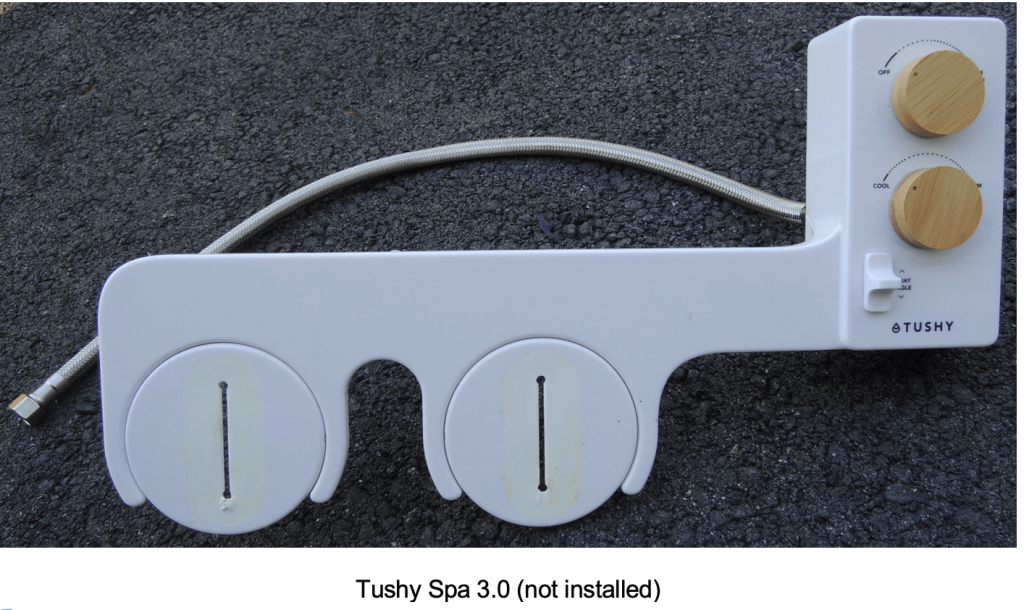
Tushy Spa 3.0
https://hellotushy.com/products/warm-water-bidet-tushy-spa
Our son still needed a bidet that washed him AND didn’t hurt or make him slide forward. We bought a Tushy Spa 3.0 ($100) bidet (actually a washlet). (See photo below). It was a different concept. It fit under a standard toilet seat. It was very flat (maybe 1” high). I removed the original seat, mounted the Tushy, then put the seat back on. The clever, two large slotted circles in the photo are meant to accommodate the bolts on many toilet models.
This model came with two hoses, one for connecting to the toilet’s normal cold water supply and the other one for optionally connecting to a nearby sink’s hot water supply. The Tushy didn’t store or heat water like either of the SmartBidets or Toto. It didn’t need electricity. That meant if we wanted hot water for the Tushy, we had to turn on the hot water at the sink, run it down the drain until it came out hot, then divert it through the Tushy, then also turn on the cold water to the Tushy so the two mixed to a comfortable temperature before I could rinse my son. That was a huge waste of water. The easier choice was just toughing it out with the cold water. (Tushy does have much costlier models with heated water.) The spray wand itself could be angled up or down to try to hit the target. The one advantage of the Tushy was that because it didn’t have a pressure sensor, we could operate with no one sitting on it. That came in handy, sort-of. We used the ceiling lift (discussed below) to raise our son an inch above the seat, then turned on the sprayer, and moved him around until we hit the “target”. However, I once got squirted in the face while cleaning our son this way.
None of the washlets was satisfactory for our son. We always had trouble cleaning him, because he could not speak to tell us whether we were hitting the target. Most of the times, he needed additional cleaning. After he finished, we used the ceiling lift to raise him up high and away from the toilet. Then I put on disposable gloves and used baby wipes to clean and dry him.
The lesson to be learned from all this is that you will have to shop around for what is best. I recommend a washlet with a battery-operated remote that retains the settings during a power failure, heated water, no sharp edges, and a long enough retractable wand to reach the patient.
Washlet operation after a power failure
Keep in mind the following summary for a washlet connected to the house’s electricity:
| During: | Toilet | Washlet |
| Normal operation | Works as normal | All personal settings will be operational:
|
| A power failure | Will still work!!! | Will NOT work!!! (Unless you have a generator running that circuit), but the settings may change during the switchover to the generator.) |
| After power is restored | Will still work!!! | Depending on the washlet model, the seat, water, nozzle, and other settings may have to be reset because they are either off, or have reverted to factory settings. If the settings are stored in a remote control, the settings may start up once electricity returns. |
SureHands ceiling lift
Our house’s new addition had a SureHands ceiling-mounted lift with a metal frame lift (not a sling). If I remember correctly, I spent around $16,000 on it. Construction of the new wing took such a long time to finish, due to a lousy builder who had too many irons in the fire, that our son could no longer walk by the time the addition was finished. See the two photos below.
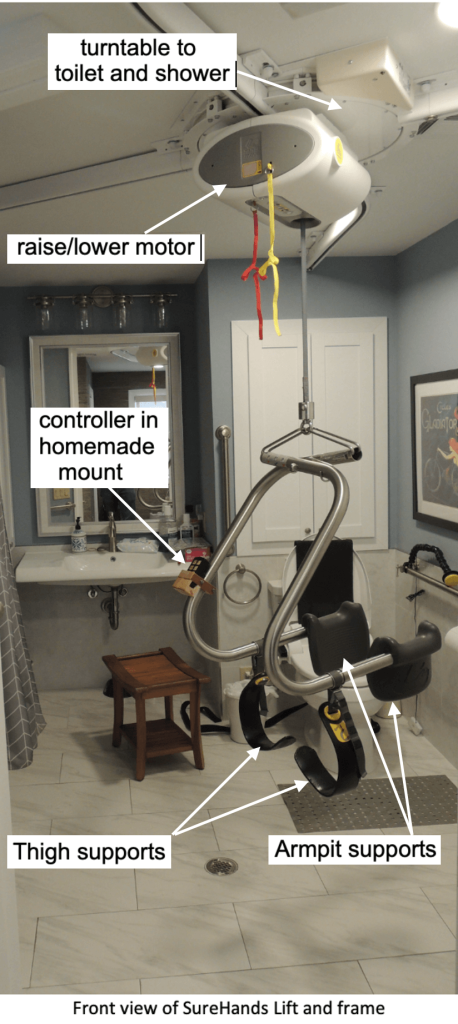
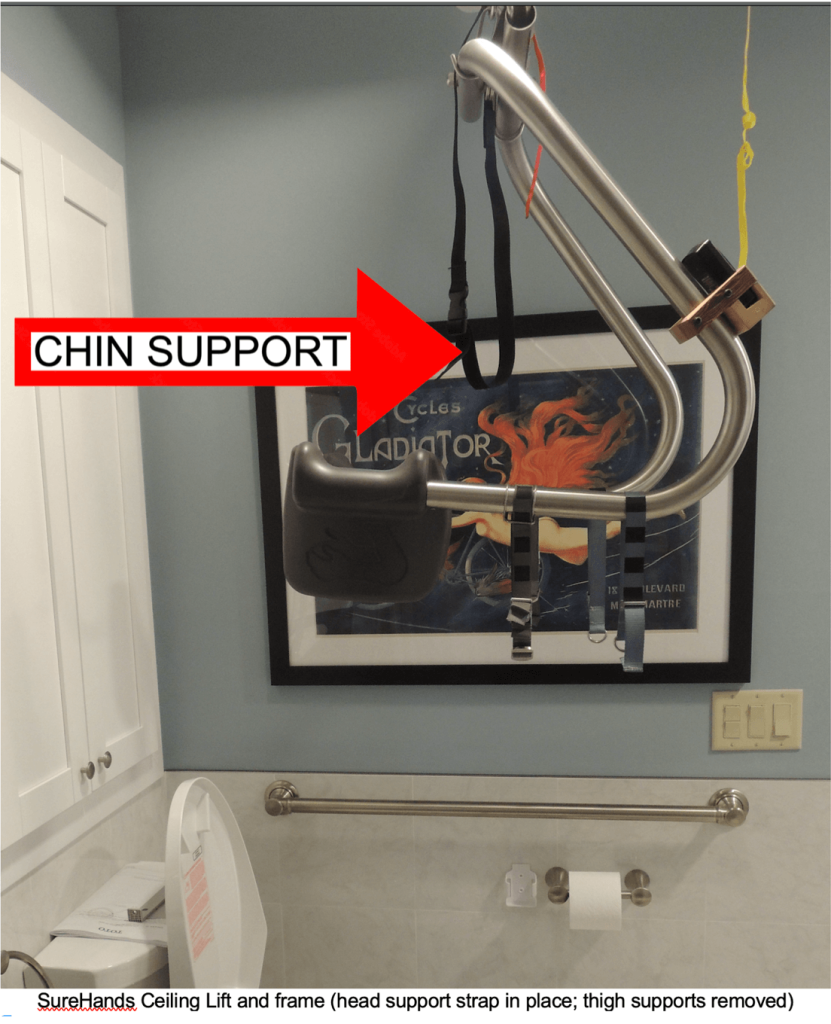
The ceiling lift enabled us to lift our son out of his bed or wheelchair or shower chair, position him over the toilet, lower his pants, then lower him onto the toilet seat. When he was finished on the toilet, he could not position himself for the bidet’s spray/cleaning cycle, so we had to turn on the sprayer briefly and wait for him to signal that we hit the bullseye. If not, we had to lift him and reposition him, then lower him again. Because of the weight sensor in the bidet seats, I could not lift him slightly and then turn on the nozzle water. This repositioning sometimes had to be repeated up to 10 times. It was very unpleasant and very painful for him because of his pressure sores.
Pressure sores and the washlets
As our son’s ALS worsened, he developed open pressure sores on his spine, about 6” above his waist. For us to position him on the toilet so the wand could clean him when he was finished, we had to kneel in front of him, place our hands against his knees and push him up against the sharp-cornered box on the bidet. The sharp edge on the boxes of the SmartBidets dug into his open sore. We tried cushioning him with towels and some other things I built, but the cushioning prevented him from being pushed far enough back, meaning the sprayer couldn’t reach him. For him to be cleaned, he usually had to bite the bullet and allow us to remove all the cushioning so the sprayer could reach him.
ALS destroyed our son’s intestinal muscles, so his bowels would not empty by themselves, and he had no muscles left to force elimination. There were two options when he had to use the toilet:
The first was to let him sit on the toilet until gravity emptied his bowels. That option was unreliable, and he usually spent hours on the toilet towards the end of his life. Because he also had head drop, he could not even sit upright nor keep his head up. I rigged up a strong, adjustable strap as a chin/head support like you see in the photo above, then we placed the ceiling lift frame around him (minus the thigh supports), and placed his chin (not his throat) on the strap. He was so comfortable that he usually fell asleep in that position.
The second was to give him an enema. An enema is supposed to be given while lying down on your side or kneeling with your head on the floor. That wasn’t possible with our son. We placed him in the ceiling lift, elevated him about 6” over the toilet, then I gave the enema. I always wore disposable vinyl gloves. I always lubricated the area with some hand lotion first (even though the enema spout was lubricated). I inserted the enema bottle pointing upwards, squeezed the bottle (very difficult to do because I don’t think it’s supposed to work in an upright position), then quickly lowered him onto the toilet seat.
