
Over-the-counter meds
Many ALS patients and their caregivers will immediately say “Mucinex” when they are asked for help dealing with drooling, excess saliva, and mucus. Mucinex is just a brand name. You have to read the ingredients and intended actions (cough suppressant, nasal decongestant, expectorant, pain reliever) on the labels because some of the products have more than one medication and address multiple ailments. Probably the only thing you want for all the problem fluids is an expectorant. Guaifenesin is the active ingredient of many of the OTC products that claim to help you cough out fluids such as phlegm from the airways. To make guaifenesin usable, it has to be formulated (mixed) with other “inert” ingredients. Syrups are formulated with water, glycerin, or other liquids, colors, sweeteners, or thickeners to make it taste okay. Pills, tablets, and lozenges are formulated with capsule material, anti-caking agents, fillers, and extended-relief substances so they can be quickly swallowed without crumbling in your mouth or tasting bad. On MedlinePlus.gov, you’ll find a list of commercial products containing guaifenesin, like Robitussin and Dayquil, among others. If you want to deal with just phlegm, saliva, or mucus, don’t buy the OTC options that contain multiple meds, because they aren’t needed and just drive up the cost. Plus, patients are already taking numerous medications as it is and don’t need unnecessary ones. For us, the confusing thing about some of these multi-drug formulations was that the guaifenesin is supposed to produce fluids during coughing, but cough suppressants are also included in the same bottles. If the guaifenesin is supposed to work during coughing, why did the manufacturers put in meds to stop coughing? Another issue when you compare OTC brands of guaifenesin: How much of the actual med is delivered in one adult dosage? It depends on the brand and whether the formulation is a pill, capsule, liquid, and even extended release. An adult dosage of a syrup might deliver a different dosage than that of a pill or capsule. You have to compare dosages and comparison shop prices. We used the Sunmark brand shown in the photo below.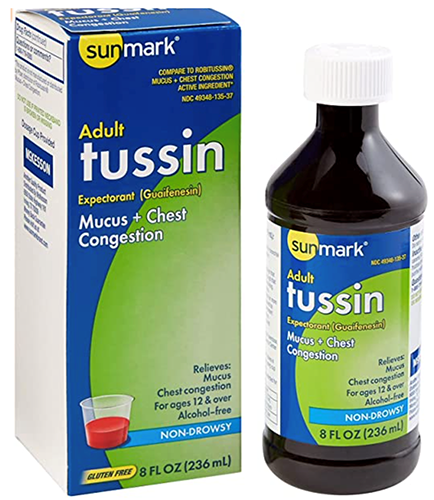
Single-med generic guaifenesin in liquid form.
Prescription meds
Scopolamine
Early in our son’s ALS misery, his doctor prescribed scopolamine, which came in adhesive patches and were to be placed just behind one of his ears on the bones. Each patch was good for two or three days, so in the beginning, when we removed an old patch from one ear, we alternated by putting the new patch behind his other ear.
But as his drooling or mucus buildup got worse, we began leaving the old patch in place and putting the new patch on the opposite ear a day earlier than prescribed, so he had the combined effect of getting a larger dose of the med.
We marked the patches with a marker so we knew which one was which. As his disease progressed, we kept having to play even with this overlapping patch idea.
Albuterol and N-acetylcysteine
Our son’s doctor subsequently prescribed two more meds to deal with the mucus. Both required a nebulizer (see the photo below, machine not shown).
The nebulizer itself was a simple little machine that we obtained through prescription. It had a loose-fitting face mask that covered our son’s mouth and nose. The medication was poured into a tiny chamber that attached to the bottom of the mask (the green area in the photo). The mask was held in place by a simple rubber band that went behind his head. It was comfortable for Jeremy.
The nebulizer sat on a table next to him and blew air through a thin tube into the bottom of the device on the mask. Just regular breathing was required. The mask brand we used (not the one pictured) was so crappy and flimsy that the connector between the mask and the chamber cracked, so we always had to wrap it with tape. I kept telling the supplier about the cracking, but I think they had only the one supplier.
The downside of the mask design was that the whole lower part of Jeremy’s face became wet. The vapors didn’t just enter his nose and mouth.
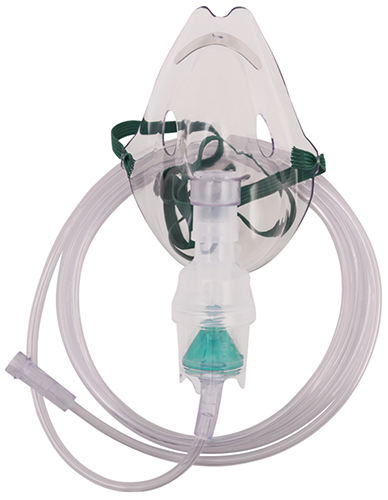
Nebulizer mask, chamber, and tubing.
Albuterol was the first of the two meds prescribed. It came in small plastic twist-off vials.
This medication loosened the mucus so much that in the early stages of ALS Jeremy didn’t want or need the cough assist afterward. Unfortunately, the loosened fluids probably ran down into his lungs.
As the disease worsened, the albuterol no longer worked by itself, so the doctor prescribed N-acetylcysteine (NAC) to be used just after the albuterol. The NAC smelled mildly like rotten eggs and also coated the lower part of his face, so he smelled too. The NAC came in a glass bottle and had to be refrigerated right after opening. It was good for only 96 hours after opening, and since our son didn’t need it frequently, we threw a lot away.
I think the NAC made the mucus so thin that it ran down our son’s throat, so the cough assist couldn’t pull it out.
Atropine
Atropine came in a tiny plastic squeeze bottle. It is actually for use in the eyes, but doctors prescribe it for drooling too.
We put four or five drops under Jeremy’s tongue to try to stop drooling. It tasted terrible, but he got used to it and requested it when drooling was heavy. Atropine is very closely related to hyoscyamine, which is also prescribed for drooling.
Botox or Myobloc
Our son went to a neurologist for injections of Botox into his salivary glands to stop the drooling and the saliva (and also into his legs to stop spasticity there).
The doctor decided on Myobloc, a botulinum B toxin (Botox is type A). Because of insurance purposes, the doctor had to keep accurate records of the exact amount she injected. It took a while for the medication to kick in and eventually it wore off, so more treatments were needed. Each one peaked maybe a week or two after injection.
Jeremy’s insurance company tightly regulated the frequency of the treatments, requiring at least three months between them. Besides the delay kicking in, we found that the Myobloc wore off before the three-month period ended. The drooling, saliva, and mucus not only returned but worsened, and we had to restart the other meds as well as increasing the dosages until the next injection.
Because we kept giving him those meds until the Myobloc took effect, excessive dryness occurred once it did take effect. It was a constant struggle.
For more information: Botox and Myobloc.
Radiation
Radiation therapy on the salivary glands in the throat has proved useful for treating excess salivation. Jeremy wanted to try it.
Preparation for these treatments was extremely difficult. He had to lie down, but whenever he was tilted back, he began choking because his weakened muscles allowed his lower jaw to slide back and rest on his trachea. He became very agitated and anxious. He took marijuana and Xanax to help him relax.
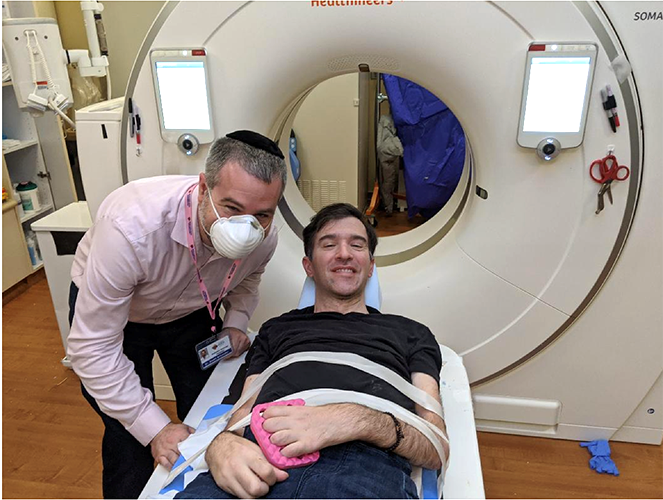
Jeremy with his doctor before the radiation procedure,
happy from marijuana and Xanax.
To ready him for the procedure, the doctor and staff made a full facial mask that looked like a graph printed on his face. Because of potential choking, the doctor had to avoid touching his throat.
I believe the mask helped the doctor focus the radiation beam. Our son never completed the treatments because he was afraid of the radiation side effects, so we don’t know if the few treatments ever worked. The radiation did stop his beard from growing for a while.
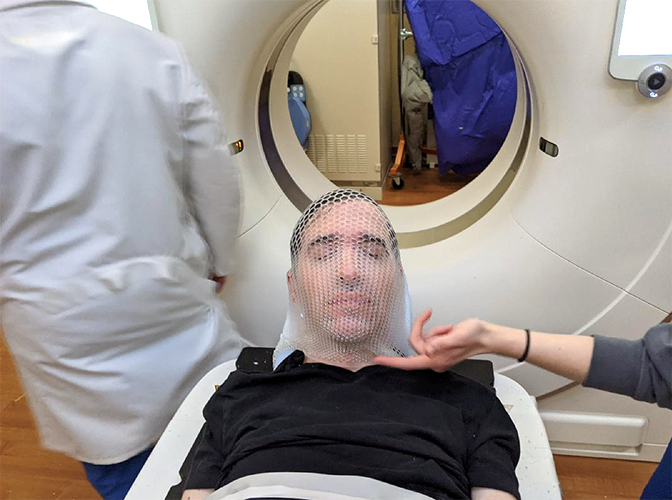
Jeremy with the mask, just before the radiation treatment.
The problem with all the meds and treatments that I mention here for mucus, phlegm, saliva, and drooling was that some things dried up or stopped all the fluids (Myobloc, radiation, scopolamine, atropine), while others seemed to promote formation of fluids (guaifenesin, albuterol, NAC).
It almost seemed that some meds canceled the effects of others.
Questionable treatments
A number of people have recommended pineapple juice or apple cider vinegar for drooling, but I was always skeptical of these.
